




A telecom chatbot is an AI-powered assistant that helps telecom companies answer customer questions, automate support, handle billing issues, guide users through plan changes, share outage updates, and move complex conversations to human agents when needed. In my experience, the real value of an AI chatbot for telecom is not just “faster replies”; it is giving customers a calmer, clearer support experience when they are already frustrated about internet, mobile data, payments, or service interruptions. And since telecom support is often full of repeat questions, long queues, and high-pressure moments, a well-trained telecom customer service chatbot can become one of the most useful support layers a provider has. Let’s walk through what it does, where it fits, and how a tool like LiveChatAI can help you build one without turning the whole thing into a technical maze.
What Is a Telecom Chatbot?
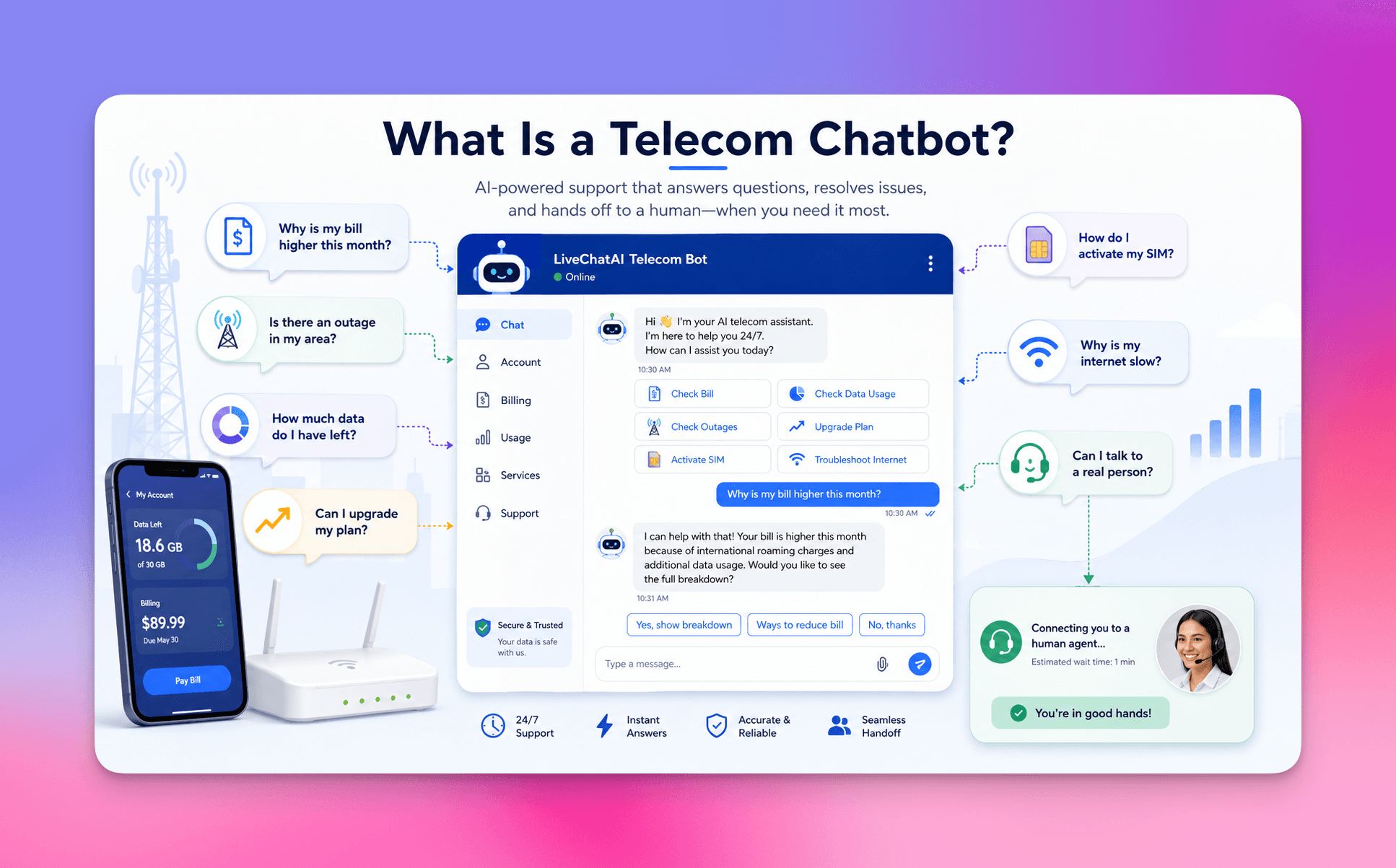
A telecom chatbot is a conversational AI tool that helps telecom companies support customers through automated, real-time conversations. It can answer common questions, guide users through account tasks, troubleshoot basic service problems, collect customer details, and hand the conversation over to a human agent when the issue needs a softer or more complex touch.
I like to think of it as the “front desk” of telecom customer support. Not because it replaces the whole support team, but because it catches the first wave of questions before they become long tickets, angry calls, or abandoned chats.
In telecom, that first wave is usually very repetitive:
- “Why is my bill higher this month?”
- “Is there an outage in my area?”
- “How much data do I have left?”
- “Can I upgrade my plan?”
- “How do I activate my SIM?”
- “Why is my internet slow?”
- “Can I talk to a real person?”
A good telecom customer service chatbot does not just throw generic answers at these questions. It understands intent, pulls from the right support content, and helps the customer move toward an actual next step.
Here is a simple way to see it:
| Customer Need | What a Telecom Chatbot Can Do |
|---|---|
| Billing question | Explain charges, payment due dates, invoices, or next steps. |
| Plan change | Recommend plans based on usage, location, or customer preference. |
| Network issue | Share outage information or basic troubleshooting steps. |
| Account setup | Help with SIM activation, password reset, or service onboarding. |
| Complex issue | Escalate the chat to a human support agent. |
This matters because telecom is huge, noisy, and always-on. According to the GSMA Mobile Economy 2025 report, unique mobile subscribers are expected to grow to 6.5 billion by 2030. More connected people means more support expectations, more account questions, and more moments where customers want help now, not tomorrow.
And that is where an AI chatbot for telecom becomes practical. It gives customers a self-service path for simple issues while giving support teams more room to handle the conversations that really need human judgment.
Key Benefits of Using a Telecom Chatbot
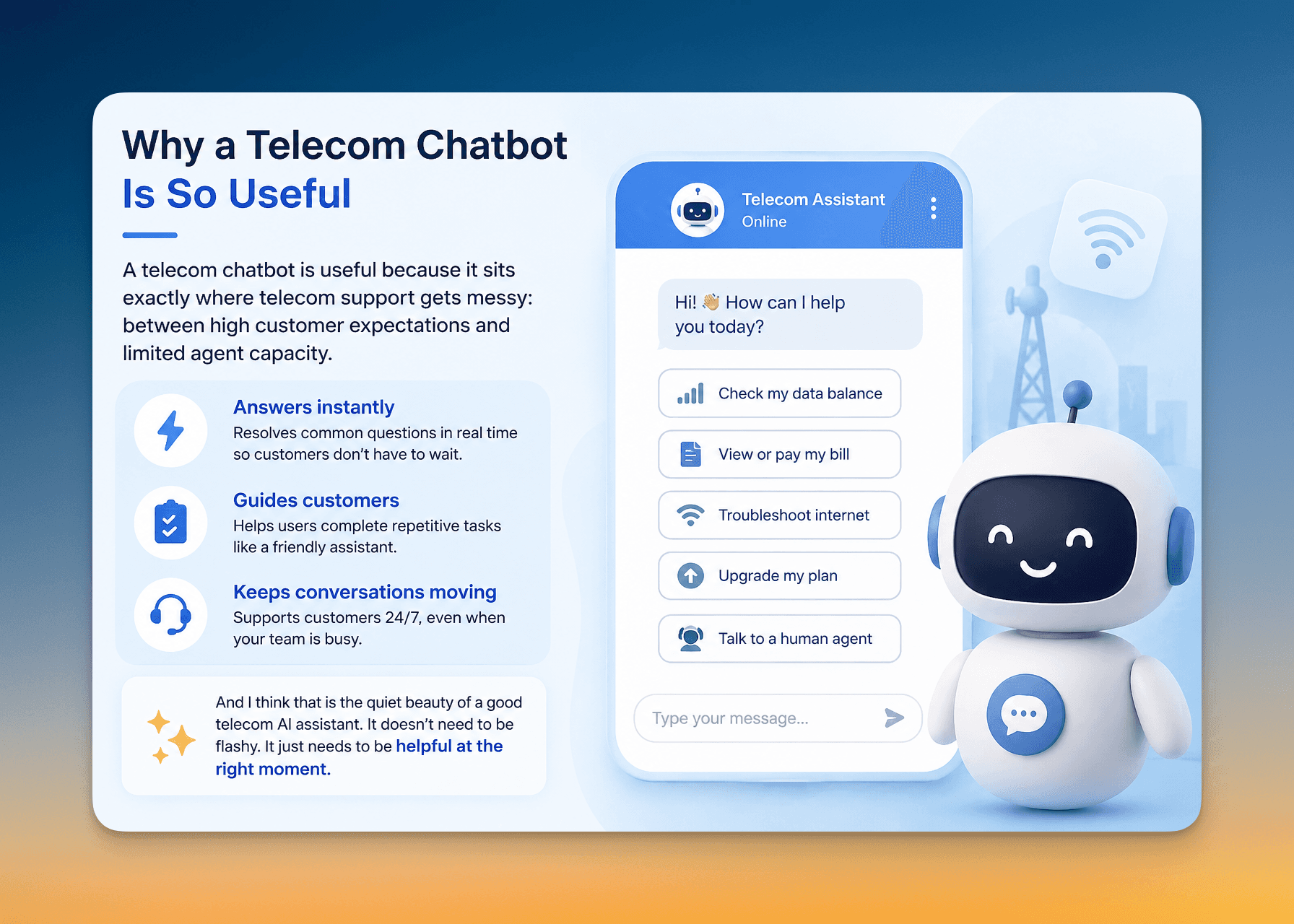
A telecom chatbot is useful because it sits exactly where telecom support gets messy: between high customer expectations and limited agent capacity. It can answer instantly, guide customers through repetitive tasks, and keep conversations moving even when your team is busy.
And I think that is the quiet beauty of a good telecom AI assistant. It does not need to be flashy. It just needs to be helpful at the right moment. ✨
Faster Customer Support
Speed matters a lot in telecom because most customer questions are time-sensitive.
If someone cannot connect to the internet, cannot activate a SIM, or sees an unexpected charge on their bill, waiting feels heavier than usual. A telecom customer service chatbot can give an instant first response and guide the customer toward a likely solution before an agent steps in.
For example, instead of making the customer wait in a queue, the chatbot can ask:
- What service are you using?
- Are you having trouble with mobile data, home internet, or billing?
- What is your ZIP code or service area?
- Have you already restarted your router or device?
That kind of guided conversation saves time on both sides. The customer feels heard earlier, and the support team gets a cleaner context if the issue needs escalation.
Lower Support Workload
Telecom support teams often deal with the same questions every day. Billing cycles, data limits, plan upgrades, password resets, SIM activation, roaming fees, and service status questions can take up a huge part of the support queue.
A chatbot for telecom companies can handle many of these repetitive requests automatically.
| Repetitive Support Task | How a Telecom Chatbot Helps |
|---|---|
| “How do I pay my bill?” | Shares payment steps or links customers to the right page. |
| “Why did my bill increase?” | Explains common reasons like plan changes, taxes, add-ons, or overdue charges. |
| “How much data do I have left?” | Guides customers to account usage details. |
| “How do I activate my SIM?” | Walks through activation steps one by one. |
| “Is there an outage?” | Collects location details and shares available service status information. |
| “Can I change my plan?” | Explains available next steps or routes to sales/support. |
This does not mean agents become less important. Actually, I see it the opposite way. When AI customer support automation handles the easy questions, human agents get more room for the conversations that require empathy, judgment, negotiation, or deeper troubleshooting.
24/7 Availability
Telecom problems do not politely wait for office hours. Internet issues happen at night. Roaming questions appear during travel. Payment concerns show up on weekends. Service interruptions can hit at the worst possible time.
That is why 24/7 availability is one of the strongest telecom chatbot benefits.
A chatbot can keep support open even when the full team is not online. It can answer FAQs, collect issue details, recommend self-service steps, and let customers know what will happen next.
For smaller telecom teams, this can be especially valuable because you do not need to staff every hour at the same level. For larger providers, it helps reduce after-hours pressure and keeps customer conversations organized before the next support shift begins.
Better Self-Service Experience
Self-service can be wonderful when it is easy. It can also be painfully annoying when customers have to dig through ten help articles just to find one answer.
A telecom self-service chatbot makes the process more conversational. Instead of forcing users to search through a help center, it lets them describe the issue in their own words.
For example:
“My internet has been slow since yesterday.”
A useful telecom virtual assistant can respond with a guided path:
- Check whether the issue is home internet or mobile data.
- Ask for the customer’s location or service area.
- Suggest basic troubleshooting steps.
- Share relevant help content.
- Offer human handoff if the issue continues.
That feels much better than sending someone to a generic article called “Internet Troubleshooting Guide” and hoping they find the right paragraph.
According to McKinsey research on customer care, companies are continuing to use digital and AI-enabled service models to improve customer care operations. For telecom, where support volume is high and customer frustration can rise quickly, better self-service is not just convenient. It is a real customer experience advantage.
More Personalized Customer Interactions
Personalization is where a telecom chatbot can become more than a simple FAQ bot.
A basic chatbot answers the same way every time. A stronger AI chatbot for telecom can use customer context, conversation history, support intent, and connected systems to give more relevant responses.
For example, a chatbot might adjust its answer based on whether the customer is:
- A new customer activating a SIM
- A long-time customer asking about an upgrade
- A business account user needing technical support
- A prepaid customer checking remaining data
- A customer on a roaming plan abroad
Of course, personalization has to be handled carefully. Telecom companies deal with sensitive account and usage information, so the chatbot should only access what it needs and should follow secure data practices.
But when done well, personalization makes support feel less like a cold transaction and more like a guided conversation.
Easier Support During High-Volume Periods
Telecom support demand can spike very quickly.
A billing cycle starts. A regional outage happens. A new plan launches. A popular device goes on sale. Suddenly, the support team has more conversations than it can comfortably handle.
This is where a telecom support automation layer can protect both customers and agents.
During high-volume periods, a telecom chatbot can:
- Answer common questions instantly
- Share outage or maintenance updates
- Collect customer details before escalation
- Prioritize urgent cases
- Route sales, billing, and technical questions correctly
- Reduce duplicate tickets from the same issue
I like to think of it as crowd control, but in a helpful, polite way. The chatbot keeps the doorway from getting blocked so customers can still move somewhere useful.
And in telecom, that matters. Because when customers are already frustrated, silence feels louder than any answer.
Top Telecom Chatbot Use Cases
A telecom chatbot becomes most valuable when it is built around real customer problems, not just generic automation. In telecom, customers usually arrive with a very specific need: they want to understand a charge, fix a service issue, change something in their account, or get help without waiting forever.
So, let’s look at the most practical telecom chatbot use cases I’d prioritize first.
Billing Questions and Payment Support
Billing is probably one of the busiest areas for telecom customer support. It is also one of the most emotional.
When money is involved, people want clarity fast.
A telecom customer service chatbot can help customers understand:
- Why their bill changed
- When their payment is due
- How to pay online
- What taxes, fees, or add-ons mean
- Whether a previous payment was received
- What to do after a failed payment
- How to download or view invoices
For example, instead of making the customer search through account pages, the chatbot can say:
“I can help you understand your bill. Are you asking about your current balance, a recent charge, or your payment due date?”
That one question already makes the support experience feel more organized.
| Billing Request | Chatbot Response Example |
|---|---|
| “Why is my bill higher?” | Explains possible reasons like plan changes, extra data, add-ons, late fees, or taxes. |
| “How do I pay my bill?” | Sends the customer to the payment page or explains payment options. |
| “Can I get my invoice?” | Guides the user to download invoices from the customer portal. |
| “My payment failed.” | Shares next steps and escalation options if needed. |
In my experience, billing chatbot flows should be extra careful with tone. A dry answer can feel dismissive. A calm, clear answer can soften the whole moment.
Plan Recommendations and Upgrades
Telecom plans can be confusing. Customers may not always know whether they need more data, a family plan, a business package, international roaming, or a cheaper option.
A telecom AI assistant can make plan discovery easier by asking simple questions first:
- How many lines do you need?
- Do you use more mobile data or Wi-Fi?
- Do you travel internationally?
- Are you looking for home internet, mobile, or both?
- Is price, speed, or flexibility most important to you?
Then, the chatbot can guide the customer toward the right plan page, collect lead details, or connect them with a sales agent.
This is where a chatbot becomes useful for both support and revenue. It does not only answer questions. It can also help customers choose better.
A simple plan recommendation flow might look like this:
| Customer Situation | Chatbot Can Suggest |
|---|---|
| Uses lots of mobile data | Higher-data or unlimited plan. |
| Travels often | Roaming or international package. |
| Works from home | Faster home internet plan. |
| Has multiple family members | Family or multi-line package. |
| Owns a small business | Business telecom package. |
I would not make this feel too pushy, though. The best conversational AI for telecom should guide, not pressure. Helpful beats salesy almost every time.
Network Outage and Service Status Updates
Few things create support spikes faster than a network outage.
When service goes down, customers often ask the same questions at once:
- “Is there an outage in my area?”
- “When will it be fixed?”
- “Do I need to restart my router?”
- “Is the problem my device or the network?”
- “Can I get compensation?”
A chatbot for telecommunications can help by collecting the customer’s location, checking available outage information, and giving a clear next step.
Even when the chatbot cannot solve the outage itself, it can reduce uncertainty. And uncertainty is often what makes customers angrier.
For example:
“There may be a service issue in your area. I can help you check basic troubleshooting steps or connect you with support if your service is still down after the update.”
That kind of answer is simple, but it gives the customer something to hold onto.
A telecom chatbot can also help prevent duplicate tickets during outages by showing known issue updates before the customer submits a new request.
SIM Activation and Account Setup
SIM activation should feel easy, but it often becomes a support-heavy process.
A telecom virtual assistant can walk new customers through setup step by step, which is especially helpful for people who are not deeply technical.
It can guide users through:
- New SIM activation
- eSIM setup
- Number transfer questions
- Account creation
- Password reset
- Identity verification next steps
- First login instructions
This is a great use case because the customer is usually at the beginning of their relationship with the telecom brand. A smooth setup experience makes a good first impression. A confusing one creates friction before the customer even starts using the service.
And we all know first impressions are tiny doors. If they open easily, people keep walking in. 🚪
Technical Troubleshooting
Technical support is another natural fit for a telecom helpdesk chatbot.
The chatbot can help users troubleshoot basic problems before escalating them to an agent. This is especially useful for issues like slow internet, weak signal, mobile data not working, router problems, or voicemail setup.
A basic troubleshooting flow might ask:
- What service are you having trouble with?
- When did the problem start?
- Are other devices affected?
- Have you restarted your device or router?
- Are there any error messages?
- Would you like to try guided troubleshooting or contact support?
Here is how this can work in practice:
| Technical Issue | Chatbot-Guided First Step |
|---|---|
| Slow internet | Ask about device, router, location, and restart status. |
| Mobile data not working | Check airplane mode, APN settings, data limit, and coverage. |
| Router issue | Suggest restart, cable check, and light status check. |
| Weak signal | Ask location and device type, then suggest next steps. |
| Voicemail problem | Provide setup or reset instructions. |
The point is not to make the chatbot pretend to be a network engineer. The point is to remove the easy-to-check problems before a human agent spends time on them.
Data Usage and Package Information
Customers often want quick answers about their usage.
A telecom self-service chatbot can help customers check or understand:
- Remaining mobile data
- Current plan limits
- Add-on packages
- Roaming usage
- Fair usage policies
- Speed limits after data caps
- Renewal dates
Even when the chatbot cannot directly show account-specific data without an integration, it can still guide customers to the correct account area or explain where to find the information.
For example:
“You can usually check your remaining data from your account dashboard. I can also help you understand what happens when your plan reaches its data limit.”
This kind of flow is simple, but it saves support teams from answering the same “where do I find this?” question again and again.
Appointment Scheduling
Telecom companies may need appointments for installations, technician visits, store visits, upgrades, or equipment returns.
A customer support chatbot for telecom providers can make scheduling easier by asking for the right details before the customer reaches a human agent.
It can collect:
- Service address
- Preferred date and time
- Installation type
- Contact information
- Issue description
- Equipment details
For example, if a customer needs home internet installation, the chatbot can gather basic information and then route the request to the right team.
This is especially useful because scheduling conversations often become long, back-and-forth exchanges. A chatbot can make them cleaner.
Customer Retention and Churn Prevention
Retention is a sensitive use case, but an important one.
When customers are unhappy, they may not always say, “I am about to churn.” Sometimes they say:
- “My bill is too high.”
- “Your competitor has a better offer.”
- “I want to cancel.”
- “My internet keeps failing.”
- “I have contacted support three times already.”
A telecom live chat automation setup can detect some of these signals and route them carefully. It might offer help, collect the reason for cancellation, share relevant options, or escalate the conversation to a retention specialist.
I would be careful here. Churn prevention should never feel like trapping the customer in a maze. The chatbot should make it easy to get help, understand options, and reach a person when needed.
Good retention support feels like:
“I’m sorry this has been frustrating. I can help you review your options or connect you with someone who can look into your account.”
Not:
“Please click through seven more buttons before we let you leave.”
There is a difference. Customers feel it.
Lead Generation for Telecom Services
A telecom chatbot can also support lead generation, especially on plan pages, business telecom pages, fiber internet landing pages, and contact pages.
Instead of leaving visitors with a static form, the chatbot can start a guided conversation:
- What service are you interested in?
- Is this for home or business?
- What location do you need service in?
- How many users or lines do you need?
- Would you like a callback or email follow-up?
This helps telecom companies qualify leads without making the visitor fill out a long form immediately.
| Page Type | Lead Generation Chatbot Idea |
|---|---|
| Fiber internet page | Ask for location and speed needs. |
| Business telecom page | Ask company size and service type. |
| Mobile plan page | Ask data usage and number of lines. |
| Contact page | Route sales, support, and billing inquiries. |
| Promotion page | Collect interest and explain offer details. |
For LiveChatAI, this is one of the areas where website-based automation can be especially useful. A chatbot can answer questions, collect lead details, and keep the conversation going while the visitor’s interest is still warm.
Live Agent Handoff for Complex Issues
Not every telecom issue should be automated.
Some conversations need a human. Billing disputes, repeated service failures, cancellation requests, angry customers, technical edge cases, and account-specific problems often need agent support.
That is why human handoff is one of the most important features of any AI chatbot for telecom.
A good handoff should include the conversation context, customer intent, and any details the chatbot already collected. That way, the customer does not have to repeat everything from the beginning.
A strong handoff might include:
- Customer’s issue category
- Service type
- Location or account context, when available
- Troubleshooting steps already tried
- Sentiment or urgency
- Requested outcome
This is where the chatbot becomes a bridge, not a wall.
And honestly, that is the version of telecom support automation I trust most: one where AI handles the predictable parts and humans remain close enough for the complicated parts.
What Features Should a Telecom Chatbot Have?
A telecom chatbot should be more than a small chat bubble that answers five basic FAQs. Telecom support is layered. You have billing questions, account requests, technical problems, plan comparisons, outage concerns, installation needs, and customers who may already be frustrated before they type the first message.
So, in my opinion, the right AI chatbot for telecom needs a mix of automation, context, safety, and human backup.
Here are the core features I would look for.
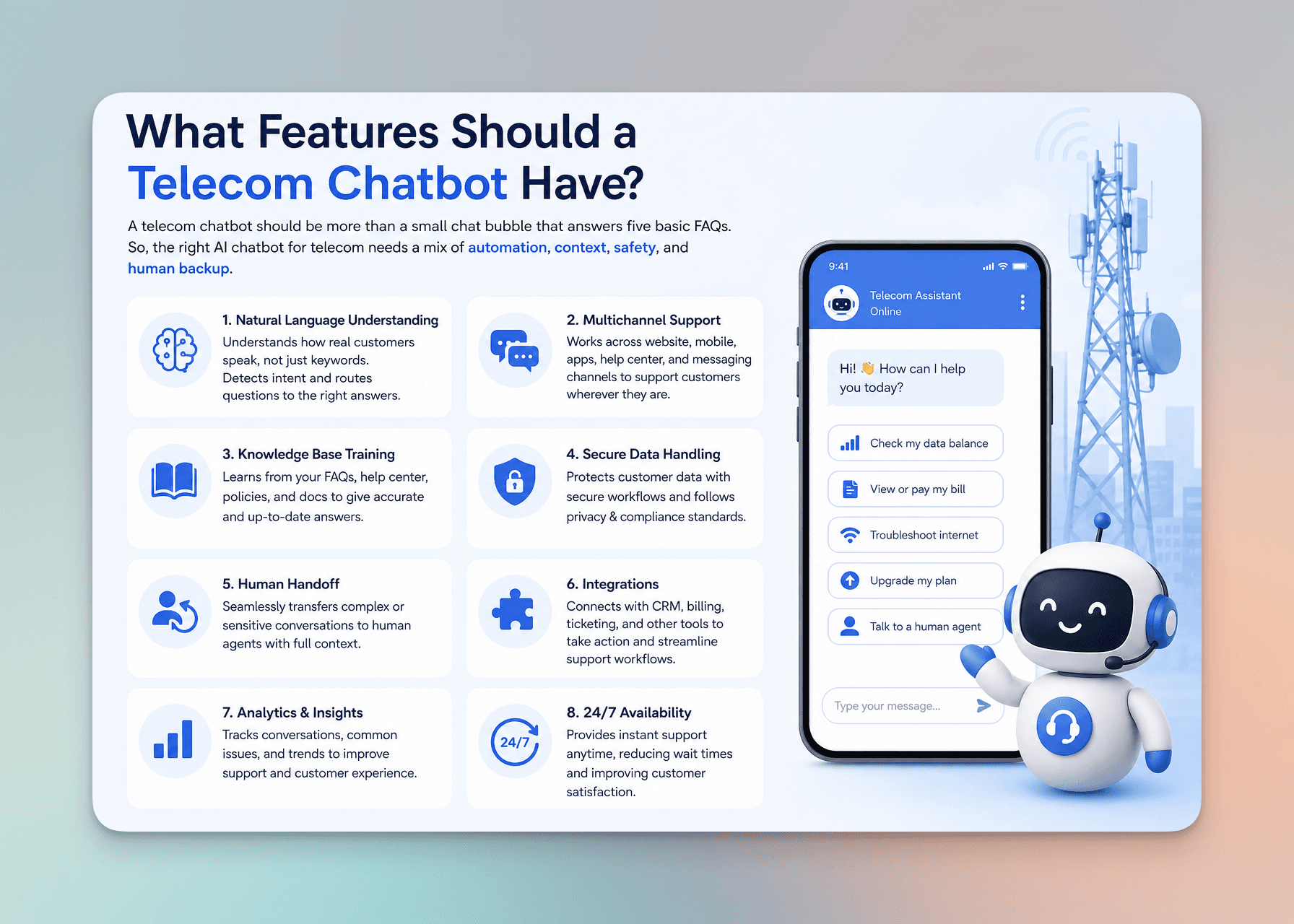
Natural Language Understanding
A strong telecom AI assistant should understand how real customers speak.
Because customers do not always use perfect support language. They usually say things like:
- “My Wi-Fi is acting weird.”
- “Why did you charge me extra?”
- “My phone has no signal.”
- “I need more internet.”
- “I want to cancel.”
- “Can someone help me with my bill?”
A basic bot may only understand exact keywords. A better conversational AI system can understand the intent behind the sentence.
For example:
| Customer Message | Likely Intent |
|---|---|
| “My internet keeps dropping.” | Technical troubleshooting. |
| “Why is my bill so high?” | Billing explanation. |
| “I need a better plan.” | Plan recommendation or upgrade. |
| “No service on my phone.” | Mobile network issue. |
| “I want to leave.” | Cancellation or churn risk. |
| “Can I speak to someone?” | Human agent handoff. |
This matters because telecom customers often arrive stressed. They should not have to “speak chatbot” to get help. The chatbot should understand them.
Multichannel Support
A chatbot for telecommunications should be available where customers already ask for help.
For many telecom companies, the website is the starting point. But customers may also reach out through messaging apps, help centers, customer portals, or product pages.
At minimum, I would want the chatbot to support key touchpoints like:
- Website live chat
- Help center pages
- Contact pages
- Pricing or plan pages
- Customer portal pages
- Mobile-friendly chat experiences
For telecom, multichannel support is not just a convenience feature. It helps customers avoid the “where do I go for this?” problem.
If someone is reading a billing article, the chatbot can answer billing questions. If someone is comparing plans, it can help with plan selection. If someone is on a contact page, it can route them to the right team.
That is how omnichannel telecom support starts to feel natural instead of fragmented.
Knowledge Base Training
A telecom chatbot is only as helpful as the information behind it.
If the bot is trained on thin, outdated, or messy support content, it will give thin, outdated, or messy answers. No magic spell fixes poor source material. And believe me, as someone who works with content, I wish there were one. 🪄
A strong telecom customer service chatbot should be trainable with useful company materials, such as:
- Help center articles
- FAQ pages
- Plan descriptions
- Billing policies
- Troubleshooting guides
- SIM activation steps
- Installation instructions
- Refund or cancellation policies
- Service-specific documentation
This is especially important in telecom because details change. Plans change. Pricing changes. Roaming rules change. Installation areas change. Support policies change.
Your chatbot should make it easy to update its knowledge so customers are not getting last year’s answer to this year’s problem.
Secure Customer Data Handling
Telecom support often touches sensitive customer information.
That can include account details, phone numbers, billing history, addresses, service locations, payment-related questions, and identity verification steps. So a telecom virtual assistant needs to be designed with data safety in mind.
At a practical level, that means the chatbot should:
- Avoid exposing sensitive account details unnecessarily
- Use secure workflows for personal information
- Route sensitive requests to human agents when needed
- Follow privacy and data protection requirements
- Be clear about what information it needs and why
This is not the most glamorous feature, but it is one of the most important.
Customers may forgive a chatbot for saying, “I need to connect you with an agent for that.” They will not forgive careless handling of personal information.
Human Handoff
A telecom chatbot should know when to stop.
That sentence sounds simple, but it is a big deal.
Some issues should not stay trapped inside automation. Billing disputes, angry customers, cancellation requests, repeated technical failures, and complex account problems often need a human agent.
A good handoff feature should let the chatbot transfer the conversation with context, not just say, “Please contact support.”
Ideally, the agent should see:
- What the customer asked
- What the chatbot already answered
- Which issue category the conversation belongs to
- What troubleshooting steps were already tried
- Whether the customer seems urgent or frustrated
- Any collected details that help the agent continue smoothly
| Conversation Type | Should the Chatbot Handle It Alone? | Better Next Step |
|---|---|---|
| “How do I activate my SIM?” | Usually yes | Guide with step-by-step instructions. |
| “Where can I pay my bill?” | Usually yes | Send payment guidance or link. |
| “I was charged twice.” | Not always | Escalate to billing support. |
| “My internet has failed 5 times this week.” | Not always | Collect details, then hand off. |
| “I want to cancel today.” | No, in many cases | Route to retention or support team. |
| “I need help with a business account contract.” | No | Route to the right specialist. |
In my experience, the best AI support systems do not pretend humans are unnecessary. They simply make the human conversation easier to reach and easier to continue.
Integration with CRM, Billing, and Support Tools
For a telecom chatbot to become truly useful, it should not live on an island.
It should connect with the tools your team already uses, such as CRM platforms, ticketing systems, billing tools, helpdesk software, live chat platforms, and internal workflows.
Without integrations, the chatbot can still answer general questions. With integrations, it can support more meaningful actions.
For example, with the right setup, a customer support chatbot for telecom providers can help with:
- Creating support tickets
- Sending lead details to a CRM
- Routing billing issues to the right team
- Triggering internal workflows
- Collecting customer details before escalation
- Notifying agents about urgent conversations
- Connecting website chat with live support
This is one reason I like using a tool like LiveChatAI for this kind of setup. For telecom companies, the chatbot should not only “talk.” It should help move the conversation somewhere useful.
That might mean answering from your knowledge base, handing off to live chat, or triggering an action that helps your team follow up faster.
Analytics and Conversation Insights
A telecom helpdesk chatbot should also help you learn.
The conversations customers have with your chatbot can reveal what your website, help center, sales pages, and support flows are missing.
You can use chatbot analytics to understand:
- Which questions are asked most often
- Which answers need improvement
- Where users ask for human support
- Which topics create confusion
- Which pages generate the most support chats
- Which issues are linked to churn or frustration
- Which plan or pricing questions appear before conversion
For example, if customers keep asking about hidden fees, your pricing page may need clearer copy. If users repeatedly ask how to activate an eSIM, your setup guide may need better steps. If many chats mention “slow internet at night,” you may need stronger troubleshooting content or a clearer network status flow.
This is where a telecom chatbot becomes more than a support tool. It becomes a feedback loop.
And if there is one thing I have learned from SEO and content work, it is this: customer questions are never random noise. They are signals. The better you listen, the better your website, support, and customer experience become.
How to Build a Telecom Chatbot with LiveChatAI
Building a telecom chatbot does not have to mean building a heavy, custom AI system from scratch. For many telecom teams, the better starting point is simpler: train an AI chatbot with your own support content, place it on your website, connect it with human support, and improve it over time.
That is where LiveChatAI fits naturally. It lets you create an AI support agent, train it with your website or support content, use live chat handoff, and connect AI Actions for automated tasks. LiveChatAI also positions its AI agent around resolving a large share of customer queries instantly, while still keeping human support available when needed. LiveChatAI explains this hybrid AI + live chat approach across its product and help content.
Train the AI Chatbot with Telecom Support Content
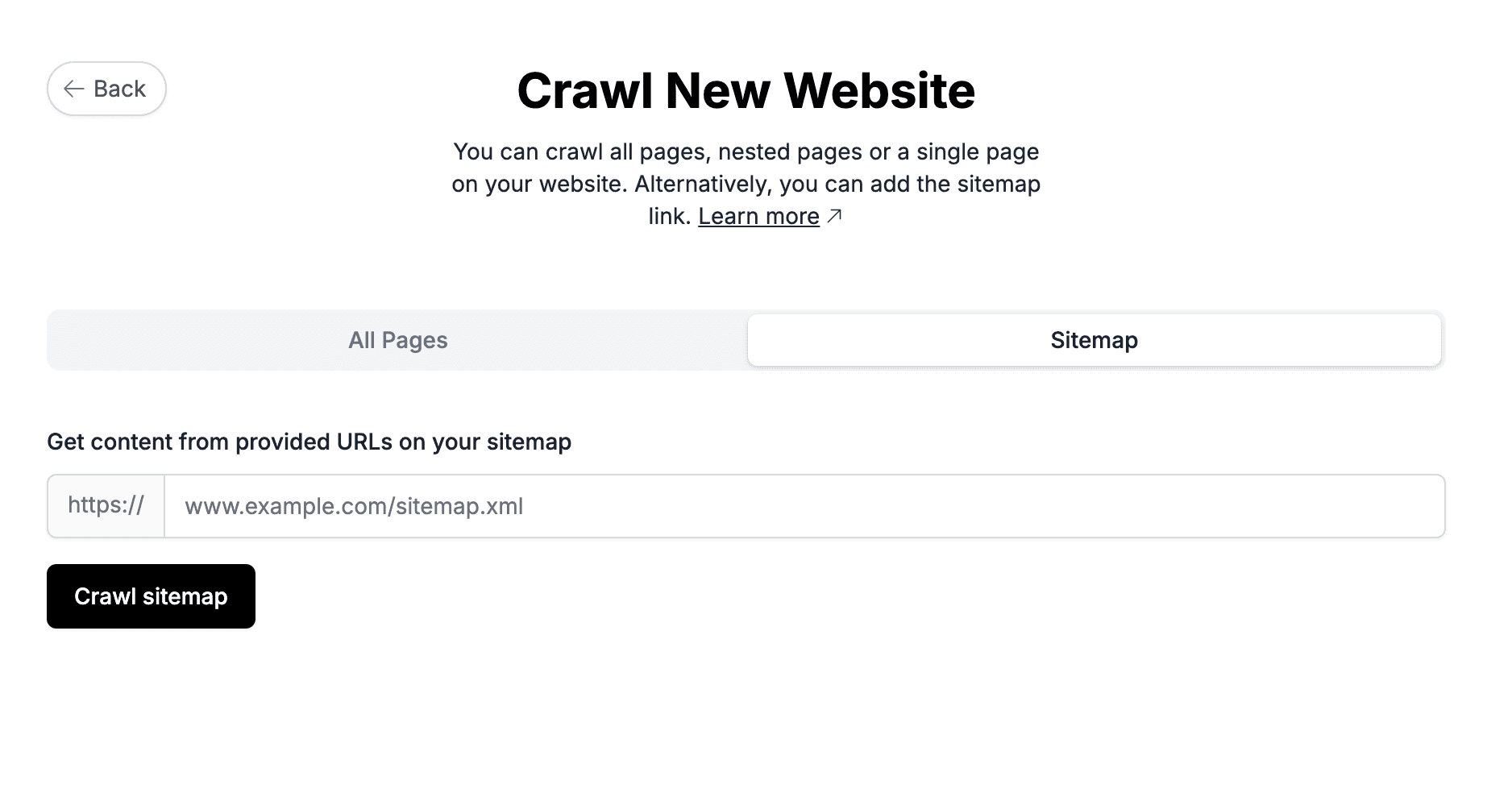
The first step is to give your chatbot the right knowledge.
For a telecom company, that usually means training the chatbot with content like:
- Billing FAQs
- Payment instructions
- Plan details
- Roaming information
- SIM and eSIM activation guides
- Router setup guides
- Troubleshooting articles
- Installation instructions
- Cancellation or refund policies
- Service status explanations
- Business account support docs
In LiveChatAI, you can create a chatbot by adding website URLs, a full domain, a help center URL, or a sitemap as a data source. That makes it easier to turn existing support content into chatbot-ready knowledge without writing every answer manually from zero. LiveChatAI’s help guide explains this setup process clearly.
Here is how I would think about the training phase:
| Telecom Content Type | Why It Matters for the Chatbot |
|---|---|
| Billing pages | Helps answer payment, invoice, due date, and charge-related questions. |
| Plan pages | Helps users compare packages, upgrades, and service options. |
| Troubleshooting guides | Helps customers solve basic internet, mobile data, or router issues. |
| SIM activation docs | Supports new customers during setup. |
| Help center FAQs | Gives the chatbot reliable answers for repeat questions. |
| Policy pages | Helps explain cancellations, refunds, service terms, and account rules. |
My small SEO-person note here: do not train the chatbot only on “official-sounding” pages. Train it on the pages customers actually need when they are confused. A beautiful product page is useful, but a clear billing FAQ may save your support team hundreds of conversations.
Add Website Live Chat for Real-Time Conversations
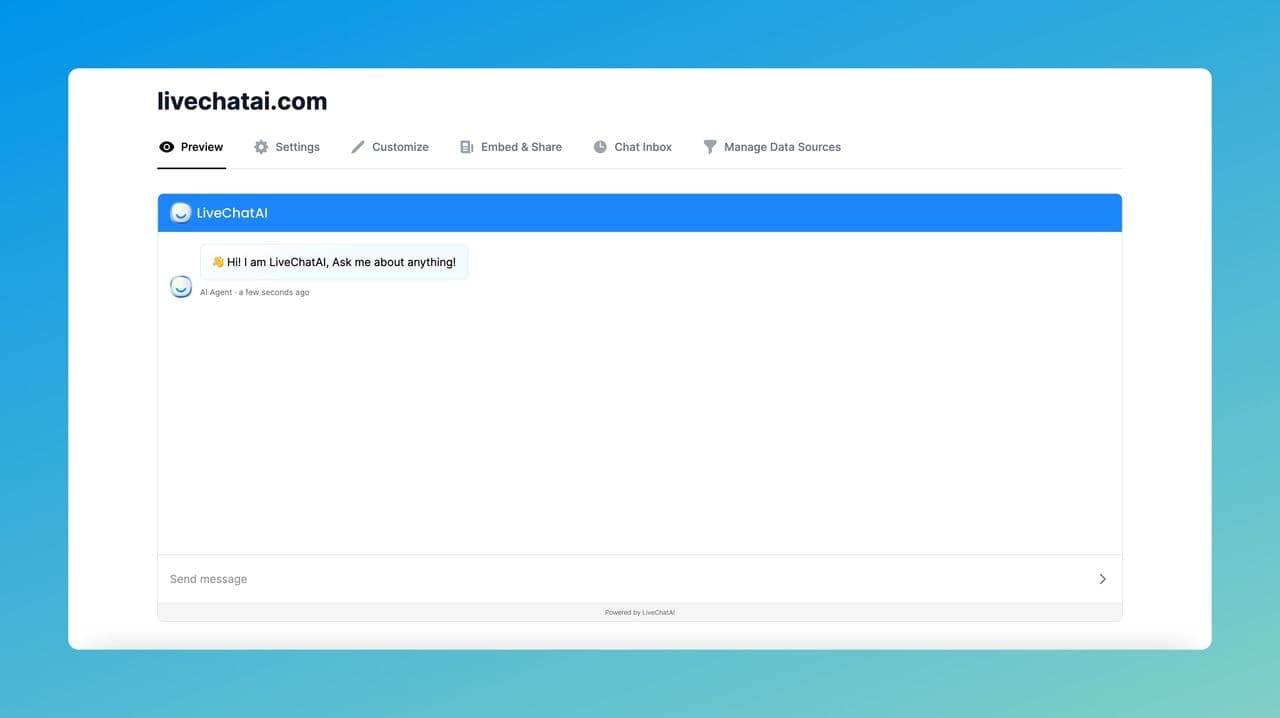
Once the chatbot has useful telecom support content, the next step is making it visible where customers need help.
For a telecom provider, I would place the chatbot on high-intent and high-friction pages first:
- Pricing or plan pages
- Billing support pages
- Contact page
- Help center
- Service status page
- SIM activation page
- Internet troubleshooting pages
- Business telecom service pages
This is where telecom live chat automation becomes practical. A visitor does not have to leave the page, open a new tab, call support, or search through five help articles. They can ask the chatbot right there.
For example, on a plan comparison page, the chatbot can help with:
“Which plan is better for remote work?”
On a billing page, it can help with:
“Why did my bill change this month?”
On a troubleshooting page, it can help with:
“My router lights are blinking. What should I check first?”
That kind of contextual support can make the website feel less static and more alive. Like someone has finally turned the lights on in the hallway. 💡
Connect Support Actions and Integrations
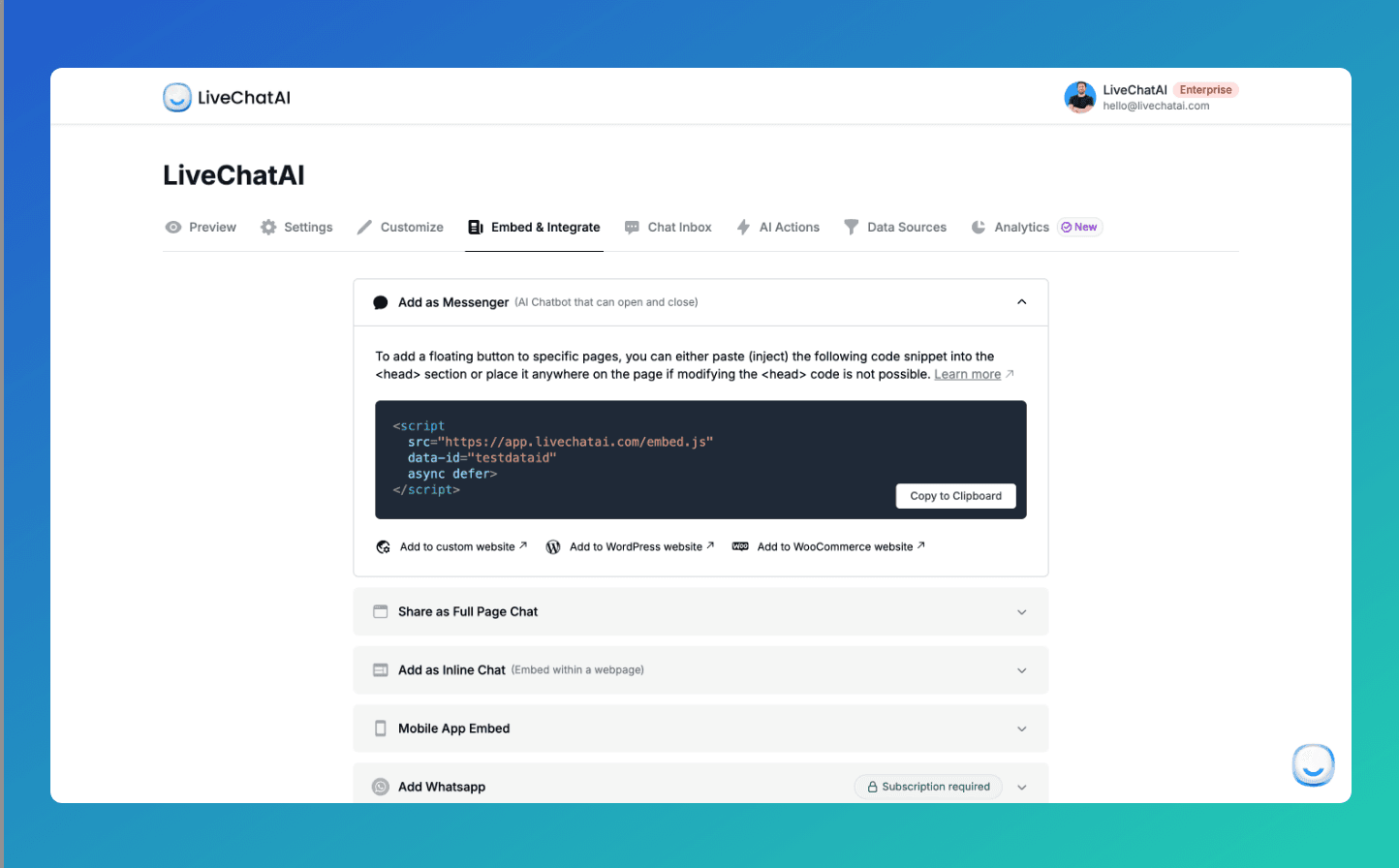
A basic AI chatbot for telecom answers questions. A stronger one helps customers take action.
With LiveChatAI’s AI Actions, chat conversations can connect to automated workflows, ready-made templates, or custom API calls. LiveChatAI describes AI Actions as a way to let the bot act, update, and sync data when customers ask, with options such as pre-built actions and custom API-based setups. LiveChatAI AI Actions can be especially useful when support needs to move beyond simple answers.
For telecom companies, this can support workflows like:
| Customer Request | Possible AI Action |
|---|---|
| “I need a callback.” | Collect contact details and send them to the right team. |
| “I want an installation appointment.” | Start a scheduling workflow. |
| “I need help with billing.” | Create or route a billing support request. |
| “I am interested in a business plan.” | Send lead details to sales. |
| “I want to report a service issue.” | Collect issue details and create a support ticket. |
| “I need a technician visit.” | Gather address, service type, and preferred time. |
Of course, the exact setup depends on the telecom company’s systems. But the principle is simple: the chatbot should not only answer; it should help move the request forward.
Set Up Escalation to Human Agents
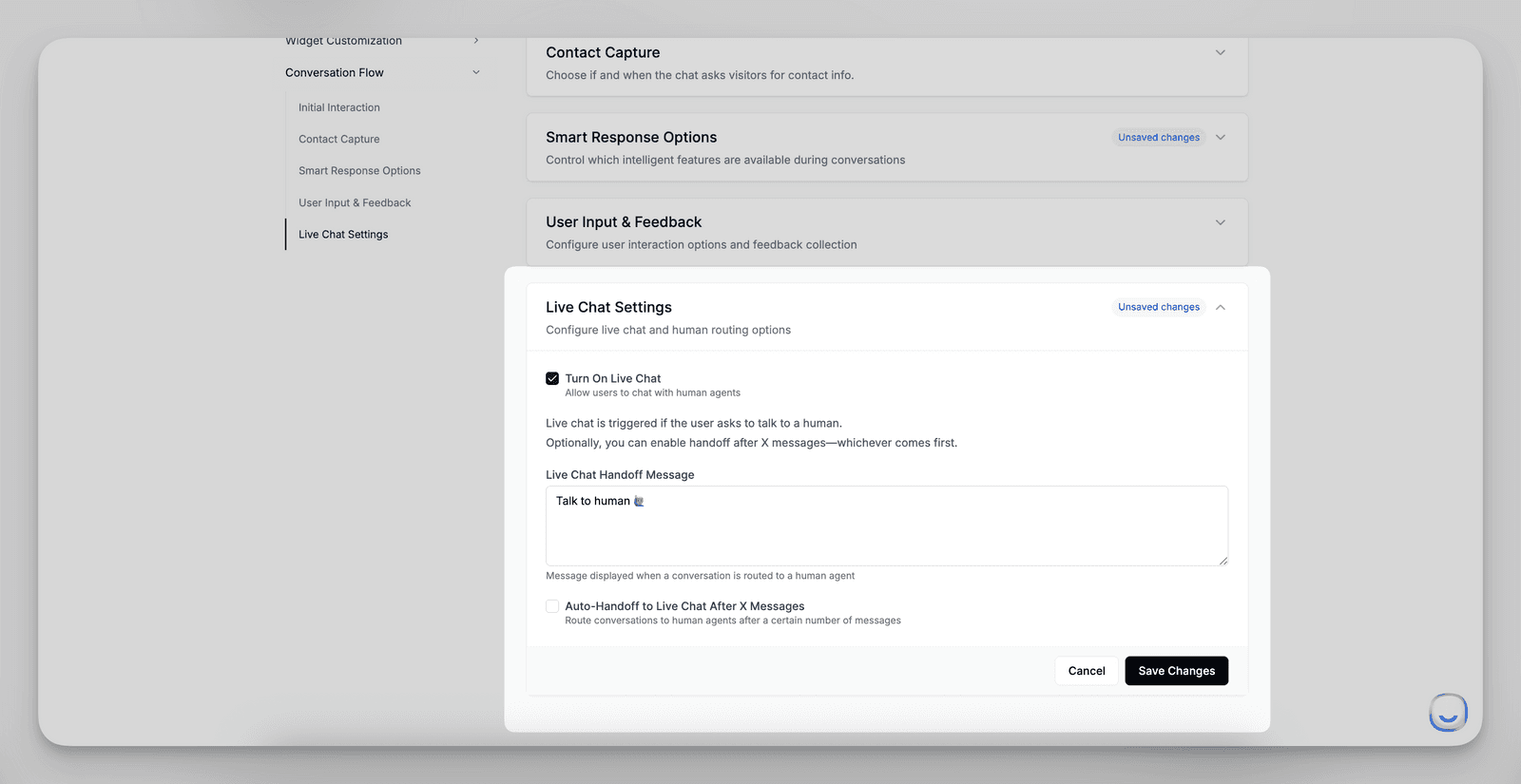
This part is non-negotiable for telecom.
A telecom customer service chatbot should always have a clear path to human support. Telecom issues can be too sensitive, too emotional, or too account-specific to automate completely.
LiveChatAI supports combining AI-powered answers with live chat handoff, so customers can get quick automated help while still having the option to escalate to a real agent when needed. LiveChatAI’s help article on AI chatbot and live chat explains this hybrid setup.
For telecom support, I would trigger human handoff when:
- The customer asks to speak with a person
- The issue involves a billing dispute
- The customer mentions cancellation
- The chatbot detects repeated frustration
- Troubleshooting does not solve the problem
- The request requires account-specific verification
- The customer is a business or high-value account
- The issue has legal, security, or contract implications
A good handoff should not feel like the chatbot is giving up. It should feel like the conversation is being carried carefully to the right person.
For example:
“I can connect you with a support agent for this. I’ll pass along what you already shared so you do not have to repeat the whole issue.”
That is the kind of sentence that makes automation feel humane.
Monitor Conversations and Improve Answers
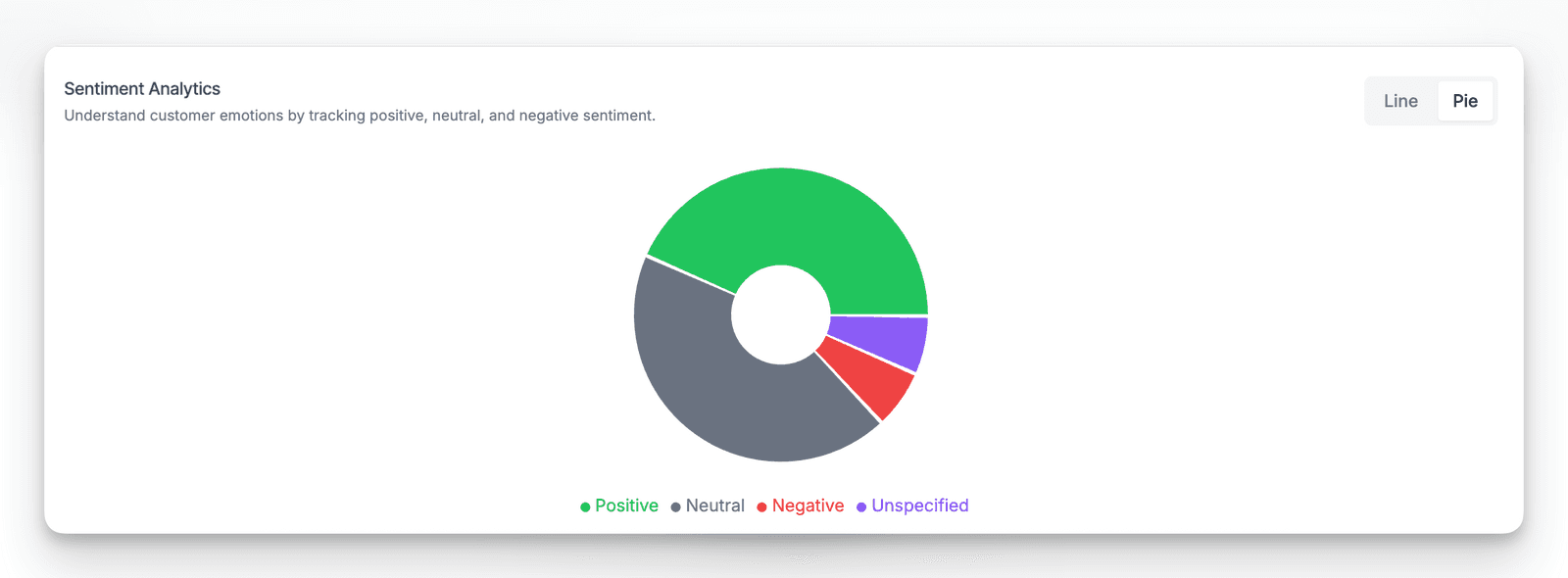
The final step is not really final.
Once your telecom chatbot is live, you need to review how it performs. I would not treat launch day as the finish line. I would treat it as the first draft.
Look at questions like:
- What are customers asking most often?
- Where does the chatbot fail to answer clearly?
- Which conversations lead to human handoff?
- Which pages generate the most support questions?
- Are customers asking about topics missing from your help center?
- Are billing answers clear enough?
- Are plan recommendations helpful or too vague?
- Are technical troubleshooting flows too long?
This is where LiveChatAI can become part of a larger support and content improvement loop. If customers keep asking the same question, that is not just a chatbot issue. It may mean your website copy, FAQ structure, help center, or onboarding flow needs improvement.
And honestly, I love that part. Because customer conversations are not just support data. They are little windows into what people do not understand yet.
A customer support chatbot for telecom providers gets stronger when you keep feeding it better content, sharper flows, and clearer escalation rules.
So the simple version is:
- Train it with your telecom support content.
- Place it where customers actually need help.
- Connect it with useful workflows.
- Keep human support close.
- Improve it based on real conversations.
That is how you build a telecom chatbot that feels less like a script and more like a helpful support layer.
Final Thoughts
A telecom chatbot works best when it is built with one simple idea in mind: customers do not want to fight for basic answers.
They want to know why their bill changed. They want to check whether there is an outage. They want to activate their SIM without confusion. They want to compare plans without reading five different pages. They want to talk to a human when the issue becomes too personal, too complex, or too frustrating.
That is why I think a good AI chatbot for telecom should not feel like a cold automation tool. It should feel like a practical support layer that helps customers move faster and helps agents breathe easier.
For telecom companies, the opportunity is pretty clear: automate the repeatable questions, guide customers through self-service, collect useful context before handoff, and use conversation insights to improve the whole support experience over time.
And if you are using LiveChatAI, you can build that flow around your existing telecom support content, combine AI answers with live chat, and connect actions that help move customer requests forward.
In the end, a telecom customer service chatbot is not about replacing the human side of support. It is about protecting it.
Because when AI handles the repetitive noise, your team has more space for the conversations where human care really matters.
Frequently Asked Questions
What is a telecom chatbot?
A telecom chatbot is an AI-powered conversational assistant that helps telecom companies answer customer questions, automate support tasks, and guide users through common issues like billing, plan changes, SIM activation, technical troubleshooting, and outage updates.
How can chatbots help telecom companies?
Chatbots can help telecom companies reduce support workload, answer repeat questions instantly, support customers 24/7, collect customer details before agent handoff, and improve self-service experiences. A chatbot for telecom companies is especially useful because telecom support often includes high-volume, repetitive, and time-sensitive questions.
Can a telecom chatbot handle billing questions?
Yes, a telecom customer service chatbot can help with many billing-related questions, such as payment due dates, invoice access, common charge explanations, failed payment steps, and where to pay a bill. For sensitive billing disputes or account-specific issues, the chatbot should escalate the conversation to a human support agent.
Can telecom chatbots help with network outages?
Yes. A telecom AI assistant can help customers check service status, collect location details, share basic troubleshooting steps, and reduce duplicate support requests during outage spikes. It may not fix the outage itself, but it can give customers faster direction and clearer next steps.
Does a telecom chatbot replace human support agents?
No, and I do not think it should. A telecom chatbot is best used for repeatable first-level support, simple self-service, lead collection, and guided troubleshooting. Human agents are still needed for complex technical issues, emotional conversations, billing disputes, cancellations, and account-specific cases.
Check out these blog posts as well: