




An AI chatbot for restaurant businesses helps automate reservations, answer customer questions, manage orders, recommend menu items, and improve guest experience across websites, WhatsApp, Instagram, and other messaging channels. In my experience, the best restaurant chatbot solutions reduce staff workload while increasing bookings and customer satisfaction at the same time.
What Is an AI Chatbot for Restaurant Businesses?
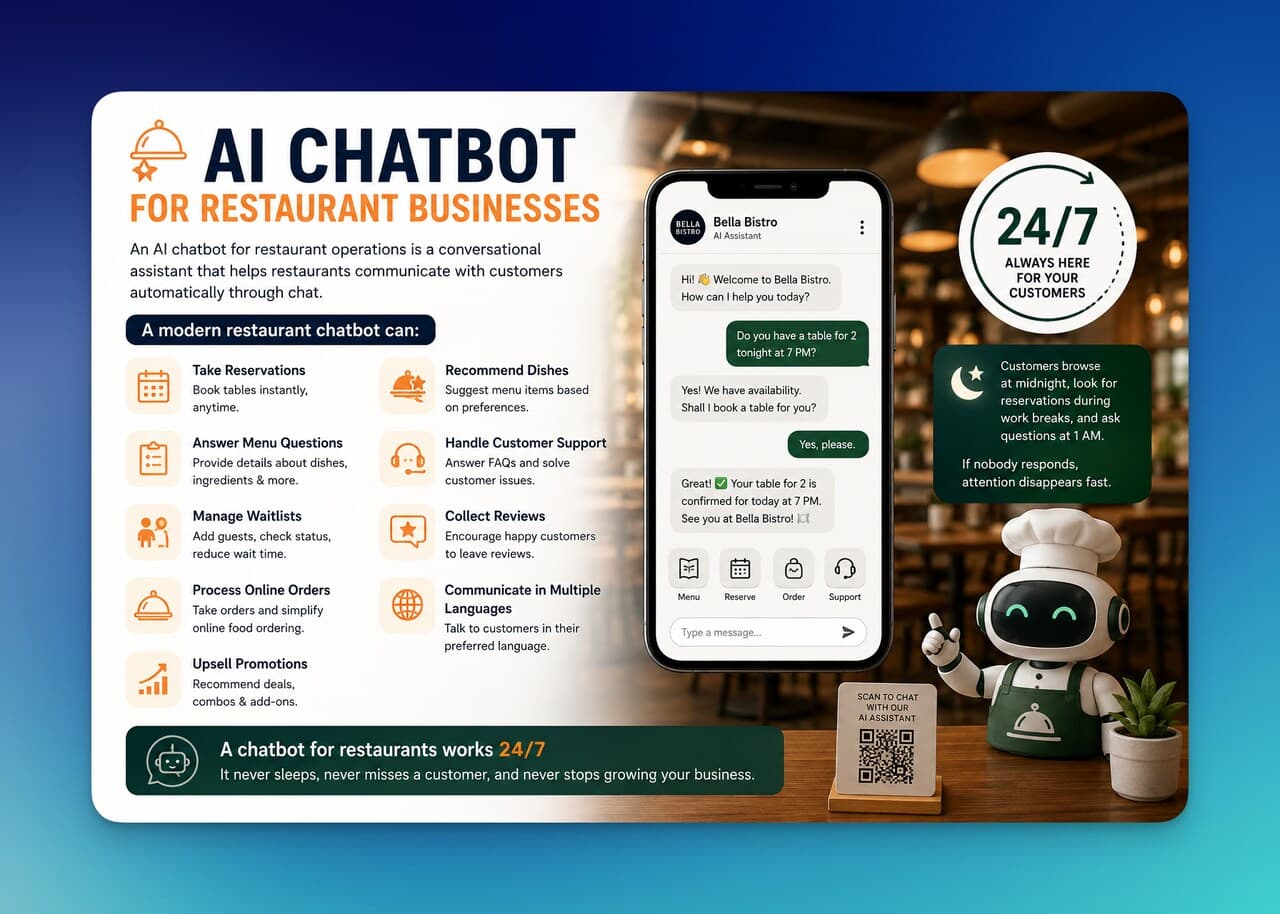
An AI chatbot for restaurant operations is a conversational assistant that helps restaurants communicate with customers automatically through chat.
Simple definition, yes. But in practice, it can do much more than most restaurant owners expect.
A modern restaurant chatbot can:
- take reservations
- answer menu questions
- manage waitlists
- recommend dishes
- process online orders
- handle customer support
- collect reviews
- upsell promotions
- communicate in multiple languages
And the important part is this: it works 24/7.
I think this is where many restaurants underestimate the value. Customers do not only interact with restaurants during opening hours anymore. They browse menus at midnight, look for reservation availability during work breaks, and ask questions while scrolling Instagram at 1 AM.
If nobody responds, attention disappears fast.
That is exactly where a chatbot for restaurants becomes useful.
AI Chatbot vs Traditional Restaurant Chat Widget
Not every chat bubble qualifies as AI.
Some restaurant websites still use old-school rule-based bots that can only answer a few predefined questions. They work for basic automation, but conversations break easily.
AI-powered restaurant chatbots are different because they understand intent and context.
Here’s a quick comparison:
| Feature | Traditional Chatbot | AI Restaurant Chatbot |
|---|---|---|
| Understands natural language | No | Yes |
| Handles complex questions | Limited | Yes |
| Menu recommendations | Basic | Personalized |
| Reservation automation | Partial | Advanced |
| Learns from conversations | No | Yes |
| Multi-language support | Limited | Strong |
In my experience, restaurants usually start searching for a chatbot restaurant reservation solution because they want fewer phone calls. Then they realize the chatbot can also improve customer experience, increase direct bookings, and reduce operational chaos at the same time.
That is when the chatbot stops being “a support tool” and becomes part of the restaurant experience itself.
Why Restaurants Are Adopting AI Chatbots
Restaurants are under pressure from every direction right now.
Labor shortages, rising operational costs, increasing delivery demand, higher customer expectations, and nonstop digital communication.
At the same time, customers expect instant responses.
According to Salesforce research, most customers expect companies to respond immediately when they contact a business. Restaurants are part of that expectation too.
The problem is that restaurant teams are already overloaded.
A hostess cannot:
- answer Instagram DMs
- pick up phone reservations
- manage walk-ins
- handle online bookings
- explain gluten-free options
- and coordinate seating
all at the same time during dinner rush.
That operational gap is one of the biggest reasons restaurant AI assistants are growing fast.
The Shift Toward Conversational Dining Experiences
I think people often forget that restaurants are emotional businesses.
People are not only buying food. They are booking birthdays. Date nights. Family dinners. Celebrations.
The communication experience matters more than many operators realize.
A restaurant chatbot helps remove friction from that experience:
- instant reservation confirmation
- fast answers
- no hold music
- no missed calls
- easy ordering
- personalized interactions
Even small improvements here can affect conversion rates significantly.
And honestly, modern customers are becoming surprisingly comfortable talking to AI systems if the experience feels smooth.
Benefits of Using a Restaurant Chatbot
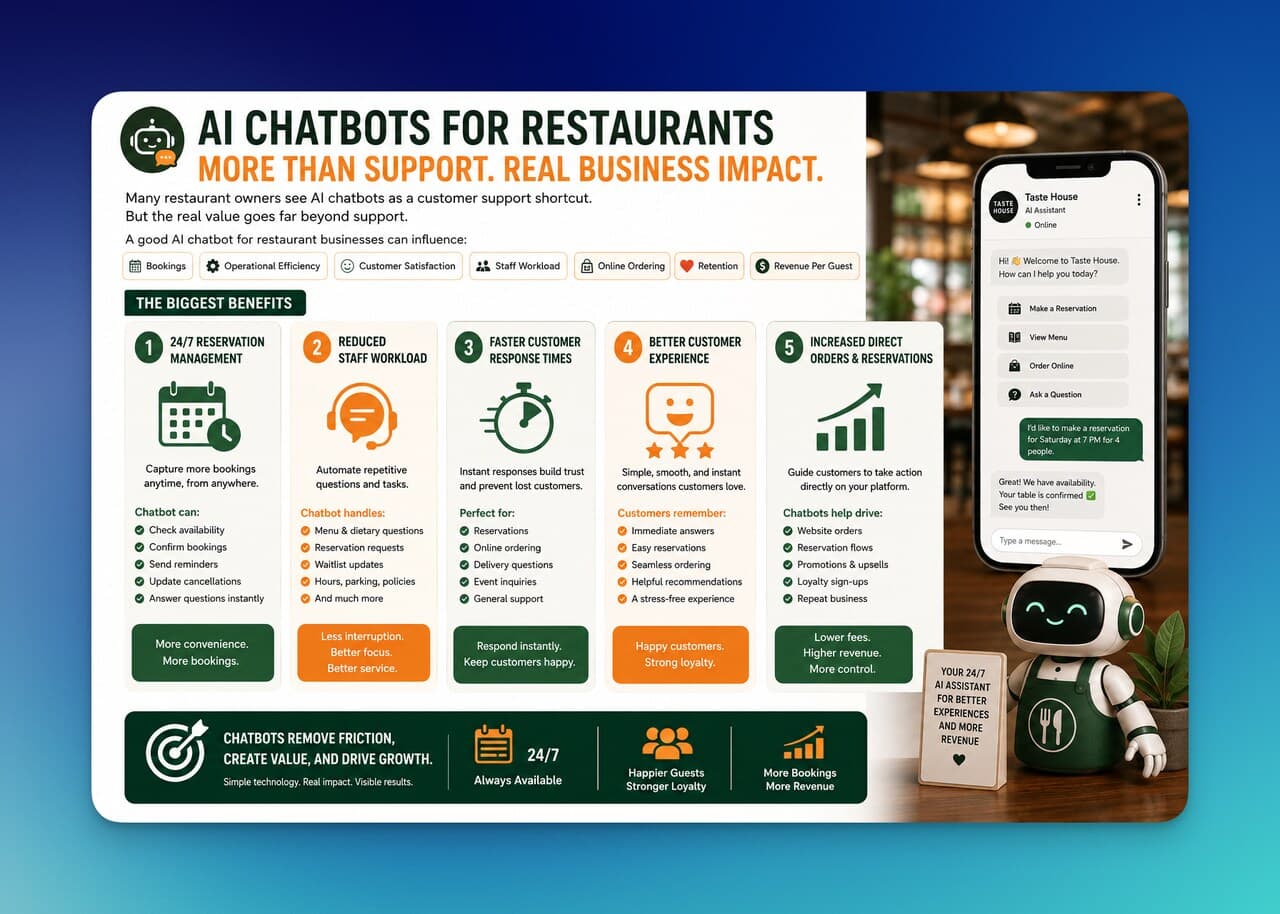
I think many restaurant owners initially look at AI chatbots as a customer support shortcut.
But after implementation, the real value usually becomes much bigger than support alone.
A good AI chatbot for restaurant businesses can influence:
- bookings
- operational efficiency
- customer satisfaction
- staff workload
- online ordering
- retention
- even revenue per guest
And unlike many restaurant tech tools, chatbots interact directly with customers. That means the impact becomes visible very quickly.
Here are the biggest benefits I consistently see.
1. 24/7 Reservation Management
Customers do not reserve tables only during business hours.
A lot of reservations happen:
- late at night
- during commutes
- during work breaks
- while browsing social media
If your restaurant cannot respond instantly, many users simply move on to another option.
A chatbot restaurant reservation system removes that delay completely.
Instead of:
- missed calls
- voicemail chaos
- manual booking confirmations
the AI chatbot can:
- check availability
- confirm bookings
- send reminders
- update cancellations
- answer reservation questions instantly
The easier the reservation experience feels, the more bookings restaurants tend to capture.
2. Reduced Staff Workload
Restaurant staff already juggle too many things simultaneously.
Front-of-house teams especially deal with nonstop interruptions:
- phone calls
- repetitive questions
- reservation requests
- dietary inquiries
- waitlist updates
Many of these interactions are important, but repetitive.
A restaurant chatbot can automate the repetitive layer so staff can focus on actual guest experience inside the restaurant.
Questions like:
- “Do you have vegan options?”
- “Are you open on holidays?”
- “Can I bring my dog?”
- “Do you have parking?”
- “Can I reserve for 8 people?”
can all be answered automatically within seconds.
And honestly, removing small interruptions often improves service quality more than people expect.
3. Faster Customer Response Times
Speed matters more than restaurants sometimes realize.
Especially on mobile.
According to HubSpot customer service research, customers increasingly expect immediate responses from businesses online.
Restaurants that reply slowly often lose customers before the conversation even starts.
This becomes even more important for:
- online ordering
- delivery questions
- reservation requests
- event inquiries
A chatbot for restaurants helps maintain instant communication even during peak hours.
That consistency builds trust surprisingly fast.
4. Better Customer Experience
This is probably the most underrated benefit.
People remember friction.
They remember:
- unanswered calls
- confusing reservation systems
- delayed responses
- complicated ordering flows
But they also remember smooth experiences.
A restaurant AI assistant creates a simpler customer journey:
- Customer asks a question
- Customer gets an immediate answer
- Customer completes an action quickly
- Customer leaves satisfied
Simple.
And simple usually converts better.
5. Increased Direct Orders and Reservations
One thing I personally like about restaurant chatbots is their ability to reduce dependency on third-party platforms.
Instead of pushing users toward external marketplaces, restaurants can guide visitors directly through:
- website ordering
- reservation flows
- loyalty programs
- promotions
- upselling opportunities
That matters financially because third-party delivery fees can become painful over time.
A chatbot for restaurant websites helps bring part of that customer journey back under the restaurant’s control.
| Benefit | Business Impact |
|---|---|
| 24/7 reservation handling | More bookings |
| Instant responses | Higher customer satisfaction |
| Automated FAQs | Reduced staff workload |
| Faster order assistance | Better conversion rates |
| Personalized recommendations | Increased upselling |
| Multi-language support | Better guest accessibility |
| Direct website engagement | Reduced third-party dependency |
And honestly, most restaurants do not need a futuristic AI setup to see results.
Even relatively simple restaurant chatbot implementations can remove operational friction almost immediately.
Common Restaurant Chatbot Use Cases
This is where things start getting interesting.
Because when people hear “restaurant chatbot,” they usually imagine a tiny website assistant answering opening hours.
But modern AI chatbot for restaurant systems can handle much larger parts of the customer journey.
In many cases, the chatbot becomes:
- a reservation assistant
- a digital waiter
- a support agent
- a marketing assistant
- and sometimes even a sales channel
all at once.
Here are the most common restaurant chatbot use cases I see in real implementations.
1. Chatbot Restaurant Reservation Automation
This is by far the most popular use case.
And honestly, it makes sense.
Reservations create constant operational interruptions for restaurants:
- phone calls during rush hours
- manual confirmations
- no-show management
- cancellations
- scheduling conflicts
A chatbot restaurant reservation system automates most of this process.
Instead of calling the restaurant, customers can simply:
- select date and time
- choose guest count
- receive confirmation instantly
- modify reservations
- cancel bookings
- receive reminder messages
The process becomes smoother for both customers and staff.
Typical Reservation Flow:
| Step | Chatbot Action |
|---|---|
| Customer starts chat | Bot asks reservation details |
| Date/time selection | Bot checks availability |
| Booking confirmation | Bot confirms reservation instantly |
| Reminder sequence | Automated reminder sent before visit |
| Cancellation or modification | Customer updates reservation through chat |
I think this is one of the fastest ROI use cases for restaurants because reservation handling consumes so much repetitive staff time.
2. Menu Assistance and Recommendations 🍕
Menus can overwhelm people.
Especially:
- large restaurant menus
- specialty diets
- wine pairings
- allergy restrictions
- unfamiliar cuisines
A restaurant chatbot can simplify decision-making by helping customers discover suitable options faster.
For example:
- “Show me vegetarian dishes”
- “What’s your most popular pasta?”
- “Do you have gluten-free desserts?”
- “Recommend something spicy”
- “Which wine pairs with steak?”
These interactions feel surprisingly natural with modern AI systems.
And from a business perspective, they also create upselling opportunities.
A chatbot can intelligently suggest:
- drinks
- desserts
- premium dishes
- combos
- seasonal items
without feeling overly pushy.
3. Online Ordering Support
Online ordering friction kills conversions.
Small issues like:
- confusing menus
- customization questions
- delivery uncertainty
- payment confusion
can make customers abandon orders quickly.
A chatbot for restaurants can guide users throughout the ordering process:
- helping customers choose items
- answering delivery questions
- explaining ingredients
- handling modifications
- tracking orders
I think restaurants sometimes underestimate how many customers leave simply because they cannot get a quick answer during checkout.
Even one unanswered question can stop an order entirely.
4. Customer Support and FAQ Handling
This is the operational backbone of many restaurant AI assistants.
Restaurants receive repetitive questions every single day:
- opening hours
- parking availability
- outdoor seating
- pet policies
- dietary accommodations
- event bookings
- delivery zones
Instead of forcing staff to repeat the same answers hundreds of times, the chatbot can automate those conversations instantly.
This becomes especially useful on:
- websites
- Facebook Messenger
where customer expectations for quick replies are extremely high.
5. Waitlist and Queue Management
Busy restaurants know how chaotic waitlists can become.
Especially during weekends.
A restaurant chatbot can help manage:
- digital waitlists
- estimated wait times
- queue notifications
- seating updates
without overwhelming front-desk staff.
Customers also appreciate transparency.
Knowing:
- how long the wait is
- when their table is ready
- where they stand in line
reduces frustration significantly.
6. Loyalty Programs and Promotions
This is one of the more underrated restaurant chatbot use cases.
Chatbots can become highly effective marketing tools when connected to:
- loyalty programs
- discounts
- seasonal campaigns
- personalized offers
For example, a chatbot can:
- send birthday discounts
- recommend returning-customer offers
- promote lunch specials
- distribute promo codes
- encourage repeat visits
And because conversations feel more personal than traditional popups or email banners, engagement rates can become surprisingly strong.
7. Multilingual Customer Communication 🌍
Restaurants in tourist-heavy areas benefit enormously from multilingual AI chat.
Language barriers create friction fast.
An AI chatbot for restaurant businesses can communicate with international guests in multiple languages simultaneously, helping with:
- reservations
- menu explanations
- allergy information
- ordering assistance
without requiring multilingual staff availability 24/7.
That alone can improve guest experience dramatically for international visitors.
What Features Should a Chatbot for Restaurants Have?
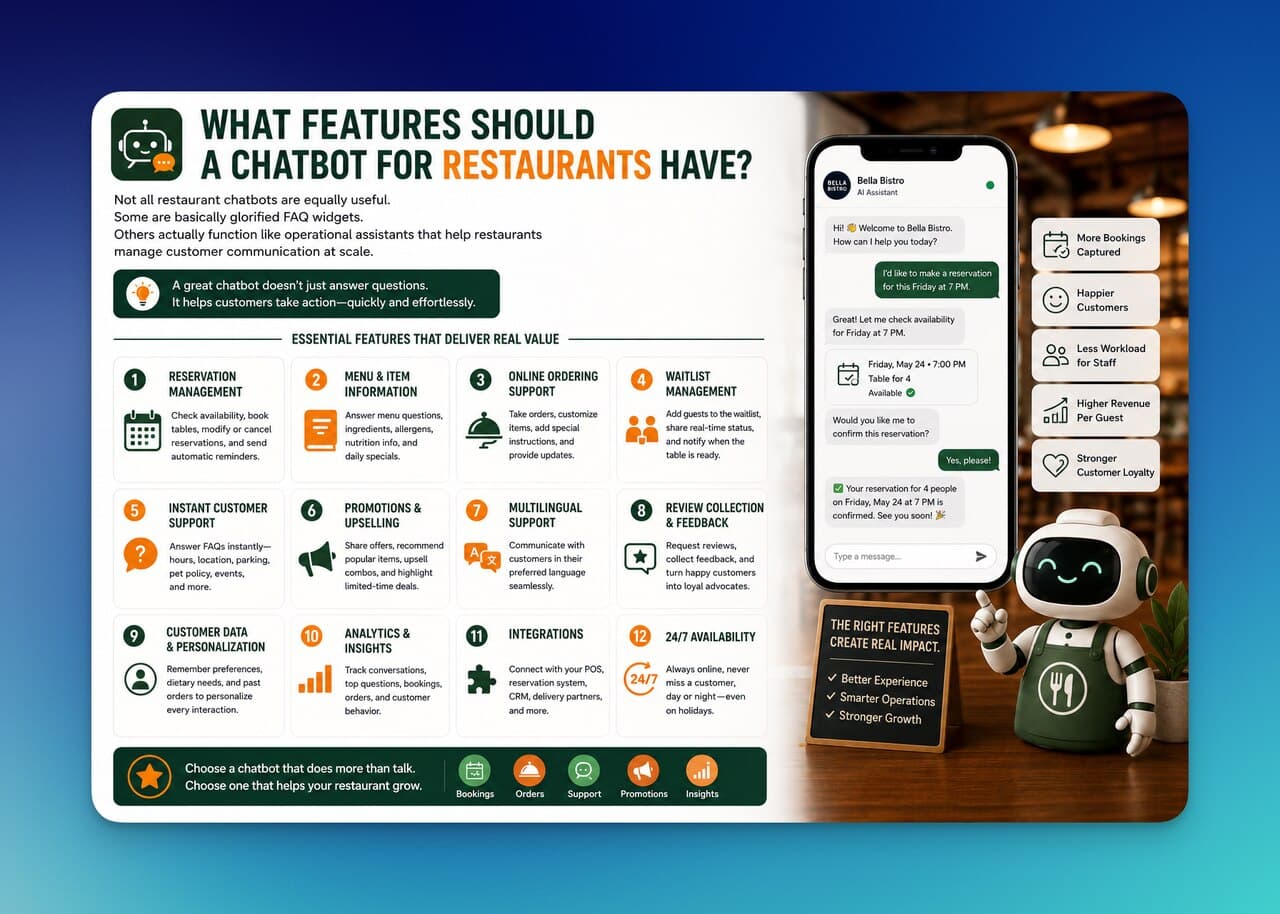
Not all restaurant chatbots are equally useful.
Some are basically glorified FAQ widgets.
Others actually function like operational assistants that help restaurants manage customer communication at scale.
In my experience, the difference usually comes down to features.
A chatbot for restaurants should not only answer questions. It should help customers complete actions smoothly.
That distinction matters a lot.
Here are the features I think matter most when evaluating a restaurant AI assistant.
1. AI-Powered Natural Conversations
This is the foundation.
Customers rarely speak in perfect scripted commands.
They say things like:
- “Can I book a table for tonight?”
- “Do you guys have vegan pizza?”
- “I need a table for 6 around 8 PM”
- “Is your patio dog friendly?”
A good AI chatbot for restaurant businesses should understand conversational language naturally instead of forcing customers through rigid button-based flows.
The smoother the interaction feels, the higher the completion rate usually becomes.
2. Reservation System Integration
This is non-negotiable for most restaurants.
A chatbot restaurant reservation setup should integrate directly with reservation systems so customers can:
- check real-time availability
- confirm bookings instantly
- update reservations
- cancel reservations
- receive reminders
Without integration, the chatbot creates extra manual work instead of reducing it.
And honestly, that defeats the purpose.
Reservation Features Checklist:
| Feature | Why It Matters |
|---|---|
| Real-time availability | Prevents double bookings |
| Instant confirmations | Improves customer experience |
| Automated reminders | Reduces no-shows |
| Cancellation management | Saves staff time |
| Multi-location support | Helps restaurant chains |
| Calendar synchronization | Keeps operations organized |
3. Multi-Channel Support
Customers do not only communicate through websites anymore.
They message restaurants through:
- Facebook Messenger
- Google Business profiles
- SMS
- web chat
A restaurant chatbot should ideally support multiple communication channels from one system.
This creates a more consistent guest experience while helping restaurants centralize conversations.
I think this is becoming increasingly important because modern customer journeys are fragmented across platforms.
4. Menu and Ordering Assistance
Menus create decision fatigue more often than people realize.
Especially on mobile devices.
A strong restaurant chatbot should help customers:
- browse menus
- filter dietary preferences
- customize orders
- discover recommendations
- ask ingredient questions
And ideally, it should support visual menus too.
Food is emotional. Images help.
5. Human Handoff Capability
This feature gets overlooked constantly.
Even the best AI chatbot for restaurants will sometimes encounter:
- complex complaints
- unusual reservation requests
- VIP situations
- sensitive customer issues
At those moments, the chatbot should smoothly transfer the conversation to a human staff member.
Bad chatbot experiences usually happen when:
- users get trapped
- the AI refuses escalation
- conversations loop endlessly
Good automation knows when to step aside.
6. Analytics and Customer Insights
One thing I personally like about restaurant AI systems is the amount of behavioral insight they can generate.
Restaurant chatbots can reveal:
- frequently asked questions
- peak booking times
- common customer frustrations
- popular menu items
- abandoned reservation flows
That information becomes operationally valuable very quickly.
Restaurants can use these insights to improve:
- staffing decisions
- menus
- customer service
- marketing campaigns
- booking strategies
7. Multilingual Support
Restaurants serving tourists or international customers should absolutely prioritize this feature.
Multilingual AI chat helps restaurants provide:
- smoother communication
- better ordering experiences
- clearer allergy explanations
- easier reservation handling
without needing multilingual staff available at all times.
And honestly, multilingual support often creates a surprisingly premium customer experience.
8. CRM and Marketing Integrations
Modern restaurant chatbots increasingly connect with:
- CRM platforms
- email marketing tools
- loyalty systems
- SMS campaigns
- review collection tools
This allows restaurants to automate follow-up communication like:
- reservation reminders
- feedback requests
- loyalty offers
- re-engagement campaigns
which turns the chatbot into more than just a support tool.
At that point, it becomes part of the restaurant’s growth system itself.
Why Some Restaurants Are Turning to AI Platforms Like LiveChatAI
Choosing a chatbot for restaurants is not only about automation anymore. Restaurants increasingly want AI systems that can actually hold natural conversations and guide customers toward actions like reservations or orders.
This is one reason platforms like LiveChatAI are getting attention in the hospitality space.
Instead of relying on rigid scripted flows, AI-first platforms allow restaurants to create more conversational experiences across:
- websites
- customer support channels
In my opinion, this matters because restaurant conversations are rarely predictable. Customers ask highly specific questions about:
- dietary restrictions
- reservation changes
- menu details
- group bookings
- delivery policies
A more conversational AI system handles these situations far more naturally than traditional rule-based bots.
Another advantage is centralized communication.
Rather than managing customer conversations separately across multiple channels, restaurants can streamline interactions through one AI-powered workflow. That becomes especially useful for busy teams trying to reduce operational overload without sacrificing customer experience.
For restaurants exploring AI chatbot implementation seriously, platforms focused on conversational AI rather than simple scripted automation are usually worth evaluating first.
How to Choose the Right Restaurant Chatbot
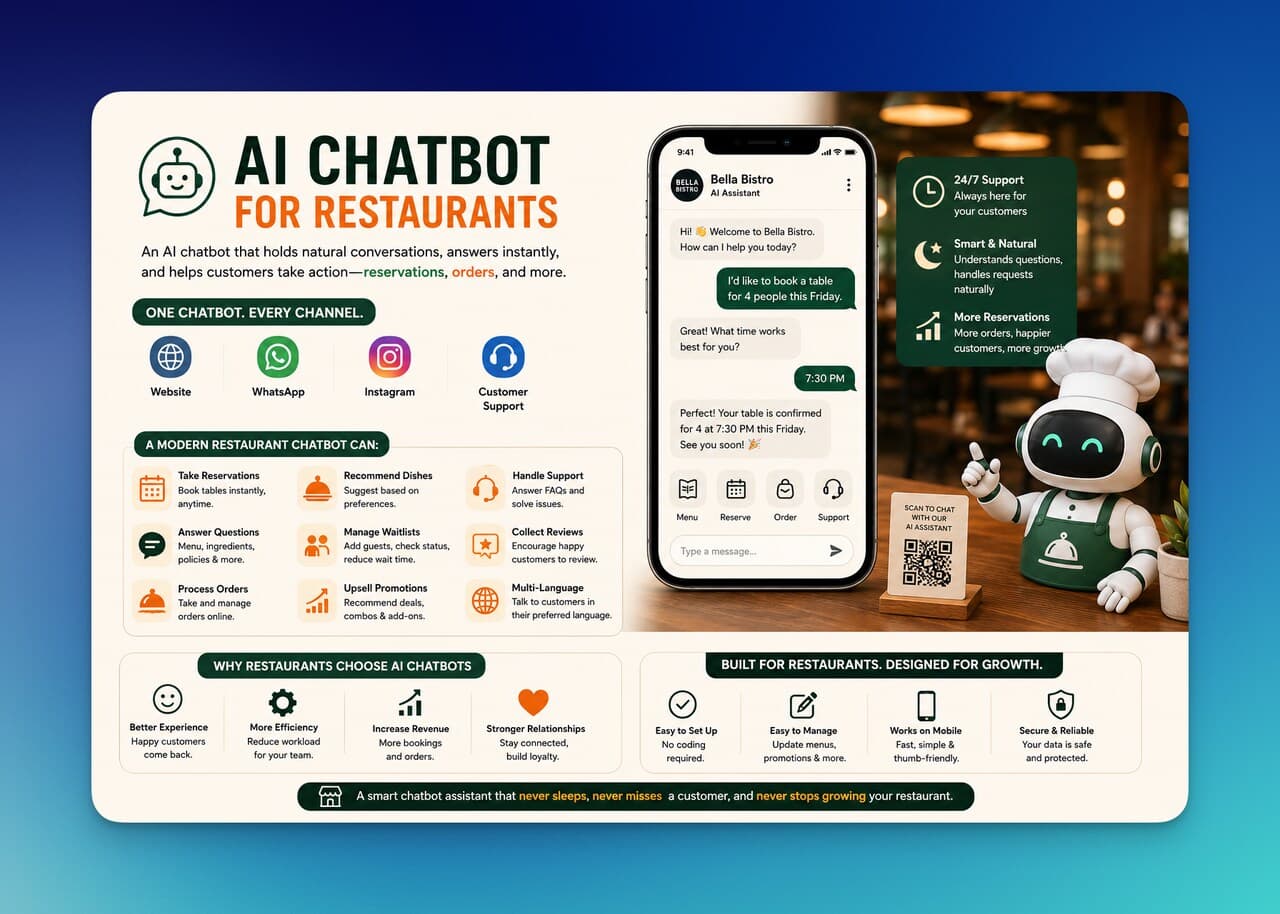
Choosing a restaurant chatbot is less about finding the “most advanced AI” and more about finding the right operational fit.
I think this is where many restaurants make mistakes.
They focus heavily on flashy AI features while ignoring the actual customer journey.
A chatbot for restaurants should solve real operational problems first.
Everything else comes second.
Here are the factors I would personally evaluate before choosing an AI chatbot for restaurant operations.
1. Start With Your Biggest Operational Pain Point
Before comparing tools, identify what problem you actually want to solve.
For example:
| Restaurant Need | Best Chatbot Focus |
|---|---|
| Too many reservation calls | Reservation automation |
| High customer support volume | FAQ automation |
| Slow online ordering support | Ordering assistance |
| Low direct bookings | Website engagement |
| International customer traffic | Multilingual AI support |
| Staff overload | End-to-end automation |
Trying to solve everything immediately usually creates messy implementations.
I think restaurants get better results when they focus on one major workflow first.
2. Check Integration Capabilities
This matters more than fancy AI branding.
A restaurant chatbot should integrate smoothly with your:
- reservation software
- POS system
- CRM
- ordering platform
- communication channels
Otherwise, staff ends up manually moving information between systems, which creates more operational friction instead of reducing it.
Always ask:
- Does it integrate with my reservation platform?
- Can it sync customer information?
- Does it support my ordering system?
- Can it connect with WhatsApp or Instagram?
Good integrations save enormous amounts of time later.
3. Evaluate Conversation Quality
Not all AI conversations feel natural.
Some bots still sound robotic and frustrating:
- repetitive replies
- awkward phrasing
- broken intent recognition
- endless loops
That experience hurts restaurant branding more than people realize.
I always recommend testing:
- complex questions
- slang
- dietary requests
- unusual reservation scenarios
before choosing a chatbot provider.
The smoother the conversation feels, the more customers will actually use it.
4. Consider Ease of Setup and Maintenance
Restaurants rarely have large technical teams.
So simplicity matters.
A chatbot for restaurants should ideally allow staff to:
- update menus
- edit responses
- change opening hours
- manage promotions
- review conversations
without needing developers constantly involved.
If maintaining the chatbot becomes difficult, adoption usually drops over time.
5. Prioritize Mobile Experience
Most restaurant conversations happen on mobile devices.
That means the chatbot experience should feel:
- fast
- clean
- simple
- thumb-friendly
A cluttered or slow mobile chat experience creates immediate friction.
And honestly, mobile UX often determines whether users complete reservations or abandon them halfway through.
6. Think Beyond Support
This is something I strongly believe.
The best restaurant AI assistants are not just support tools. They are revenue tools.
A strong chatbot can help:
- increase reservations
- improve direct ordering
- boost repeat visits
- upsell menu items
- collect customer insights
- strengthen guest relationships
That broader perspective helps restaurants choose solutions that support long-term growth instead of only reducing support tickets.
Questions I’d Ask Before Choosing a Restaurant Chatbot:
| Question | Why It Matters |
|---|---|
| Does it support AI conversations naturally? | Better customer experience |
| Can it automate reservations? | Operational efficiency |
| Does it integrate with existing tools? | Reduced manual work |
| Is it easy for staff to manage? | Long-term usability |
| Does it support multiple languages? | Better accessibility |
| Can it scale with business growth? | Future-proofing |
In my experience, the restaurants that succeed with chatbot adoption are usually the ones that keep the implementation practical.
They do not try to automate everything overnight.
They start with one meaningful customer workflow, optimize it well, and expand gradually from there.
Future of AI in the Restaurant Industry
I honestly think restaurants are only at the beginning of AI adoption.
Right now, most businesses use restaurant chatbots mainly for:
- reservations
- FAQs
- ordering support
- basic automation
But the next few years will likely push restaurant AI much further into the overall dining experience.
And no, I do not think robots will replace hospitality.
If anything, I think AI will make human hospitality more valuable by removing repetitive operational work from restaurant teams.
AI Will Become More Personalized
One of the biggest shifts I expect is personalization.
Future AI chatbot for restaurant systems will likely remember:
- guest preferences
- favorite dishes
- dietary restrictions
- seating choices
- ordering history
- visit frequency
which allows restaurants to create far more tailored guest experiences.
Imagine a returning customer receiving:
- personalized menu recommendations
- automatic dietary filtering
- favorite table preferences
- loyalty rewards
- birthday offers
without staff manually tracking any of it.
That level of personalization is becoming increasingly realistic.
Voice AI Will Grow Inside Restaurants
Text chat is only one part of the picture.
Voice AI is improving rapidly too.
We are already seeing AI voice assistants appear in:
- drive-thrus
- phone ordering systems
- reservation hotlines
- self-service kiosks
And honestly, this trend will probably accelerate because restaurants constantly look for ways to reduce operational pressure during peak hours.
Hyper-Automated Restaurant Operations
I think restaurant AI will gradually evolve from “chat assistant” into “operational layer.”
Future restaurant chatbots may connect directly with:
- kitchen systems
- inventory management
- staffing tools
- loyalty programs
- delivery operations
- customer analytics
creating much more connected restaurant ecosystems.
For example:
- reservation spikes could trigger staffing recommendations
- low inventory could adjust menu suggestions automatically
- customer sentiment could influence loyalty campaigns
- weather conditions could impact promotional flows
That level of operational intelligence is where things get really interesting.
AI Will Not Replace Human Hospitality
This part matters.
Restaurants are emotional spaces. Human interaction still matters enormously.
People still value:
- warmth
- atmosphere
- recommendations
- personality
- emotional connection
I do not think customers want fully robotic dining experiences.
What they want is less friction.
And that is where restaurant AI assistants fit best. Ironically, the better AI becomes, the more human restaurants may actually feel.
Conclusion
AI chatbots are becoming a key part of how modern restaurants operate, not just because they automate conversations, but because they fundamentally improve how restaurants communicate with customers. From managing reservations and answering repetitive questions to supporting online orders and guiding menu choices, they help create a smoother, faster, and more reliable guest experience across every digital touchpoint. At the same time, they reduce pressure on staff during busy hours, minimize missed opportunities from slow responses, and allow teams to focus more on in-restaurant service rather than constant message handling. As customer expectations continue to shift toward instant and always-available communication, restaurants that adopt AI-driven chat systems are in a much stronger position to stay competitive and increase both satisfaction and direct bookings.
If you’re ready to bring this kind of efficiency and responsiveness into your own restaurant, you can explore LiveChatAI and see how an AI chatbot can integrate into your existing workflow.
Frequently Asked Questions
How long does it take to set up a restaurant chatbot?
In my experience, basic restaurant chatbot setups can go live within a few hours, especially if you only need FAQ automation and simple reservation flows. More advanced implementations with POS, CRM, or ordering integrations may take several days or weeks depending on complexity.
Can a restaurant chatbot help reduce no-shows?
Yes, significantly. AI chatbots can automatically send reservation reminders, confirmation requests, and follow-up messages before the booking time. This helps restaurants reduce forgotten reservations and improve table management.
Is a chatbot useful for small restaurants or cafés?
Absolutely. Small restaurants often benefit the most because staff usually handle multiple responsibilities simultaneously. Even simple automation for reservations, opening hours, and menu questions can save a surprising amount of time.
Can restaurant chatbots collect customer feedback?
Yes. Many restaurant chatbots can automatically ask customers for reviews or feedback after reservations or orders. This helps restaurants monitor customer satisfaction and identify operational issues faster.
What is the difference between a restaurant chatbot and live chat?
Live chat requires a human agent to respond manually, while a restaurant chatbot uses AI and automation to answer questions instantly. Some systems combine both by allowing AI to handle basic conversations before transferring complex cases to staff members.