




Live chat canned responses are pre-written replies stored as shortcuts in your support tool, so agents answer common questions in seconds instead of retyping the same lines. Used well, they cut response time by 30-40% and keep your team's voice consistent across every conversation.
What Are Live Chat Canned Responses?
I'm Perihan, and I've spent the last three years writing and testing canned response libraries for LiveChatAI customers. After auditing more than 200 scripts across SaaS and e-commerce support teams, I've put together the library below — 49 ready-to-use examples organized by the situations that actually pop up in a real queue. Every example has the placeholder variables marked so you can drop them straight into your tool.
Live chat canned responses are saved message templates that customer support agents insert into a chat window with a keyboard shortcut, slash command, or single click. Some tools call them shortcuts, macros, snippets, or predefined messages. The core idea is the same: write the reply once, reuse it forever, edit the variable parts before you send.
A canned response usually contains three pieces: a greeting with the customer's name, the answer or next step, and a placeholder for any context-specific detail like an order number or refund amount. The agent fills the placeholders and ships the reply.
Canned responses work across live chat widgets, email, and AI chatbot fallbacks. For e-commerce teams they handle the "where's my order" wave. For SaaS support they cover password resets, plan changes, and feature requests. For agencies running multi-client support, they keep voice consistent even when five different reps cover the same brand.
Why Live Chat Canned Responses Matter in 2026
Customers don't tolerate slow replies anymore. According to Helpable's live chat benchmark, the average live chat response time is 1 minute 35 seconds, but 90% of customers expect a reply within 10 minutes. That gap is where canned responses earn their keep.
The performance lift is measurable. Helpable also reports that canned responses cut first-touch response time by 30-40%, mostly because agents stop retyping the same sentences. On the team-wide level, Comm100's benchmark report found that structured live chat workflows — canned responses included — drop wait time by 37.5% in large teams.
Adoption has caught up with the data. Digital Minds BPO reports that 69% of companies now use canned responses to speed up common inquiries. If your team isn't running a library, your competition almost certainly is.
The benefits I see in production:
• Faster first replies: Most repetitive questions go out in under 30 seconds when the script is ready and the variables are obvious.
• Consistent voice: New hires sound like senior agents on day one because the language is already written.
• Lower agent fatigue: Writing the same shipping update fifty times a shift is what burns junior reps out. Canned responses kill that fatigue.
• Easier QA: When everyone uses the same approved script for refunds, your QA team checks the variables and the tone, not the entire reply.
• Better handoff to AI: Your canned response library is the cleanest training set you can give an AI chatbot. It's already battle-tested.

How I Built This Library of 45+ Examples
I didn't pull these out of thin air. Every example below started as a real reply from a real support queue, then got rewritten until it passed three tests:
• Plain English: A new agent can use it without asking what a word means.
• Edit-friendly: Every variable is wrapped in [square brackets] so it's obvious what needs swapping before the message goes out.
• Empathy-first: No "your call is important to us" energy. Every script acknowledges the customer's situation before it gets to the answer.
If you're new to scripts entirely, our guide to positive scripting covers the language patterns that make replies feel human instead of corporate. The examples below assume those basics.
1. Greeting and Welcoming Customers (8 Examples)
Greetings set the temperature of the whole conversation. A good opener acknowledges the customer by name (when you have it), introduces the agent, and invites the question. Skip "welcome to our chat, how may I assist you" — that's the corporate elevator music of support.
1. Hey [name], Perihan here. What can I help you sort out today?
2. Hi [name], good to see you back. Last time we chatted about [previous topic] — is this related, or something new?
3. Hello [name], thanks for reaching out. Before we dig in: are you looking for help with billing, your account, or something on the product side?
4. Hi there, I'm [agent name] with the support team. Quick heads up: I'll have an answer for you in the next minute or two — give me a sec to pull up your account.
5. Hey [name], welcome. If you've got an order number or [reference ID] handy, drop it in chat and I'll get to the answer faster.
6. Hi [name], thanks for the message. Just so I send you somewhere useful: are you using [Product] on web, iOS, or Android?
7. Hello [name], [agent name] here from the [Brand] team. I see you signed up [time period] ago — happy to help with anything that's tripping you up.
8. Hey [name], thanks for stopping by. Whether this is a quick question or something bigger, I'm around for the next [time] — fire away.
Why these work: They acknowledge the customer, set a time expectation, and ask a clarifying question — three moves that prevent ten back-and-forth messages. For more on this, see our 35 live chat greeting examples, which goes deeper on tone variations.
2. Asking for More Information (5 Examples)
Half the support requests I've ever audited started with "it's not working" and no context. These scripts ask for what you need without sounding like an interrogation.
9. Got it, [name]. To get this sorted, I'll need three things: your [account email], the [error message] you're seeing, and a screenshot if you have one. Drop them whenever you're ready.
10. Thanks [name]. Quick question before I dig in — when did this start happening? Today, or has it been going on for a while?
11. Hi [name], I want to make sure I send you the right fix. Can you tell me whether you're on the [plan name] plan, or something else?
12. [name], I've pulled up your account. Before I touch anything, can you confirm the last [action] you took? Just want to make sure we're rolling back the right thing.
13. Hey [name], one more detail and I think we're good — what browser and version are you using? You can find it under Help > About in most browsers.
Why these work: Each request is specific. Asking "can you give me more details" is lazy — asking for the error message, screenshot, and timestamp gives the customer a clear path.
3. Confirming Work in Progress and Status Updates (5 Examples)
Silence is the killer in support chat. If you can't fix it in two minutes, the customer needs to know you're on it. These scripts buy you time without sounding evasive.
14. Thanks [name], I've got your request in front of me. Our [department] is working on order [order number] right now — I'll have an update for you within [time].
15. Hey [name], quick status check: your [issue] has been escalated to [team]. They typically resolve these within [time frame], and I'll loop back with you the moment I hear back.
16. [name], I'm staying with you on this one. The [department] is reviewing your case as we speak — give me until [specific time] and I'll either have a fix or a clear next step.
17. Hi [name], good news and a small ask — we found the issue and we're testing the fix. Can you stay logged in for another [time] so we can verify it works on your end?
18. [name], wanted to check back in. Your ticket [ticket number] is still active and being worked on. No new info yet, but I didn't want you to feel forgotten — I'll message again by [time].
Why these work: They commit to a specific time window. "We'll get back to you soon" is a broken promise waiting to happen — "I'll message again by 3pm your time" is one you can keep.
4. Putting Customers on Hold (5 Examples)
Holds are unavoidable when you need to check with another team. The trick is asking permission, not announcing it.

19. [name], I need to check this with our [team name] team. Mind if I put you on a short hold? Should be back with you in [time].
20. Hey [name], the answer to this lives with [department] and I want to get it right the first time. Two options: I can hold here for about [time] while I check, or I can email you the answer within the hour — your call.
21. [name], one sec — pulling up your billing history. Stay with me, I'll be back in under 90 seconds.
22. Quick update [name]: the hold is taking longer than I expected. Want to stay on chat, or should I send you an email update the second I hear back?
23. [name], thanks for hanging in there. I'm still waiting on [team] — I know that's frustrating. I'll keep checking and message you the moment I have something solid.
Why these work: Each script gives the customer a choice. Forcing a hold without asking is the fastest way to turn a calm conversation into a complaint.
5. Offering Alternative Solutions (5 Examples)
"No, we can't do that" is rarely the whole story. These scripts pair the "no" with a workaround that keeps the customer moving.
24. [name], honest answer — we don't offer [requested feature] on the [plan name] plan. What we can do: I can walk you through [workaround], which gets you most of the way there. Want me to send the steps?
25. [name], your specific case isn't something we can handle directly, but I've put together [link/resource] that covers the same outcome. Take a look and let me know if you hit a wall.
26. Hey [name], I dug into this and the request you're describing isn't on our roadmap right now. That said, [alternative tool/method] is what most of our customers use for [use case] — happy to share what I know.
27. [name], I want to be upfront — what you're asking for would take an engineering change we can't ship this quarter. But [workaround] achieves about 80% of what you need, and I can set it up with you right now if you have five minutes.
28. [name], here's a thought — instead of [original request], have you considered [alternative]? I've seen it work for teams in your situation, and it's faster to set up.
Why these work: They never just say no. The customer arrived with a problem, and they leave with a path forward — even if it's not the path they expected.
6. Apologizing for Mistakes (5 Examples)
When your team gets something wrong, the apology matters as much as the fix. These scripts admit fault clearly, name what went wrong, and commit to making it right.
29. [name], I owe you an apology. I quoted you [old price] earlier and that was wrong — the correct price is [correct price]. I should have double-checked before sending. Want me to hold the [old price] for you anyway as a goodwill gesture?
30. [name], that was on us. Your invoice went to your old email address because we hadn't updated your contact info in our billing system. I've fixed the record and we're adding [number] days to your next billing cycle for the trouble.
31. Hey [name], I just realized I gave you the wrong info about [topic]. The accurate answer is [correct info]. Sorry for the confusion — that's on me for not checking before I responded.
32. [name], I'm sorry — we missed your message yesterday because of a queue routing bug. That's not the experience we want you to have. Here's what I can do: I'll personally make sure your issue gets resolved today, and I've flagged the routing issue with our team so it doesn't happen again.
33. [name], your account got charged twice this month and that's our error, not yours. The duplicate charge of [amount] is being refunded right now — you should see it back in 3-5 business days. Apologies for the headache.
Why these work: They use the word "sorry" without hedging, name the specific mistake, and offer concrete remediation. "We apologize for any inconvenience" reads as a corporate shield — "I owe you an apology, I quoted you the wrong price" reads as a human admitting they messed up.
7. Closing Tickets and Following Up (5 Examples)
Closing a ticket cleanly is what turns a one-time interaction into a returning customer. These scripts confirm the resolution and leave the door open.
34. [name], looks like we've sorted [issue] — anything else on your mind before I close this out? I'm here for another [time].
35. Hey [name], it's been [number of days] since we last heard from you on [case topic], so I'm going to mark this resolved. If anything else comes up, just reply to this thread or start a new chat — no need to start over.
36. [name], wanted to circle back. Did the fix I sent you on [date] solve the issue? If yes, I'll close the ticket. If not, drop me a line and I'll take another look.
37. Glad we got that sorted, [name]. Quick favor: if you have 30 seconds, I'd love your feedback on how this chat went — there's a one-question survey when you close the window. Helps us spot patterns in what's working.
38. [name], your case [ticket number] is marked resolved as of today. If you need to reopen it within the next 14 days, just reply to this thread. After that, a fresh chat is the fastest route.
Why these work: They confirm closure, mention the follow-up path, and keep the tone warm. Our positive review response templates pair well with these — the customers you close cleanly are the ones who leave 5-star reviews.
8. Out-of-Hours and Auto-Replies (4 Examples)

Auto-replies are where most teams sound the most robotic. These scripts feel human even when no human is typing them.
39. Thanks for the message, [name]. The support team is offline right now — we're back at [time] [timezone]. If it's urgent, [emergency channel] is the fastest route. Otherwise, we'll reply first thing tomorrow.
40. Hey [name], you've reached us outside business hours ([hours] [timezone], Monday to Friday). I've logged your message and someone from the team will respond by [expected reply time]. In the meantime, [self-service link] might have the answer.
41. Hi [name], thanks for reaching out over the holiday. The team is taking a short break until [return date], but your message is in the queue. We'll get back to you in the order received once we're back.
42. [name], looks like you're chatting after hours — totally fine. While you wait, [chatbot/AI] can usually answer the most common questions, or you can leave your email here and we'll follow up first thing.
Why these work: Each one tells the customer exactly when to expect a reply and offers a faster path if they need it. Compare this to "Our support team is currently offline. Please leave a message." That sentence does nothing.
9. Handling Frustrated or Difficult Customers (4 Examples)
This category is where canned responses can backfire hardest. A frustrated customer can sniff out a template instantly. These scripts are starting points — they need heavy customization before they go out.
43. [name], I hear you, and I'm sorry this has been so frustrating. Let me make sure I understand: [restate the issue in their words]. Did I get that right?
44. [name], you're right to be upset — this should have been handled better from the start. I'm going to stay with you until we've got a resolution you're happy with. Tell me what would actually make this right from your perspective.
45. [name], I'm sorry. I can't undo what's already happened, but here's what I can do today: [specific action]. Will that work as a starting point?
46. [name], I want to escalate this directly to my manager — they have the authority to [action] and I don't want to leave you waiting any longer. Give me 10 minutes to brief them, and they'll respond to you here in this same chat.
Why these work: They acknowledge the emotion before they get to the fix. The biggest mistake I see in support training is rushing to a solution before the customer feels heard. Our 15 chat etiquette rules covers the language patterns that defuse hostile conversations.
10. Upselling and Recommending Products (3 Examples)
Support chat is one of the highest-converting upsell channels you have — the customer is already engaged. The line between helpful recommendation and pushy sales pitch is whether you've actually solved their problem first.
47. Glad we sorted the [feature] question, [name]. Since you're using [feature] a lot, you might find [related feature] useful too — it pairs naturally with what you're already doing. Want a quick demo, or shall I send you the docs?
48. [name], based on what you've described, your usage is bumping up against [plan name] limits. The next tier up gets you [benefit] for an extra [amount]. No pressure — just flagging it because it'd save you from running into this again next month.
49. Hey [name], one more thing before we wrap. A lot of customers in your situation also use [add-on/integration] — it shaves about [time] off the workflow you mentioned. Worth a look when you have a moment: [link].
Why these work: They make the recommendation feel like a favor, not a pitch. The "based on what you've described" framing tells the customer this isn't a script — even when it absolutely is.
How to Personalize Canned Responses Without Sounding Robotic
The fastest way to spot a lazy canned response is when the customer's name is the only thing personalized. Here's what actually moves the needle:
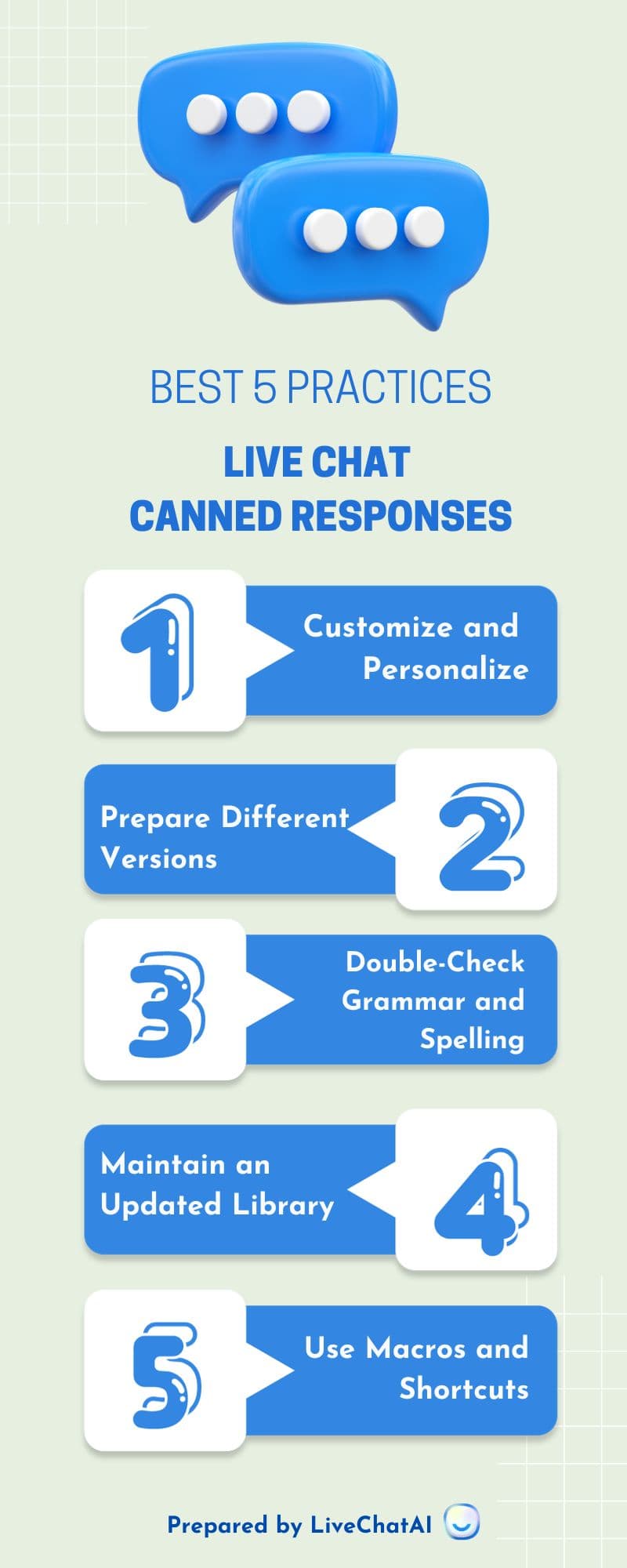
• Reference the specific issue, not "your concern": Saying "I see your order #4523 is stuck in processing" is ten times warmer than "I see you have a concern about your order."
• Mirror their language: If they wrote "the thing is broken," don't reply with "we apologize for the technical malfunction." Use their words back.
• Add one sentence of context: Reference their account age, plan, or last interaction. "I see you've been with us since 2023" lands differently than a cold opener.
• Edit before you send, every time: The rule I enforce on my own teams: every canned response must be touched before it goes out. Even just changing one word forces the agent to read it in context.
• Skip the emoji autopilot: One emoji per conversation, max. Two starts feeling performative.
According to Comm100's live chat statistics, the average wait time across live chat is 22.8 seconds and the average response time is 44.6 seconds. If your canned response goes out faster than the customer can finish typing their question, you've left the personalization step out entirely. Slow down by five seconds and edit it.
Common Mistakes to Avoid With Canned Responses
I've audited enough libraries to spot the patterns that drag down team performance. Watch for these:
• Library bloat: Once you hit 100+ canned responses, agents stop searching and start guessing. Cap your library at the responses your team actually uses weekly.
• Outdated pricing or feature info: A canned response that quotes a price from 2024 will quietly damage your trust score. Review the whole library every quarter.
• Stiff corporate voice: "We sincerely regret any inconvenience this may have caused" is the canned response equivalent of beige paint. Write like a person.
• No empty-state version: When the customer has a question nobody on your team has answered before, your agent shouldn't be reaching for a template. Train them to write from scratch when nothing fits.
• Same script for every channel: The greeting that works on chat sounds wrong on email. Build channel-specific versions.
• Skipping the proofread step: Typos in a canned response live forever, embarrassing your brand on every send. Always proof twice before saving.
• Forgetting variables: [name] sent as-is to a customer is the most common canned response failure I've seen. Build a habit: edit variables, then send.
How to Build Your Canned Response Library (Step by Step)
If you're starting from zero, don't try to write 50 templates this week. Build the library the way your team actually uses it.
1. Mine your existing tickets: Pull the last 90 days of resolved tickets and group them by topic. The 20 most common topics are your starter library — nothing else.
2. Write the first draft as your best agent would: Don't write them in committee. Pick your top-performing agent's actual replies and use those as the template. The voice will be human because it was originally human.
3. Test with a single agent for two weeks: Before you roll out to the team, have one agent use the library exclusively for two weeks. They'll spot the gaps and the awkward phrasing.
4. Add placeholder variables in [square brackets]: Wrap every name, order number, time window, link, and amount in brackets. This is what forces the edit-before-send habit.
5. Categorize ruthlessly: Greetings, billing, technical, escalations — keep your categories under 8. More than that and your agents won't find what they need.
6. Assign shortcuts that make sense: /greet, /refund, /shipping. If the shortcut is a random number or code, agents won't memorize it.
7. Schedule quarterly reviews: Put a recurring calendar invite on your team lead's calendar. Every 90 days, retire what's stale and add what's new.
8. Train new hires on the library before they touch the queue: A canned response library only works if everyone uses the same one. Make library training part of week-one onboarding.
According to Comm100's benchmark report, AI chatbot-to-agent handoffs deliver a 92.6% CSAT score when the handoff includes the conversation context. That's only possible when your canned response library is structured enough for the AI to pattern-match against — yet another reason to build the library cleanly from the start.
If your team is also building chatbot flows, our guide on how to write AI chatbot scripts uses the same principles applied to bot conversations.
Measuring the Impact of Canned Responses on Support Metrics
If you can't measure it, you can't improve it. Here are the metrics I track every quarter when I review a team's canned response library:
| Metric | Target | How Canned Responses Move It |
|---|---|---|
| First Response Time | Under 40 seconds | Pre-written replies cut typing time by up to 80% |
| Average Handle Time | 5-7 minutes | Faster replies lead to shorter conversations |
| CSAT Score | Above 85% | Consistent voice and messaging build trust across agents |
| First Contact Resolution | Above 70% | Standardized information reduces follow-up tickets |
| Agent Tickets per Shift | 40-60 | Less retyping enables agents to handle more conversations |
| QA Pass Rate | Above 90% | Pre-approved language makes quality assurance more consistent |
The benchmarks here aren't aspirational — they're achievable for teams that use canned responses well. According to Lorikeet's first response benchmark, strong live chat teams hit under 40 seconds for first response, while average teams land around 2 minutes. The difference between those two buckets is almost always whether the team has a usable canned response library.
Live chat as a channel still outperforms most digital alternatives. Unthread's CSAT data shows live chat leads digital support channels with an 87% CSAT score — but only when reply times stay under the customer's tolerance threshold. Canned responses are the lever that keeps reply times tight without burning out your agents.
One more benchmark worth knowing. Neuwark's 2026 data found that AI chatbots respond in under 2 seconds compared to 2 minutes 40 seconds for human-led live chat. That's a meaningful gap, and it's why the best support stacks pair AI for first-touch with human agents armed with strong canned response libraries for everything that needs nuance.
FAQs About Live Chat Canned Responses
What are live chat canned response examples?
Live chat canned response examples are pre-written reply templates support agents use for common scenarios — greetings ("Hi [name], how can I help?"), status updates ("Your order [number] is being processed"), apologies ("I owe you an apology — the correct price is [price]"), and closings. The library above covers 49 examples across 10 categories.
Where can I find free live chat canned responses?
The 49 examples in this post are free to copy. You can also find smaller libraries in the documentation of most live chat platforms. Build your own list from your top 20 ticket topics — that's more useful than borrowing 100 generic ones.
What is a script live chat example?
A live chat script is a written template an agent uses for a specific conversation pattern. Example: "Hi [name], thanks for reaching out. To help with [issue], can you share your [account email] and a screenshot of what you're seeing?" Our 200 live chat script examples covers script variations for different industries.
How do I create live chat scripts in PDF format?
Most live chat tools (LiveChat, Intercom, Zendesk) let you export your canned response library as a CSV, which converts to PDF in seconds. Internally, I keep our scripts in a shared doc — PDF is fine for training materials but bad for live editing.
What are good live chat greeting examples?
Good greetings name the agent, acknowledge the customer (use their name if you have it), and ask a clarifying question. "Hi [name], Perihan here — what can I help you sort out today?" works better than "Welcome to our chat, how may I assist you?" See our live chat greeting examples guide for 35 variations.
How do I use live chat canned responses for better support?
Use them as starting points, not finished messages. Every canned response should be edited before sending — even if you just swap the customer's name and one detail from their question. Treat the library as scaffolding, and your agents will sound human while still replying fast.
Ship Your First Canned Response Library This Week
You don't need 100 canned responses to see the lift. You need 20, written in your team's actual voice, organized by the situations your queue throws at you weekly. Start with the 49 examples above, cut the ones that don't fit, rewrite the rest in your brand's tone, and ship the library to your team by Friday.
The teams I've seen succeed all share one habit: they review their canned response library every quarter. Add what's new, retire what's stale, and watch your response time drop. According to Gitnux's live chat benchmarks, the average live chat reply time across industries is 46 seconds. If you're above that and you haven't built a canned response library yet, that's your first move this week.
Once your library is in shape, the next step is plugging it into an AI layer. Our 20 best live chat practices covers what to automate and what to keep human. If you're tracking the reply-time data behind all this, our customer support response time statistics roundup has the full benchmark set.