




A kind review is a small window your happiest customers hold open for you. Close it with silence or a stock "Thanks for your feedback!" and you waste the one moment they were already looking at your brand with affection. This guide gives you 50 positive reviews response examples, a 5-part formula, platform-specific patterns, and an honest take on where AI fits.
A strong positive review response thanks the customer by name, echoes one specific detail they mentioned, reinforces the value they praised, invites a next step, and closes with a real person's sign-off. Do those five things in under 75 words, publish within 24 hours, and you turn a single five-star rating into a retention and SEO asset.
A good positive review reply follows a five-beat structure: Thank → Personalize → Reinforce → Invite → Sign off. Keep it 40-80 words, use the reviewer's name once, reference one concrete detail from their review, and avoid generic phrases like "We appreciate your business."
Why Responding to Positive Reviews is Important?
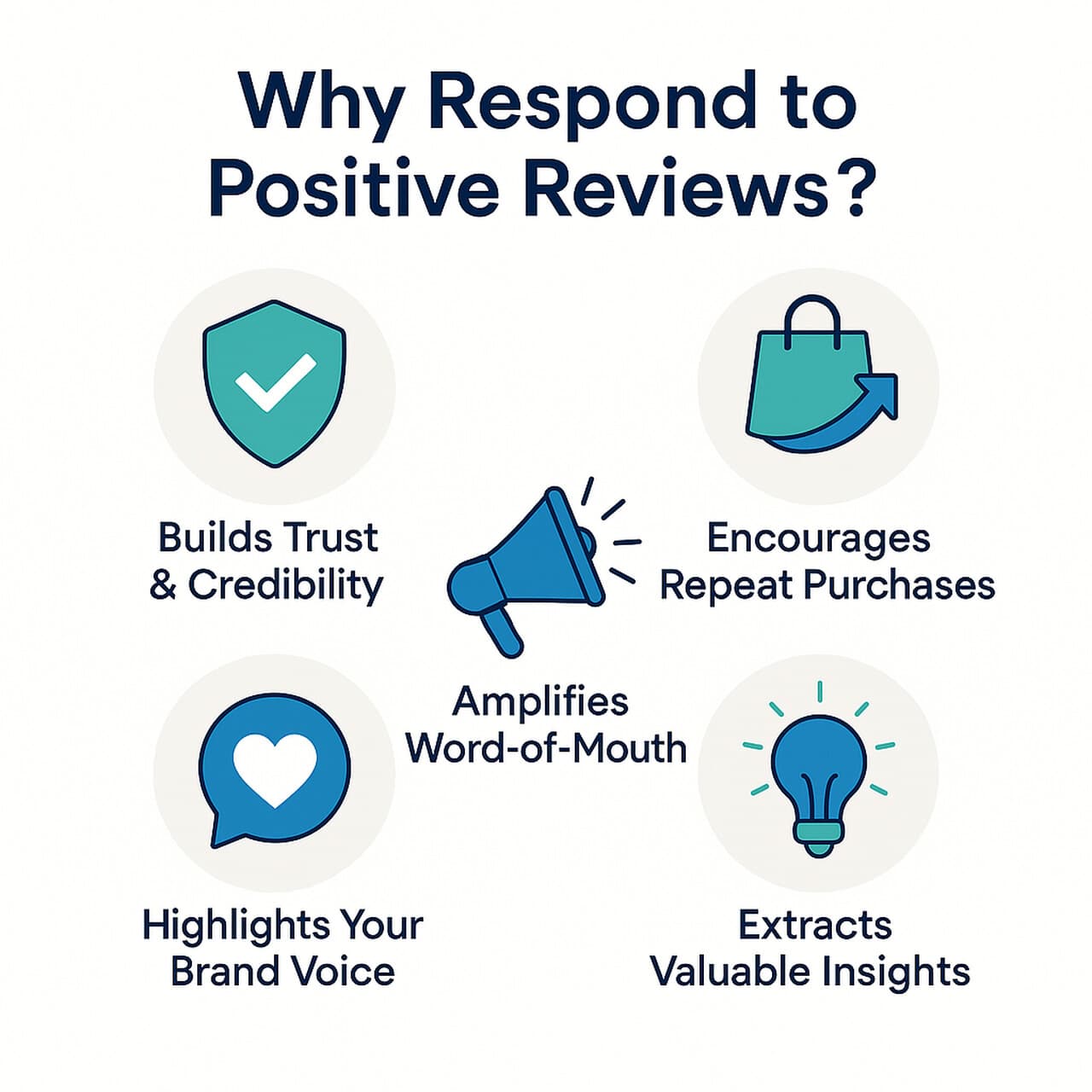
I have spent the last three years watching review behavior drift from "nice-to-have social proof" to "required pre-purchase homework." Buyers do not just skim star counts anymore. They open reviews, read replies, and judge the brand by how it talks back. Ignoring a five-star review in 2026 sends the same signal as never showing up to your own party.
The shift is measurable. According to 1440.io's 2026 reviews report, 41% of consumers now always read reviews when researching a business, up from 29% just one year earlier. The same report shows 68% will only use a business with four or more stars, compared to 55% in 2025. That gap of 13 points in a single year is the steepest year-over-year jump I have seen in local search data.
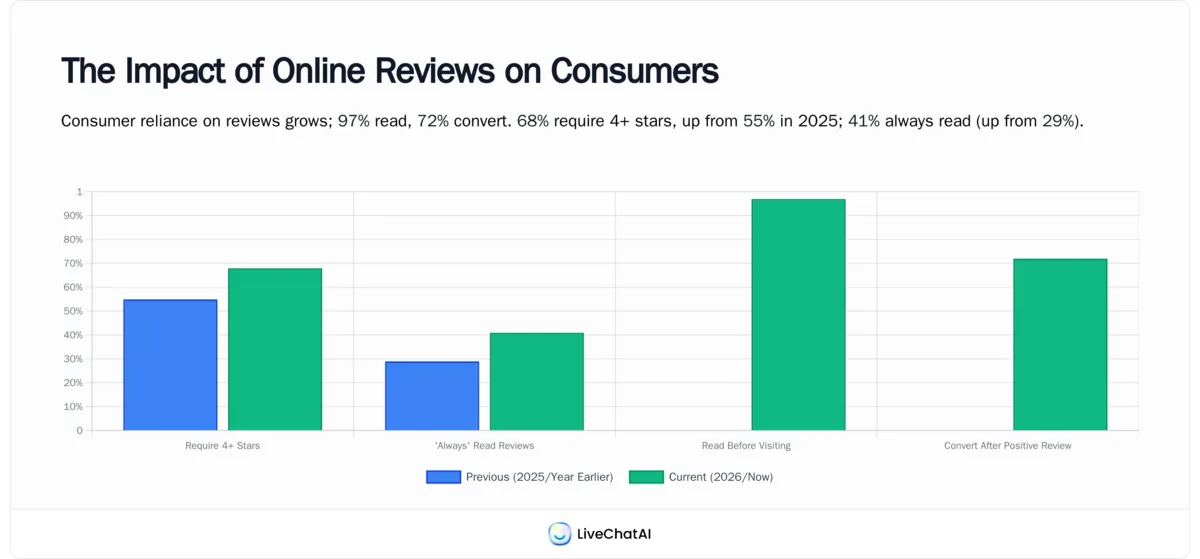
The financial side is just as clear. Per LocaliQ's 2026 review statistics roundup, 72% of consumers will convert to customers only after reading a positive review. Positive reviews do not just warm up a page, they are often the last conversion step before a paid signup or a cart checkout. If you leave that page littered with unanswered reviews, you are handing your conversion asset to competitors who reply under every star.
Reply volume is now a visible trust signal on Google Maps, G2, and Trustpilot. Google's own support docs confirm that replying to reviews improves listing engagement, and I have watched client map packs move a position or two after three months of consistent replies on previously neglected profiles. This is the cheapest retention and local SEO work most brands still skip.
The 5-Principle Formula for Strong Review Responses
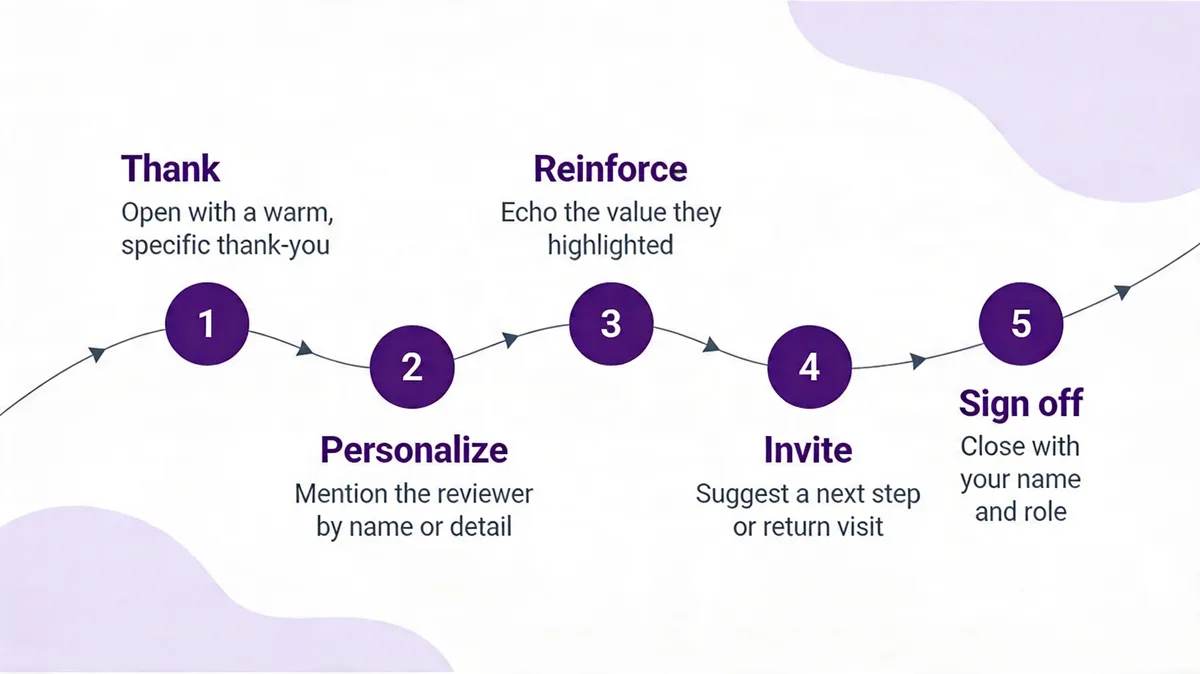
Every strong reply I have studied follows the same five beats. The formula is short enough to memorize and flexible enough to scale across Google Business Profile, G2, Trustpilot, and Capterra. Treat it as a scaffold, not a script — the words should still sound like a human from your team.

1. Thank
Open with real gratitude in the first sentence, not buried in paragraph two. Skip "We appreciate your feedback" — it reads like a form letter. Instead, name the reviewer and thank them for the specific action (leaving the review, sharing detail, sticking with you through a rollout). A good thank-you takes one sentence and uses the word "thank" only once. Overdoing it sounds insincere, which is the opposite of the effect you want.
2. Personalize
Quote or paraphrase one concrete detail from the review itself. If they praised your onboarding flow, mention onboarding. If they mentioned an agent named Mia, name Mia in the reply. This single habit separates a personal response from a template that could be auto-fired at any customer. For this kind of targeted phrasing, our guide on positive scripting in customer service covers the exact language patterns that sound warm without tipping into corporate-speak.
3. Reinforce
After the personal hook, reinforce the positive outcome. If the review praised fast shipping, affirm that reliability is the standard, not the exception. If they loved a feature, confirm the team is investing in it. Reinforcement serves two audiences: the reviewer, who feels validated, and every future reader skimming your review tab, who is mentally collecting proof of what you do consistently well.
4. Invite
Give the reviewer a reason to come back. This can be as soft as "let me know if you try the new export feature" or as direct as "here is the link to our April webinar on the same topic." Invitation is where you turn a reviewer into a returning customer — a point covered thoroughly in our piece on how to build customer trust and loyalty. Keep the ask soft; pushy upsells inside a thank-you reply feel transactional.
5. Sign off
Close with a real first name and title. "— Perihan, Content Marketing, LiveChatAI" sounds like a person. "— The LiveChatAI Team" sounds like an auto-responder. Future readers reading your review tab want to see a human on the other side. Rotate sign-offs across different team members so the reply feed looks like a real team and not one bot wearing different hats.
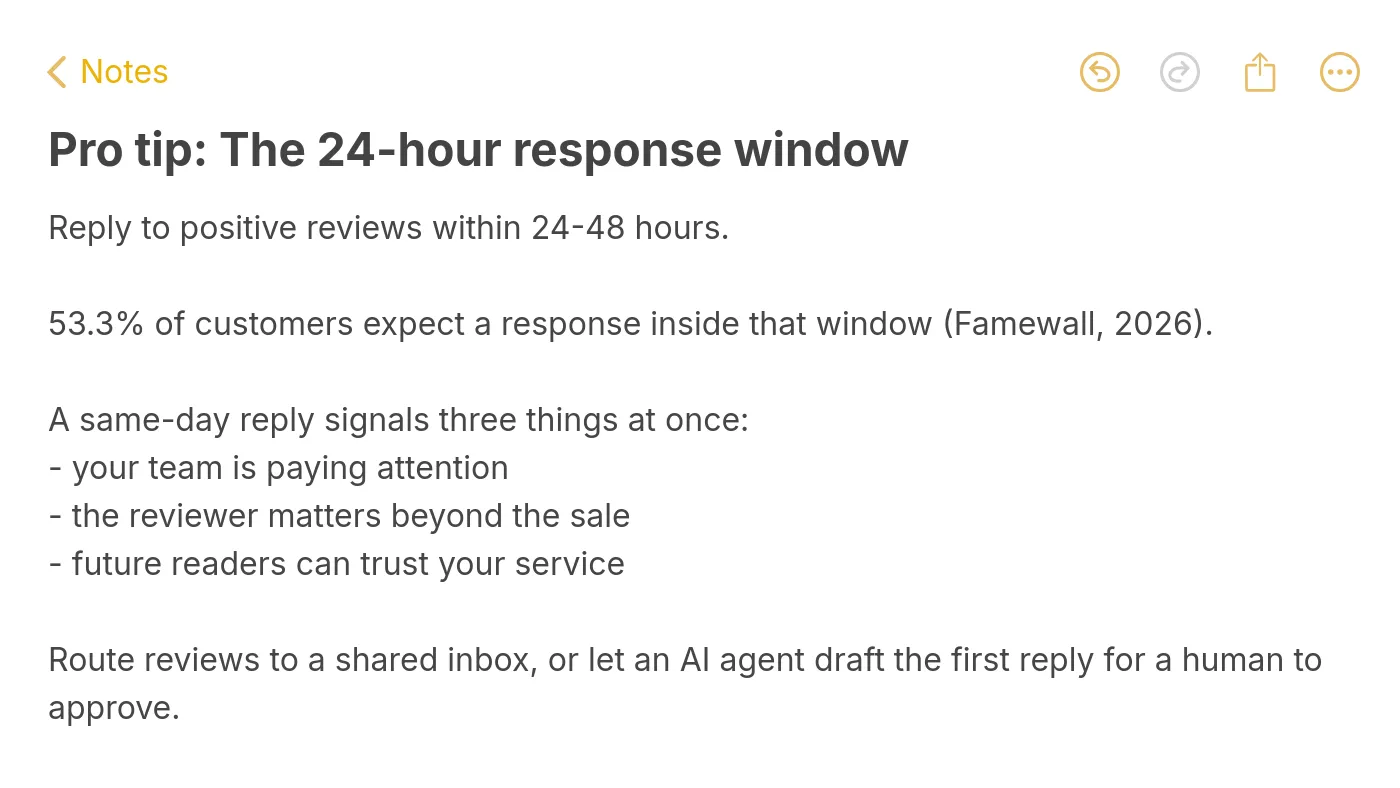
On timing: according to Famewall's review response guide, 53.3% of customers expect a reply within 24-48 hours. I set a Slack alert on every new Google review and aim for under four hours during business days. The extra speed rarely takes more than three minutes per reply, and the impression it leaves on a reader is disproportionate.
50 Positive Review Response Templates
Use these as starting points, not copy-paste scripts. Every template below leaves room for a real customer name and at least one specific detail from the actual review. Pair each with the 5-principle formula above. The six categories map to the most common response scenarios I see on Google Business Profile, G2, Trustpilot, Capterra, and Yelp. For more ready-made phrasing across support channels, our library of 45+ live chat canned response examples pairs naturally with these review templates.
Short and Appreciative (templates 1-8)
Use these when you have high review volume and need fast, warm acknowledgments — Google Business Profile replies for local service businesses, or high-traffic e-commerce stores. Keep them under 50 words. They should read like a genuine quick note, not a corporate thank-you card.
1. "Thank you, [Name] — this really made my Monday. So glad [specific feature] clicked for you. Let me know if you want the walkthrough for the advanced settings. — [Agent, Team]"
2. "[Name], appreciate you taking a minute to write this. Your note about [detail] is exactly what we are trying to get right every time. See you soon. — [Agent]"
3. "Short and sweet: thank you, [Name]. Happy the [product/feature] landed. Ping us anytime — our inbox is always open. — [Agent, Team]"
4. "Reading this on a Tuesday morning made our week, [Name]. Glad [detail] worked out. Let me know if anything else comes up. — [Agent]"
5. "Five stars from you mean a lot, [Name]. We will keep the same energy on the [specific area] you mentioned. Talk soon. — [Agent, Team]"
6. "Thanks for the shout, [Name]. Small reviews like this keep the team going. Reach out anytime you want to dig into [feature]. — [Agent]"
7. "[Name], this one went straight to the team Slack channel. Thank you for the kind words about [detail]. More to come. — [Agent, Team]"
8. "Short reply, huge thanks, [Name]. We will keep showing up the same way on [detail]. See you on your next visit. — [Agent]"
Personalized and Detailed (templates 9-17)
Reach for these when a reviewer wrote two or more paragraphs, mentioned a specific agent by name, or praised a particular workflow. Personalized replies should match the review's depth — a short reply to a long review feels dismissive. Aim for 60-90 words each.
9. "[Name], thank you for laying out your experience in so much detail. The part about [specific agent] spotting the integration issue on call — that is exactly the standard we aim for, and I am passing this note directly to them and their manager. If you ever want to pilot the new [feature], reply to this and I will set you up. — [Agent, Team]"
10. "This review is the kind I screenshot and send to the team, [Name]. Your point about [detail] being the difference between our platform and what you used before is what we want every new customer to feel by month two. Reach out directly next time you spin up a new workspace — happy to help. — [Agent]"
11. "Thank you for taking the time to write such a thorough note, [Name]. You captured exactly what we are trying to build: a [specific outcome] that does not require your team to become specialists. Your feedback on [feature gap] is already on our roadmap and I will ping you when it ships. — [Agent, Team]"
12. "[Name], reading this back — the part where you said [quoted detail] is one of the best pieces of feedback we have had this quarter. I am forwarding it to our [department] lead because it validates a direction we were debating. Thank you for showing up with this level of care. — [Agent]"
13. "Reviews like this remind us why we started, [Name]. You mentioned [specific detail] — and the fact that it saved your team [outcome] is the exact use case we designed around. Looking forward to seeing what you do with the upcoming [feature]. — [Agent, Team]"
14. "I read this one twice, [Name]. Thank you. The line about [detail] made me stop and think — that is a specific framing we had not heard before and it helps us talk to new customers better. Let me know when you want to explore [related feature]. — [Agent]"
15. "[Name], this is the kind of review that reshapes how we introduce ourselves to new users. The angle you took on [detail] — we had not articulated it that cleanly internally. Thank you. If you are open to a short chat for a case study, I would love to set that up. — [Agent, Team]"
16. "Thank you for the write-up, [Name]. Your three points — [detail one], [detail two], and [detail three] — mirror what our power users tell us, but hearing it from a team in [industry/use case] adds weight we cannot generate internally. Always around if you want to trade notes. — [Agent]"
17. "[Name], honestly — this is one of the more generous reviews we have received, and it matters more because you named [specific agent]. I am making sure they see this today. On the [feature idea] you floated at the end: let's talk. Reply to this and I will send over a link. — [Agent, Team]"
Loyalty-Focused (templates 18-25)
Pull from this set when the reviewer is clearly a repeat customer, has mentioned renewing, or signals they have been around for a while. The invitation in these templates should feel like continuity, not a new pitch. Aim for 50-75 words.
18. "Second year with us, [Name] — and a five-star review on top of that. Thank you. The part about [detail] getting better over time is the metric we watch most closely. When your renewal hits, I will personally make sure your account manager has this review open. — [Agent, Team]"
19. "[Name], you have been with us since the early days, and this review is a real gift. Your team's willingness to try [feature] before it was polished helped us ship it right. I will make sure the [department] team sees this. See you on the next release call. — [Agent]"
20. "Three years in, [Name], and you are still taking time to write this — thank you. Your point about [detail] aging well is the best compliment we can get for a product. Let me know when you want to try the new [feature] — I will grandfather you into the beta. — [Agent, Team]"
21. "Long-time customer, long-overdue thank you, [Name]. Your review of [detail] is now part of how we onboard new accounts. If you ever want a direct line to the roadmap team, reply to this — that door stays open for customers like you. — [Agent]"
22. "[Name], I remember your first ticket in 2023 — we have come a long way together. Thank you for the kind words about [detail]. Your account lead will follow up this week about a few upcoming changes you will want to see early. — [Agent, Team]"
23. "A renewal and a five-star review in the same week, [Name] — you spoiled us. Thank you. Your note on [detail] being the reason you stuck around is a compass for our roadmap. We will keep earning it. — [Agent]"
24. "[Name], loyal customers like you are the reason we can keep building. Your shout-out to [specific agent] has been shared with the team. When our [upcoming feature] launches next quarter, I will make sure you get an early invite. — [Agent, Team]"
25. "Every renewal is a vote of confidence, [Name]. Your review went further by actually naming [detail] — and that matters. Reply here when you are ready to expand seats or try [related product]; I will handle it personally. — [Agent]"
Product or Service Specific (templates 26-34)
Use these when the review highlights one feature, touchpoint, or workflow so clearly that a generic reply would waste the signal. Your reply should mirror the specificity of the review. Aim for 60-85 words.
26. "[Name], the fact that you called out [specific feature] by name tells me the team nailed the launch. Thank you. We built that feature after six months of beta feedback, so reviews like yours are the payoff. If you hit a use case we did not plan for, reply here and I will route it to product. — [Agent, Team]"
27. "Thank you for the review, [Name]. Your note about our [specific feature] saving your team [outcome] is the kind of proof we use when new prospects ask if it actually works. Mind if we quote you — with credit — on our case study page? — [Agent]"
28. "[Name], you picked the exact feature we obsess over: [specific feature]. Thank you for the detail on [how you use it]. Your workflow is one I want to share with the team — it is a better version than the one we show in demos. — [Agent, Team]"
29. "When a review calls out [specific touchpoint], it means the whole chain worked that day — [Name], thank you. Our team cares deeply about getting that flow right, and your feedback is now taped to our quarterly review wall. Ping me the next time you test a new workflow. — [Agent]"
30. "[Name], your review is a reminder that [specific feature] is worth the engineering investment. Thank you. The improvement you mentioned in [metric] is similar to what other teams are seeing, and we are committed to protecting that curve. — [Agent, Team]"
31. "Our [specific service] team is going to love this one, [Name]. Thank you for naming them. Your feedback on [detail] confirms we staffed the right people on your account. If you want to take on [adjacent challenge] next, I can loop them back in. — [Agent]"
32. "[Name], you are one of the first customers to publicly write about [new feature] — thank you. Reviews like this shape our launch narrative more than any marketing page. I owe you a coffee. Reply and I will send a gift card. — [Agent, Team]"
33. "Thank you for calling out [specific workflow], [Name]. That was a thorny one to get right, and hearing it land with a real customer makes the late nights worth it. Your suggestion for [improvement] is on the team's list for the next sprint. — [Agent]"
34. "[Name], the detail you shared about [feature performance in real conditions] is exactly the kind of field data we cannot generate in-house. Thank you. If you ever want to join our monthly product feedback call, I will hold a seat for you. — [Agent, Team]"
Small Business and Local (templates 35-42)
These work for cafes, salons, clinics, local service providers, and any brand with a neighborhood feel. Warmth matters more than polish. First-name signatures and references to the local context are the easy wins. Aim for 45-70 words.
35. "[Name], thank you — this made our whole team smile on a slow Tuesday. We love that you pointed out [specific detail]; that is exactly the vibe we try to keep every shift. See you soon on your next visit. — [Agent]"
36. "Regulars like you are what keep a small business going, [Name]. Thank you for writing this. We will pass your shout-out to [staff name] — it will make their week. Coffee's on us next time you stop by. — [Agent, Team]"
37. "[Name], from everyone at the shop — thank you. Your review of [detail] reminded us why we started this place. Tell [friend/spouse] we said hi, and bring them by on your next visit. — [Agent]"
38. "We read every review out loud at our Monday huddle, [Name] — yours got a round of applause. Thank you for mentioning [staff or detail]. Our door is always open for you. — [Agent, Team]"
39. "[Name], the fact that you drove across town for our [service] means more than a five-star rating. Thank you. Next time, ask for [staff name] and we will make sure your [service] runs on the house. — [Agent]"
40. "Small business, big thank you, [Name]. Your note about [detail] is the reason we keep choosing the harder, slower way of doing things. See you on your next visit. — [Agent, Team]"
41. "[Name], thank you for choosing a local spot instead of a chain — and for taking the time to write about it. We are saving your note on the fridge. Bring a friend next time and the first round is ours. — [Agent]"
42. "From a family-run team to a neighbor — thank you, [Name]. Your review of [detail] is going in our scrapbook. Come by on [event day], we have something special planned. — [Agent, Team]"
Formal and B2B SaaS (templates 43-50)
Use these for G2, Capterra, TrustRadius, and enterprise-focused contexts. The tone should be professional without becoming stiff. Reference ROI, team outcomes, or measurable results when the reviewer does. Aim for 60-85 words.
43. "[Name], thank you for the detailed review. Your team's ability to cut [metric] by [result] using our platform is exactly the kind of outcome we benchmark against. I am sharing your note with our product and customer success leads. If you are open to a brief conversation about a case study, I will have our CS team reach out. — [Agent, Title]"
44. "We appreciate the thoughtful write-up, [Name]. Your point about [specific capability] fitting into your existing [tool stack] validates a design decision we made early on. Your account team will follow up this week with a short roadmap preview relevant to your use case. — [Agent, Customer Success]"
45. "[Name], thank you for taking the time to document your rollout in this detail. The section on [deployment challenge] is particularly helpful — we are adding that insight to our onboarding playbook. Please reach out to [Account Manager] directly for early access to the [feature] you referenced. — [Agent, Title]"
46. "Your review carries real weight for prospects evaluating the category, [Name] — thank you. The specificity you brought to [feature or outcome] is the kind of context buyers need. If you would consider a short customer spotlight, I am at [contact method]. — [Agent, Head of Content]"
47. "[Name], on behalf of the product and engineering teams, thank you. Your feedback on [specific capability] performing under [workload] is a measurable endorsement of the last two releases. We are committed to maintaining that performance as your volume scales. — [Agent, Title]"
48. "Thank you for the candid review, [Name]. We take your point on [minor gap] seriously; our [team] is actively scoping a fix for the next release cycle. Your CSM will share a preview as soon as it clears QA. Appreciate the partnership. — [Agent, VP Customer Success]"
49. "[Name], your review is a strong signal to the market and an even stronger one to our roadmap. Thank you. The measurable outcome you shared — [metric] — is in line with the benchmarks we publish and helps us validate them externally. We would be grateful to feature this in a case study if you are open. — [Agent, Title]"
50. "Your team's implementation of [specific workflow] has been one of the most sophisticated we have seen this quarter, [Name] — thank you for sharing it publicly. We would like to invite you to our annual customer advisory panel in Q3. Your account lead will follow up with details. — [Agent, Title]"
Platform-Specific Response Patterns
A reply that works on Google can fall flat on G2, and a G2 reply reads as stiff on a Yelp listing. The platform shapes the tone, length, and link strategy. Here is what I adjust for each.
Google Business Profile
Google reviews are the most SEO-valuable reply you will write. Your text gets indexed, shows in the map pack, and influences local rankings. Use the primary service or product phrase once in the reply — but only where it reads naturally. Keep replies to 50-90 words, use the reviewer's first name, and sign off with a real team member. I also recommend adding the city or neighborhood once for small businesses — Google's local algorithm rewards topical-plus-geographic relevance. Our guide on 15 chat etiquette rules covers tone principles that transfer one-for-one to Google replies.
Yelp
Yelp's community has a stronger allergy to corporate-sounding replies than any other major platform. Long, formal responses actively hurt you here — the community reads them as PR speak. Keep replies under 60 words, use informal language ("so glad you came by" works better than "we are delighted you chose us"), and never drop a CTA or link. If the review names a server or technician, name them back. Yelp allows public replies and direct messages — a direct message for anything requiring coordination, public reply for pure thanks.
G2, Capterra, and TrustRadius
These are B2B decision platforms where the reader is often mid-evaluation. Replies should be 70-120 words, use a real title in the sign-off ("— Sarah, Head of Customer Success"), and reference measurable outcomes when the reviewer does. Do not link to pricing or signup pages — it reads as opportunistic. Do offer a direct point of contact (email or LinkedIn) for follow-up conversations. G2 specifically displays the vendor response prominently, so well-written replies here quietly sway every prospect reading the profile during a buying cycle.
The Role of AI in Automating Review Responses
Manual review responses break at scale. Once you are handling more than 30 reviews per month across multiple platforms, the quality curve drops and replies get copy-pasted. That is where AI earns its place — not as a replacement for human judgment, but as a draft engine that cuts reply time from seven minutes to ninety seconds.
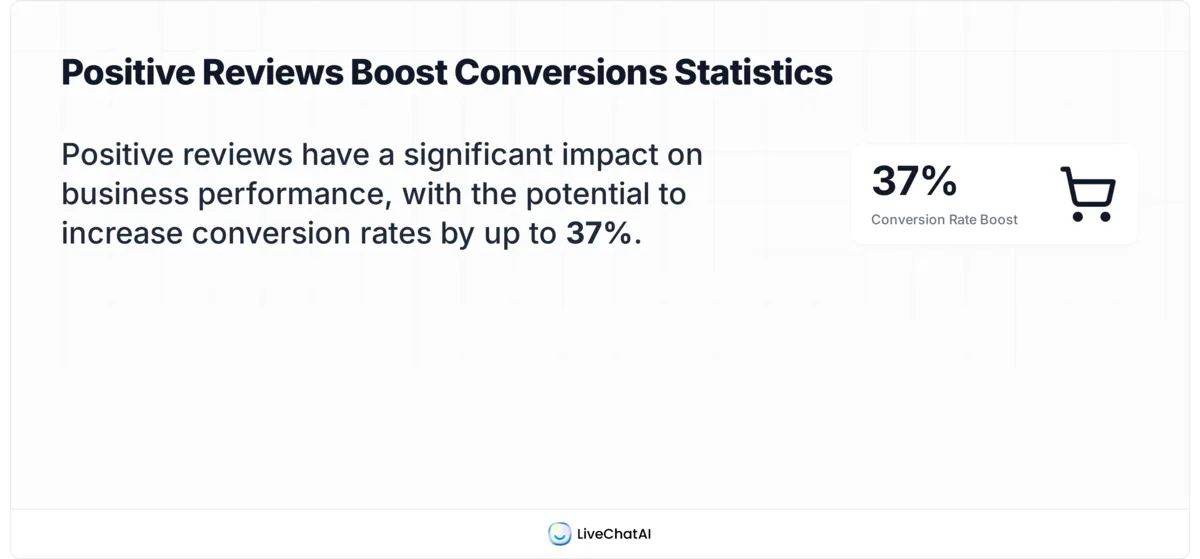
Where AI works well: detecting sentiment, flagging reviews that need urgent human attention, pulling the specific detail from a long review so the writer does not have to re-read it, and generating a first draft that follows the 5-principle formula. Per ReputeUp's 2026 review statistics, positive online reviews lift conversion rates by up to 37% — making the ROI of even a moderately-automated reply workflow significant. Combine that with the broader context from ClearlyRated's 2026 CX report, which shows 89% of businesses now compete on customer experience, and review responsiveness becomes one of the few low-cost CX levers left.
Where AI fails: sensitive reviews (a glowing review that ends with a health-related detail, for example), reviews that name specific employees by name in a way that requires HR discretion, and anything that needs first-party voice. Ungoverned AI also has a tell — it over-uses the word "delighted," starts too many replies with "We," and stacks three compliments where a real person would pick one.
The pattern I recommend: use an AI layer like LiveChatAI trained on your past human-written review replies and your brand voice, have it generate drafts, and gate every reply behind a 30-second human review. Our walk-through on streamlining feedback collection with AI chatbots covers the upstream side — capturing feedback at the moment it is freshest — which is where most review-worthy moments start.
Mistakes to Avoid in Positive Reviews Responses
Copy-pasting the same reply across reviews. Readers browse your review feed in sequence. Five identical "Thanks for your feedback!" replies in a row tell every prospect that no real person is reading reviews. Rotate openings, vary sentence length, and always personalize one specific detail. If you cannot personalize, do not reply at all — silence beats obvious templating.
Replying with a generic "Thanks for your feedback!" and nothing else. This wastes the one moment a customer was paying attention. A five-star reviewer gave you 30 seconds of attention. Use it. Reinforce the outcome, invite a next action, and sign off like a human. Our post on writing an apology letter to a customer covers similar voice principles for harder conversations.
Letting AI ship replies without a human review. Unreviewed AI replies accidentally repeat phrases, use names inconsistently, or sign off with a default that does not match your brand. The fix is a 30-second gate: every AI-drafted reply should pass a real pair of eyes before publishing. This is non-negotiable for B2B and regulated industries.
Ignoring reviews older than a week. Google shows review age publicly. A three-month-old five-star review with no reply tells prospects your team is either overwhelmed or indifferent. Batch-reply to anything older than a week with a slightly softer opening ("Catching up on reviews today — thank you for this one, [Name]"), and set a standing weekly calendar block for review maintenance.
Over-promising in replies. "We will roll that out next quarter!" reads great in the moment and terrible six months later when the feature still is not live. Keep promises vague-but-sincere: "It is on our list and I will make sure the team sees your note." Future prospects who revisit the review will not find a broken commitment.
How to Measure Response Impact
Most teams treat review replies as a qualitative exercise, then wonder why their leadership does not fund it. The fix is to measure five simple things on a monthly rhythm and share the numbers with the team that owns retention.
Response rate. Percentage of reviews replied to within 48 hours. Target 100% for G2 and Google, 90%+ for Yelp, Trustpilot, and Capterra. Anything under 80% is visible on the profile and hurts perceived responsiveness.
Time-to-respond. Median hours from review publish to reply. Aim for under 24 hours on business days. According to Capital One Shopping's 2026 online reviews data, consumers read an average of 10 reviews before trusting a business — your reply cadence is part of what they are evaluating.
Reviewer re-engagement rate. Percentage of reviewers who later return (repurchase, book another visit, expand their seat count). Track it quarterly. Brands that reply consistently see a measurable lift here, though attribution is noisy and you need at least six months of data.
Star-rating trend. Monthly average rating, trended over 12 months. Reply quality correlates with reply-rate-weighted rating — meaning platforms reward active profiles. Watch the delta, not the absolute number.
Conversion lift for pages with review replies. For e-commerce and SaaS, pages displaying reviews with vendor replies typically convert 5-15% higher than pages with unreplied reviews in my experience. Use Google Optimize or any A/B framework to confirm for your own property, then use the number to defend the review-reply time budget.
Where to Go From Here
If I had to pick three actions to start with this week, they would be these. First, audit your last 90 days of reviews across every platform and set a single rule: every five-star review gets a personal reply within 48 hours, no exceptions. Most teams skip 20-40% of their five-star reviews — just closing that gap is a measurable win. Second, pick one platform where you have the most reviews (usually Google) and rewrite your five oldest unanswered replies using the 5-principle formula. This signals to the platform and prospects that someone is home. Third, if your review volume is already over 30 per month, pilot an AI draft layer with a strict human-review gate. You will cut your reply time by 70% without losing the human voice.
Frequently Asked Questions
What is an example of a good response to a positive review?
A strong response to a positive review follows a five-beat formula: thank the reviewer by name, personalize with one concrete detail from their review, reinforce the positive outcome they experienced, invite them back with a soft next step, and sign off with a real person's name and title. Example: "Thank you, Sarah — this made our week. So glad the onboarding walkthrough clicked for your team. Reach out when you are ready to pilot the export feature — I will set you up personally. — Perihan, Content Marketing, LiveChatAI." Keep it 40-80 words, and publish within 24 hours of the review going live.
How can AI help in responding to positive reviews?
AI helps most with the time-consuming middle of review replies: reading the review carefully, extracting the one specific detail to personalize on, and generating a first draft that follows your brand's voice and the 5-principle formula. It should not ship replies unsupervised — unreviewed AI replies tend to repeat phrases, misname features, or sign off with a generic team signature. The pattern I recommend is a layered workflow: AI drafts, a human spends 30 seconds editing, then the reply publishes. At scale (30+ reviews per month), this cuts reply time by roughly 70% while keeping the voice human. Tools like LiveChatAI can be trained on your past review replies to mirror your existing voice rather than a generic default.
For further reading, you might be interested in the following:
• Positive Scripting in Customer Service: Techniques and Examples
• Streamlining Your Feedback Collection with AI Chatbots
• 45+ Live Chat Canned Response Examples for Customer Support