

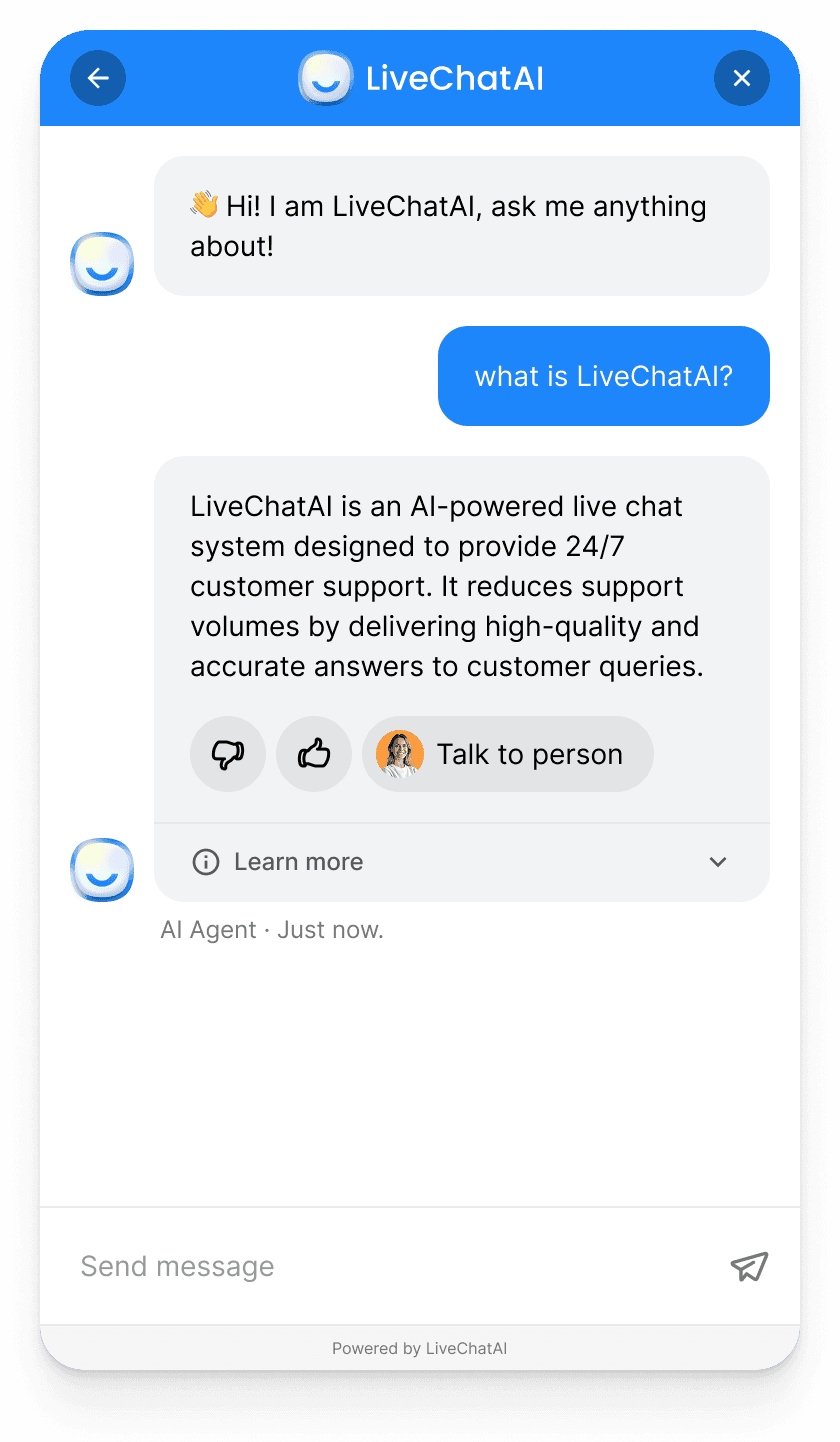




Shopify product recommendation apps use AI and behavioral data to surface the right products on product pages, carts, chat widgets, and emails. The strongest 2026 picks are LiveChatAI for conversational discovery, LimeSpot for personalization at scale, and Frequently Bought Together for Amazon-style bundle upsells. Pick based on your catalog size and where shoppers stall.
What Are Shopify Product Recommendation Apps?
A Shopify product recommendation app is a third-party tool that decides which products to show a specific shopper, in a specific spot, at a specific moment. Older apps did this with static rules ("if customer views shirt, show belt"). Newer apps use machine learning to read live behavior — clicks, dwell time, cart actions, past orders — and adjust suggestions in real time. The output shows up as "You may also like" carousels on product pages, frequently-bought-together bundles in the cart, personalized blocks on the homepage, suggestions inside chat widgets, and follow-up product picks in email or SMS.
The category matters more in 2026 than it did three years ago because shoppers expect personalization as a baseline. According to Maropost's analysis of McKinsey research, 71% of consumers want a personalized experience and 76% get frustrated when it doesn't happen. That frustration shows up in your bounce rate, your cart abandonment, and the dead time between sessions. The right recommendation app closes those gaps without forcing a merchandiser to tag products by hand every week.
If you're new to AI-driven discovery and want a primer on how conversational systems handle the same problem, our guide on retail chatbots and best practices covers the mechanics shared across recommendation engines and chat agents.
Where the Recommendations Show Up
Modern apps place suggestions across the full shopping journey rather than a single carousel slot:
• Homepage: Trending picks, "Just for you" blocks, and category teasers for returning shoppers
• Collection pages: Reordering grid results by predicted relevance for the visitor
• Product detail pages (PDP): "Frequently bought together," "Customers also viewed," and complementary item suggestions
• Cart drawer and checkout: Last-mile upsells and bundle prompts before payment
• Chat widgets: Conversational AI agents that recommend mid-conversation, similar to a Shopify chatbot built for product recommendations
• Post-purchase pages: Thank-you screens with "Complete the set" offers
• Email and SMS: Browse-abandonment reminders and replenishment nudges
Why AI-Powered Recommendations Outperform Rule-Based Ones in 2026
Rule-based apps still exist — and they still work for very small catalogs with predictable pairings. But once you cross roughly 50 SKUs or run more than one customer segment, manual rules turn into a maintenance burden that almost nobody keeps up with. AI apps replace that work with continuous learning. They watch what shoppers click, buy, and ignore, then update their suggestions overnight or in real time.
The performance gap is wide but uneven. Recommendation widgets only get clicked by a minority of shoppers — yet that minority is exceptionally valuable. According to Clerk.io's review of Salesforce Shopping data, only 7% of shoppers click a product recommendation, but those shoppers generate 26% of e-commerce revenue and 24% of orders. The implication is clear: even small lifts in recommendation accuracy compound into outsized revenue, because you're optimizing the highest-intent slice of your traffic.
The shift toward AI is also being driven by shoppers themselves. According to Akeneo's 2026 e-commerce trends report, 49% of Americans say AI recommendations already influence what they buy, and 64% say they're willing to use AI to find products. That trust threshold is what makes 2026 different — merchants who held off on AI personalization through 2024 are now meeting customers who expect it.
Here's how the two approaches break down in practice:
| Capability | Rule-Based Apps | AI-Powered Apps |
|---|---|---|
| Relevance signal | Static rules set by merchant | Live behavior + purchase history |
| Maintenance effort | Manual rule updates weekly | Automatic retraining |
| Catalog scaling | Breaks down past 100 SKUs | Scales to 100,000+ SKUs |
| Segmentation | One-size-fits-all per rule | Per-visitor, per-session |
| A/B testing | Rare or manual | Built-in on most platforms |
| Best fit | Niche stores with under 50 SKUs | Stores with 50+ SKUs or growth ambition |
If you're weighing how chat-based discovery factors into AI-driven sales overall, our breakdown of how AI chatbots can increase sales covers the 16 mechanisms that overlap with recommendation engines.
How These Apps Were Selected and Reviewed
The 10 apps on this list weren't picked from a sponsored slot or an affiliate ranking. They were selected by reviewing the Shopify App Store for current installs, install counts, and review velocity, then narrowing the field using five criteria that determine whether a recommendation app earns its monthly fee or quietly drags on store performance. Vendor documentation, App Store reviews, and third-party benchmarks informed every entry — none of the claims below come from a personal A/B test in a single merchant's store, and we don't pretend otherwise.
Industry projections back the urgency of getting this choice right. According to Envive's research on recommendation accuracy, AI-driven recommendations are projected to boost e-commerce sales by 59% as accuracy and adoption increase. That projected lift is concentrated in stores that pair the right algorithm with the right placement — which makes app selection a higher-impact decision than it looks.
The Five Evaluation Criteria
• Ease of setup: How fast can a non-developer install the app and see live recommendations in their theme? Apps that demand custom Liquid edits or week-long onboarding lost points.
• AI recommendation quality: Does the app actually learn from shopper behavior, or does it rebrand basic rule logic as "AI"? Vendor documentation and reviewer quotes about relevance were weighted heavily.
• Design and integration: Does it match Shopify themes without breaking layouts? Does it load asynchronously so it doesn't slow down PDPs? Theme-compatibility complaints in reviews are a red flag.
• Analytics and ROI visibility: Can a merchant see attributed revenue, click-through rate, and AOV lift in a dashboard — or do they have to trust the vendor's word? Apps that hide attribution dropped in the ranking.
• Support and developer friendliness: Response times, named-by-reviewer support reps, and the availability of APIs or headless support for stores that want to go beyond standard widgets.
How Reviews Were Aggregated
For each app, App Store reviews were sampled across the most recent 12 months to capture current sentiment, not legacy 2022 reviews. Common praise patterns (fast support, easy setup, instant AOV lift) and recurring complaints (pricing surprises, slow widgets, limited customization) were noted. Where vendors publish case studies, those numbers are cited as vendor claims rather than independent measurements — a distinction that matters for trust.
Top 10 Shopify Product Recommendation Apps at a Glance
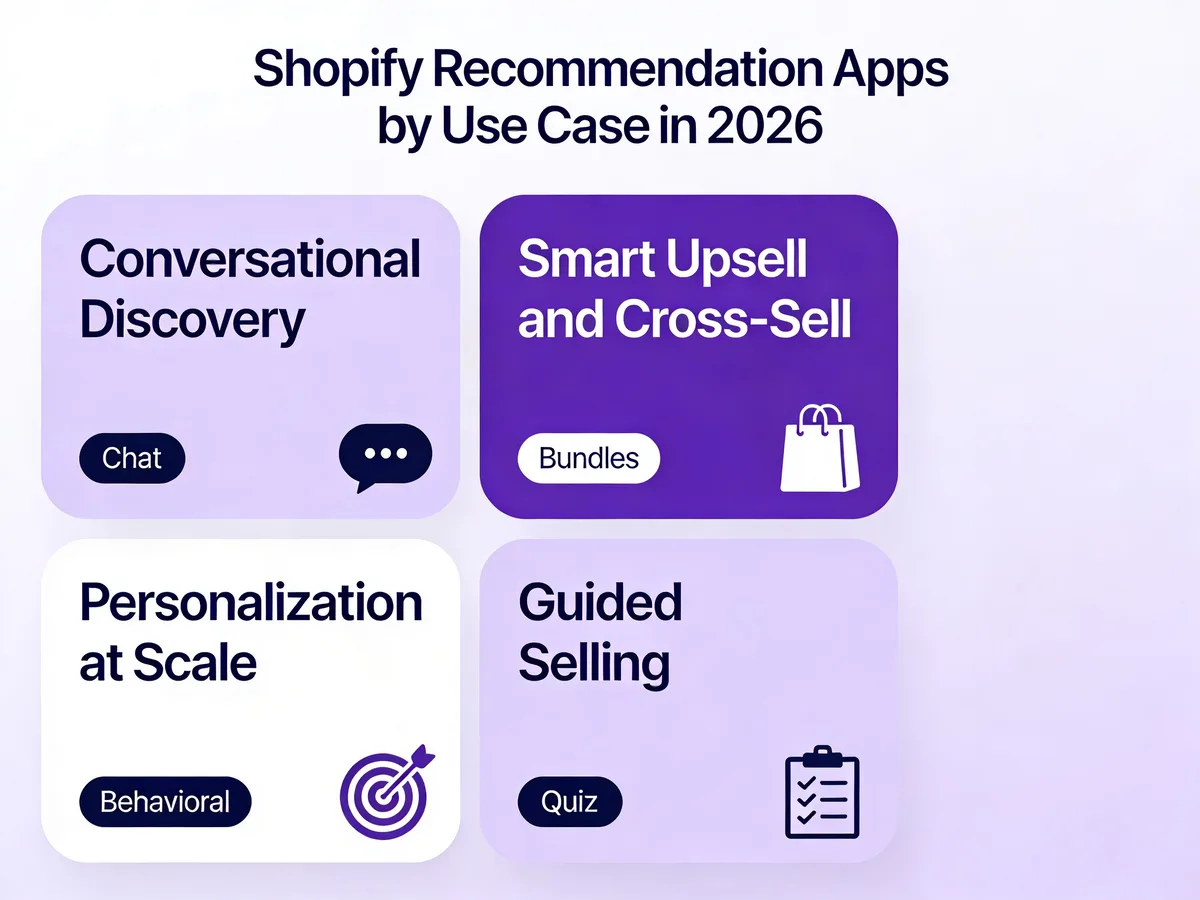
Before the detailed reviews, here's a fast read of all 10 apps grouped by what they're best at. Use this as a decision shortcut: the right pick depends more on your bottleneck than on raw feature counts.
• LiveChatAI — Conversational AI agent with native Shopify integration. Best for stores that want recommendations to happen inside a chat conversation, not just a carousel.
• Frequently Bought Together (Code Black Belt) — Amazon-style bundle widgets on product pages. Best for fast AOV wins on stores with naturally pairable inventory.
• LimeSpot Personalizer — Behavioral personalization across homepage, PDP, cart, and email. Best for omnichannel stores that already use Klaviyo.
• Also Bought (Code Black Belt) — Pure collaborative filtering for cross-sell suggestions. Best for "set it and forget it" stores that want lightweight cross-sells.
• Wiser - Personalize Upsell — Funnel-wide upsell widgets plus a quiz add-on. Best for stores that want one dashboard covering homepage through post-purchase.
• GLO Related Products — Rule-based with smart targeting and full layout control. Best for design-driven stores that want manual oversight.
• RevenueHunt (Product Recommendation Quiz) — Quiz-driven product matching with email capture. Best for catalogs where shoppers need help deciding — beauty, supplements, gifting.
• Glood Product Recommendations — Hybrid AI plus 12+ widget types with a visual editor. Best for stores that want design freedom alongside automation.
• Dialogue AI — AI recommendations with native A/B/n testing baked in. Best for CRO-focused teams that want continuous optimization.
• Obviyo — Real-time predictive personalization built for Shopify Plus. Best for high-volume stores that want enterprise logic without an enterprise contract.
10 Best AI-Driven Shopify Product Recommendation Apps for 2026
The deep dives below follow the same structure for each app: positioning, screenshot, AI functionality, pricing, what reviews say, and best fit. Pricing reflects published 2026 plans where available — confirm current rates on the listing before subscribing, since Shopify apps update tiers frequently.
1. LiveChatAI
LiveChatAI is a conversational AI agent that turns product discovery into a back-and-forth chat rather than a passive widget. Shoppers ask questions in natural language ("show me running shoes under $120 with arch support"), and the agent pulls from your live Shopify catalog to recommend specific products, check stock, and add items to cart inside the conversation.
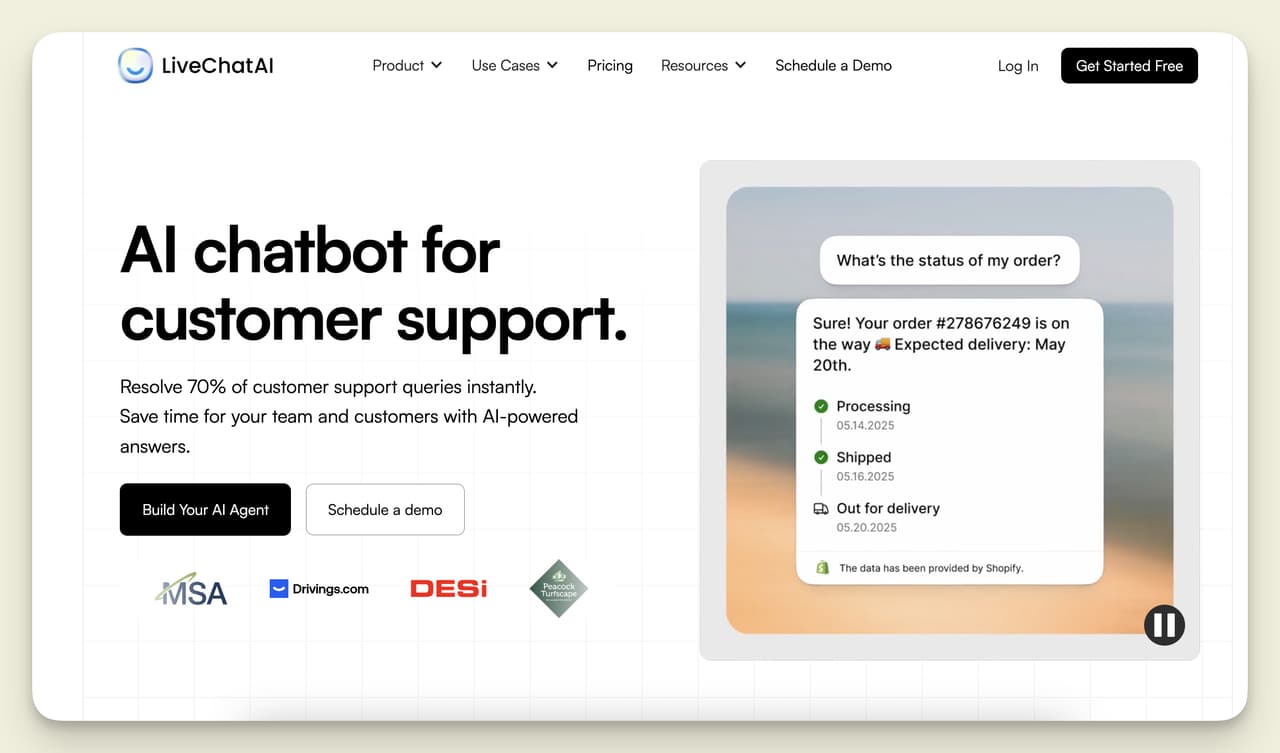
The platform's Shopify integration uses an MCP (Model Context Protocol) connection to read live product data, inventory levels, and pricing — which means the agent never recommends an out-of-stock item or quotes a stale price. Setup runs through a no-code installer that documentation describes as a 5-minute process: connect the store, train the agent on existing content, and embed the widget.
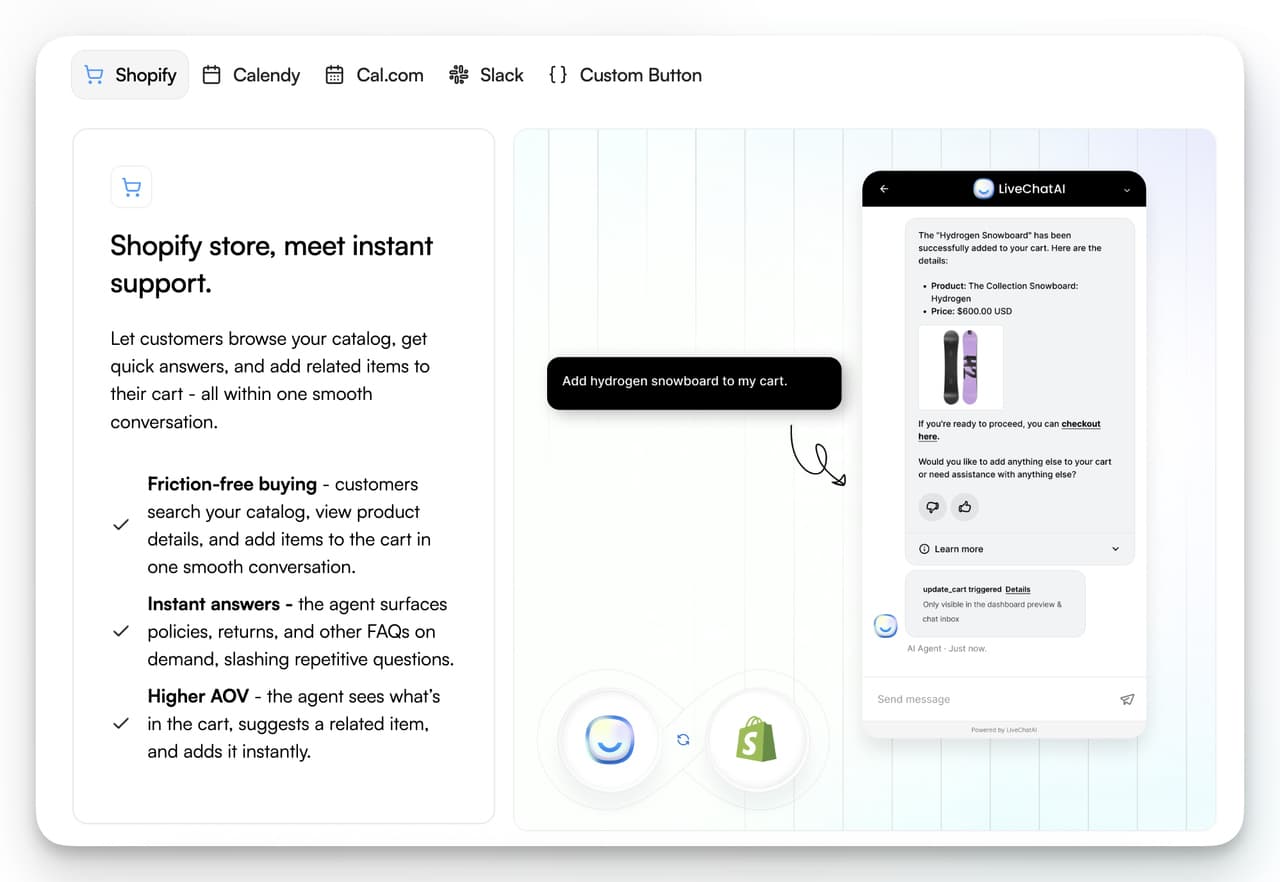
AI functionality: GPT-4o powered conversational agent with retrieval-augmented generation grounded in your store's product catalog, support docs, and policies. Handles 95+ languages without per-language configuration. Conversational memory carries context across multi-turn exchanges. According to Insider One's research on AI-driven personalization, AI-driven shopping experiences drive on average 44% of repeat purchases worldwide — a pattern that conversational discovery amplifies because the agent remembers preferences across sessions.
The agent escalates to a human teammate when confidence drops below a threshold, which matters for high-AOV transactions where shoppers want reassurance. For stores already running tools like ecommerce live chat, LiveChatAI replaces the manual response loop with an agent that recommends products automatically and hands off only when needed.
💰 Pricing: Free plan available for small stores. Paid plans start at approximately $29/month with usage-based tiers above that for higher conversation volumes and additional seats.
💬 What reviews say: Merchants consistently highlight the speed of setup and the agent's ability to deflect repetitive support questions while creating upsell openings. The multilingual support is called out as a differentiator for stores selling across borders. Common feature requests focus on deeper analytics dashboards and more native integrations beyond Shopify.
📦 Best for: Shopify merchants who want product recommendations to happen inside a conversation, plus stores that need AI support and AI recommendations in one tool rather than stitched together from two vendors. For deeper context on what conversational commerce looks like in practice, our gallery of 21 chatbot examples for 2026 shows real implementations across e-commerce and B2B.
2. Frequently Bought Together (Code Black Belt)
Frequently Bought Together is the longest-running, highest-rated Amazon-style bundling app on the Shopify App Store. It analyzes your store's order history to identify which products genuinely sell together, then displays those bundles directly on product pages with one-click "add bundle to cart" buttons.
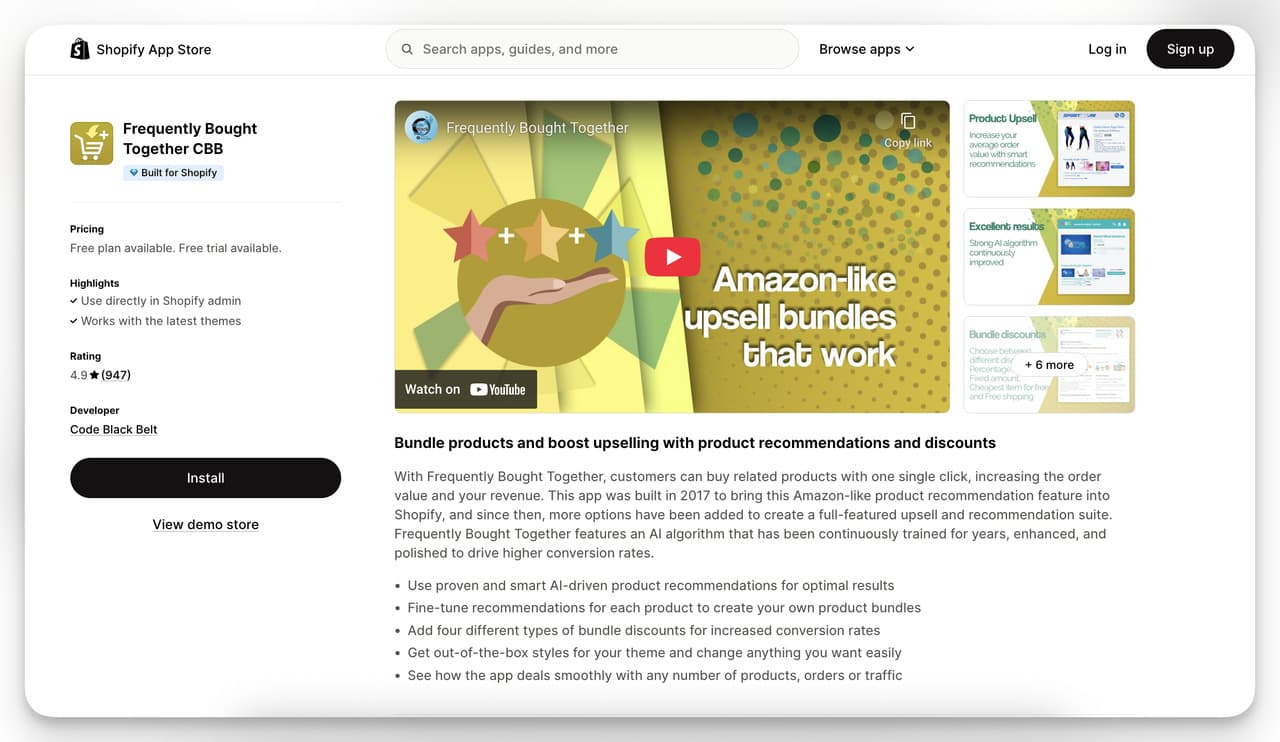
AI functionality: Market-basket analysis trained on the store's transactional data. The model learns from real orders rather than browse behavior, which makes it especially effective for stores with high purchase frequency where the order history alone reveals strong pairings. Merchants can override AI suggestions with manual bundles when they want to push specific combinations — important during seasonal campaigns or new product launches.
💰 Pricing: Starts at $9.99/month with a free 30-day trial. Pricing is flat, not usage-based, which is unusually merchant-friendly compared to apps that meter widget impressions.
💬 What reviews say: With around 5,000 reviews and a sustained 4.9-star average, this is the closest thing to a default install in the Shopify upsell category. Reviewers describe the "just works" experience: install, accept defaults, and see lift inside the first week. Support from Code Black Belt is repeatedly singled out by name in reviews, especially for theme customization help.
📦 Best for: Stores with naturally pairable catalogs (electronics, beauty kits, fashion sets, home goods) that want the fastest possible path to higher AOV without a multi-week implementation.
3. LimeSpot Personalizer
LimeSpot Personalizer is one of the older personalization platforms on Shopify, but it has aged well by expanding beyond on-site widgets into email, SMS, and segmentation tools. It treats personalization as an omnichannel problem rather than a PDP problem.
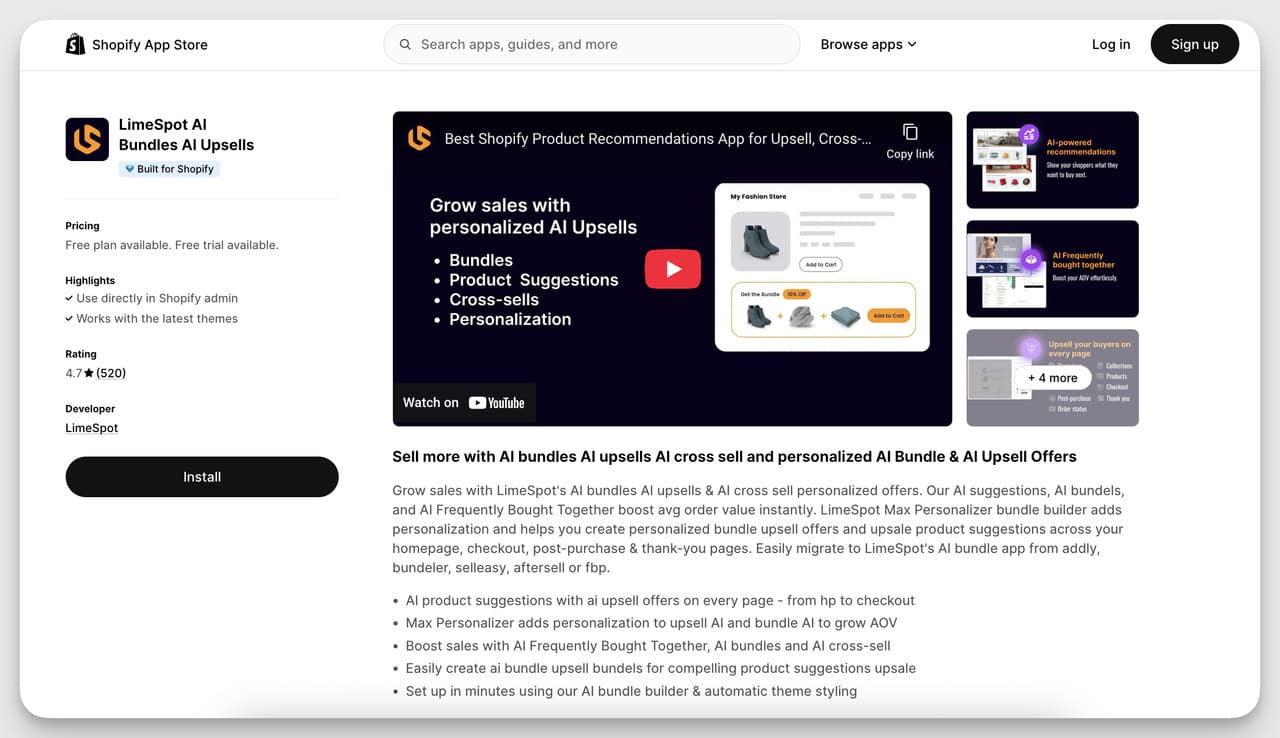
AI functionality: Real-time behavioral segmentation combined with collaborative filtering. The platform watches click patterns, purchase history, and session signals to assign each visitor a dynamic segment, then renders different widget content depending on the segment. Native A/B testing across recommendation algorithms lets merchants compare "Trending now" against "Customers also bought" without external tools. The vendor's case studies include Sapphire's reported 12X ROI with AI recommendations, cited by Insider One as an example of the upside when behavioral personalization is layered across channels rather than confined to a single carousel.
💰 Pricing: Tiered plans starting around $18/month for small stores, scaling with traffic volume. A limited free plan exists for development stores. Higher tiers unlock email/SMS personalization, advanced segments, and priority support.
💬 What reviews say: With several hundred reviews averaging around 4.7 stars, LimeSpot earns praise for depth of analytics and Klaviyo integration. A recurring critique is the learning curve — the dashboard packs a lot of segmentation power, and merchants without prior CRM experience report taking a few days to find their footing. Support is described as proactive about onboarding and strategy reviews.
📦 Best for: Medium-to-large stores already using Klaviyo or another ESP, where personalization needs to travel from on-site widgets into email and SMS without re-segmenting the audience.
4. Also Bought (Code Black Belt)
Also Bought comes from the same Code Black Belt team behind Frequently Bought Together, but it solves a different problem. Instead of bundling, it surfaces "Customers who bought this also bought" carousels — the Amazon discovery pattern, applied to Shopify product pages and cart drawers.
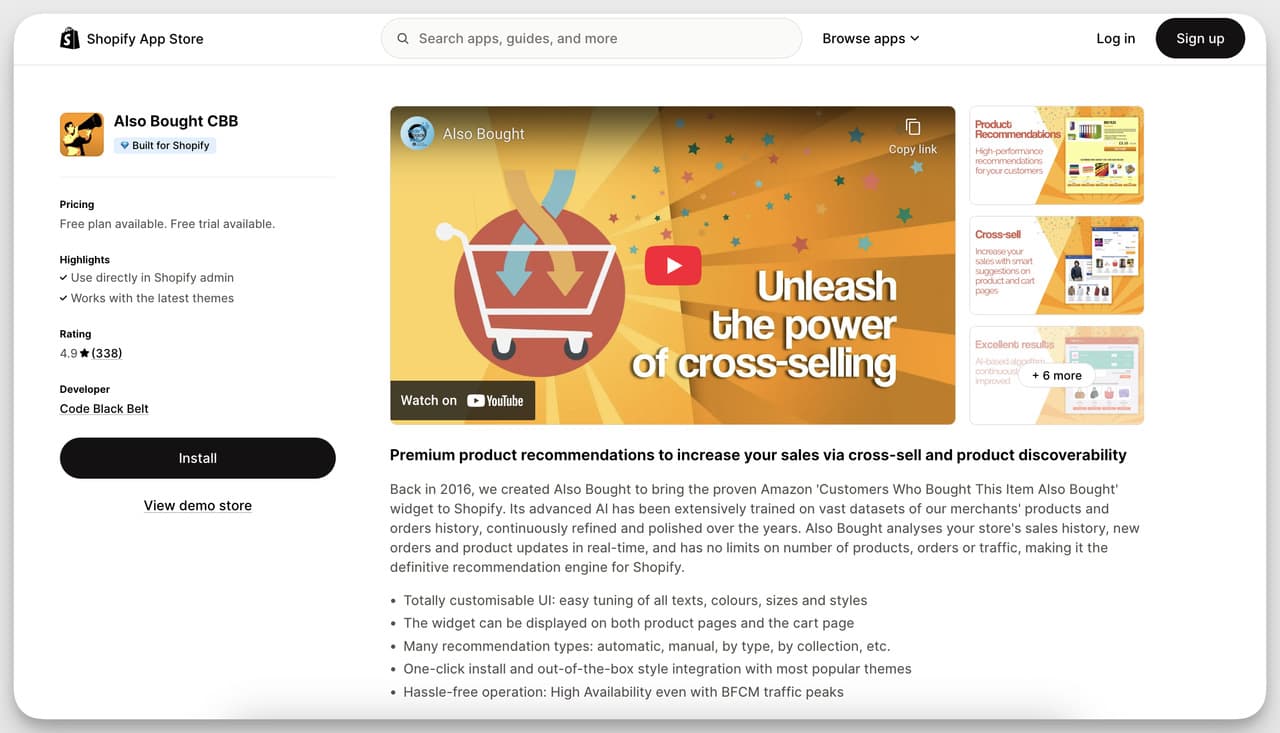
AI functionality: Collaborative filtering across the store's full order history. The model identifies products that frequently co-occur in carts and displays them as cross-sell suggestions rather than fixed bundles. Async script loading is documented as a deliberate performance choice — the widget never blocks PDP render time, which matters because slow PDPs lose conversions regardless of how good the recommendation is.
💰 Pricing: Starts at $9.99/month flat, with a free trial. No usage-based tiering, which keeps costs predictable as the store grows.
💬 What reviews say: Roughly 400 reviews at a 4.9-star average. The dominant theme is reliability: merchants install it, see cart-value lift, and rarely touch the settings again. The same Code Black Belt support reputation applies here — fast turnaround on customization tickets, including theme-specific tweaks.
📦 Best for: Stores that want discovery-style cross-selling (not bundles) on PDPs and want it to run untouched in the background. Pairs well with Frequently Bought Together when stores want both bundle widgets and discovery carousels.
5. Wiser - Personalize Upsell
Wiser packages multiple recommendation widget types into a single dashboard: "Frequently bought together," "Related products," "Recently viewed," "Trending now," and a separate quiz module. It's positioned for stores that want to cover the full funnel — homepage to post-purchase — without installing four different apps.
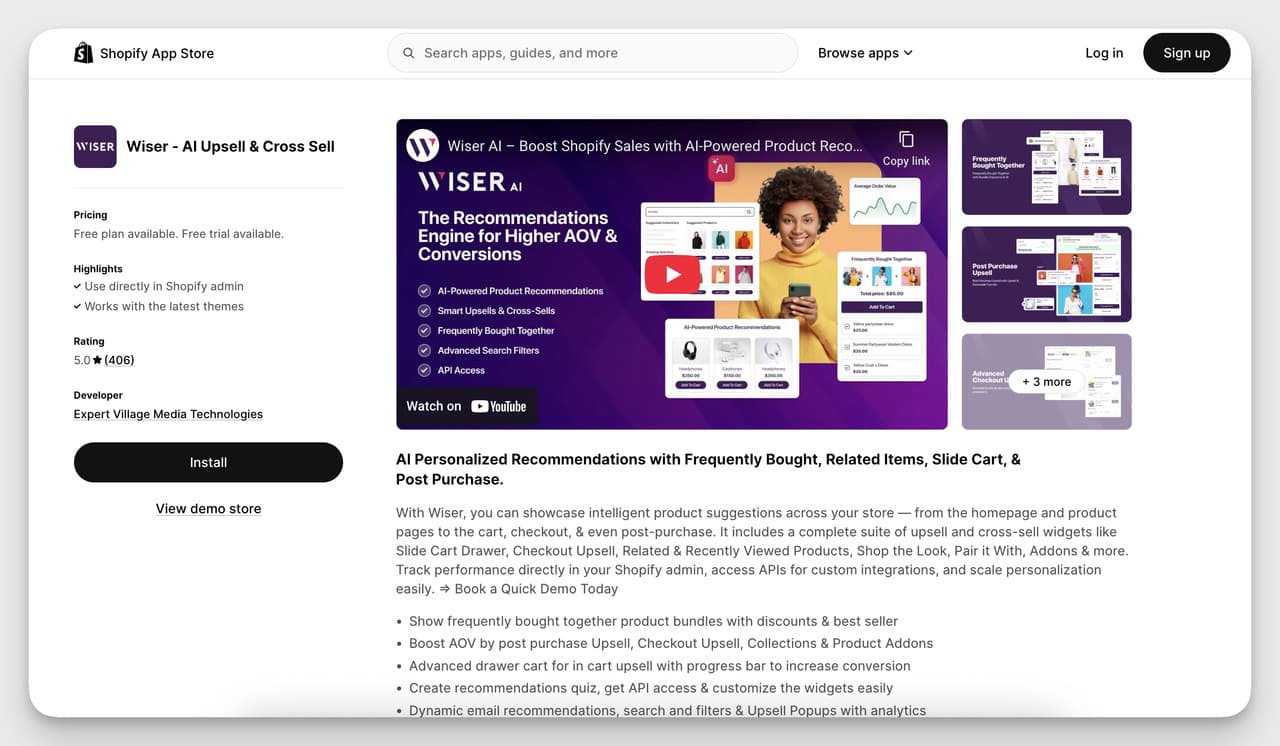
AI functionality: Behavioral learning from browsing and purchase data drives the "Trending" and "Personalized" widgets. The bundle widgets use market-basket logic similar to other apps in the category. The Wiser Quiz add-on adds guided-discovery logic for stores where shoppers need help choosing — overlapping conceptually with RevenueHunt but bundled into the same subscription.
💰 Pricing: Free plan available for development stores. Paid plans start around $9/month with tiered pricing based on traffic and feature access. Quiz features unlock on higher tiers.
💬 What reviews say: Several hundred reviews at a 5.0-star clip with consistent praise for setup speed and support responsiveness. Merchants who switched from single-purpose apps mention the consolidation benefit — one dashboard, one bill, less context-switching. Smaller stores occasionally flag that costs scale faster than expected once traffic grows.
📦 Best for: Stores that want a single tool covering recommendation widgets, post-purchase upsells, and an optional product quiz — without paying for three separate apps. Especially useful for Klaviyo-integrated stores that want recommendation data flowing into email flows.
6. GLO Related Products
GLO Related Products takes a deliberately different stance: it's lighter on AI and heavier on merchant control. Instead of letting a black-box model pick recommendations, it gives store owners rule-based targeting tools that decide which products show up based on tag, vendor, type, or collection.
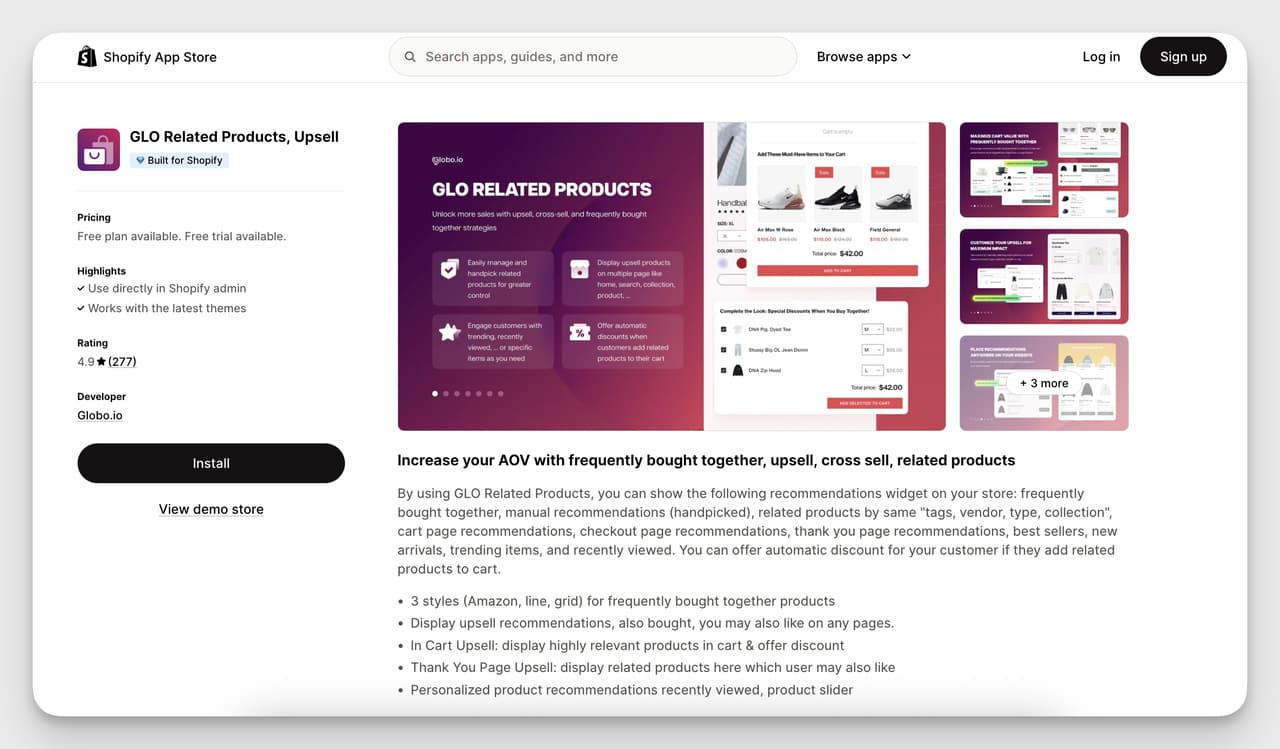
AI functionality: Lightweight smart-display logic rather than full behavioral learning. The app does not retrain on live behavior in the way LimeSpot or Obviyo do — instead, it follows merchant-defined rules with some automation around layout and ordering. This is the right architecture for stores where merchandisers want predictable output, not surprises.
💰 Pricing: Free plan available with core widgets. Premium plans start around $9.90/month and unlock advanced layouts and additional placements.
💬 What reviews say: Around 300 reviews at 4.9 stars. The free plan is regularly called out as genuinely usable, not a teaser tier. Merchants like the control over which products appear where — fashion stores and gift shops that build curated experiences mention this often. Support is described as fast on theme integration questions.
📦 Best for: Budget-conscious stores, merchandiser-led stores, and stores with seasonal catalogs where predictable, rule-based output matters more than AI optimization. Also a strong pick for stores migrating from rule-based apps that want familiar logic with a modern interface.
7. RevenueHunt (Product Recommendation Quiz)
RevenueHunt doesn't show recommendations passively — it asks shoppers questions, then maps the answers to specific products. The quiz format is purpose-built for catalogs where customers need help deciding: skincare, supplements, gifting, fashion, and any category where a wrong choice means a return.
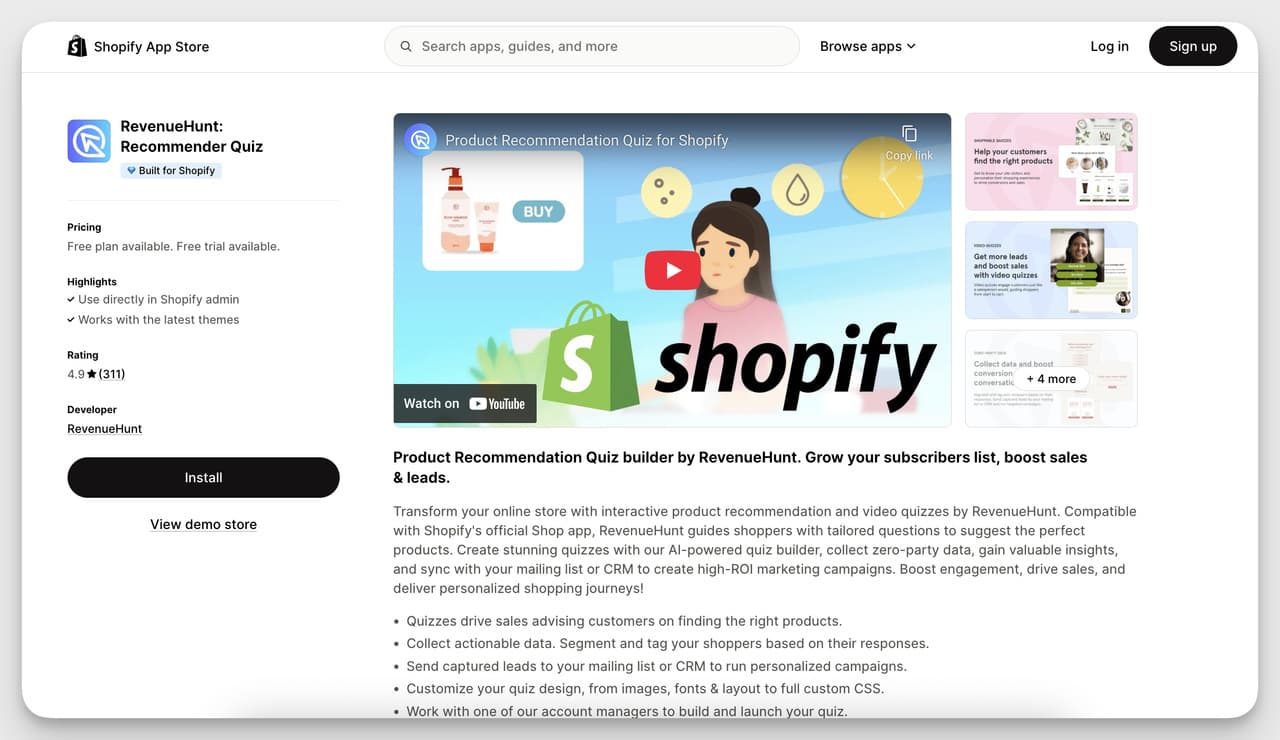
AI functionality: Rule-based conditional logic with optional dynamic tagging from Shopify product metadata. Some personalization based on aggregate response patterns, but this is not a behavioral learning system in the same sense as LimeSpot or Obviyo. The strength is the quiz logic engine itself — branching, multi-page flows, and product-tag mapping.
💰 Pricing: Free tier for small stores with quiz volume caps. Paid plans start around $39/month with higher response limits, advanced logic, and email integrations.
💬 What reviews say: Around 300 reviews averaging 4.9 stars. Common praise focuses on the visual quiz builder and the lift in email capture — quizzes double as lead-gen tools. Reviewers note that designing a high-converting quiz takes thoughtful planning; the app doesn't write the questions for you.
📦 Best for: Catalogs where product choice is overwhelming or personal: skincare (skin type, concerns), supplements (goals, conditions), gifting (recipient, budget, occasion), and fashion (fit, style preferences). Pairs naturally with email marketing because each quiz response feeds a segment.
8. Glood Product Recommendations
Glood sits between the rule-based simplicity of GLO and the enterprise-grade personalization of LimeSpot. It offers 12+ widget types, real-time behavioral tracking, and a drag-and-drop visual editor — the kind of design control that bigger personalization platforms often lack.
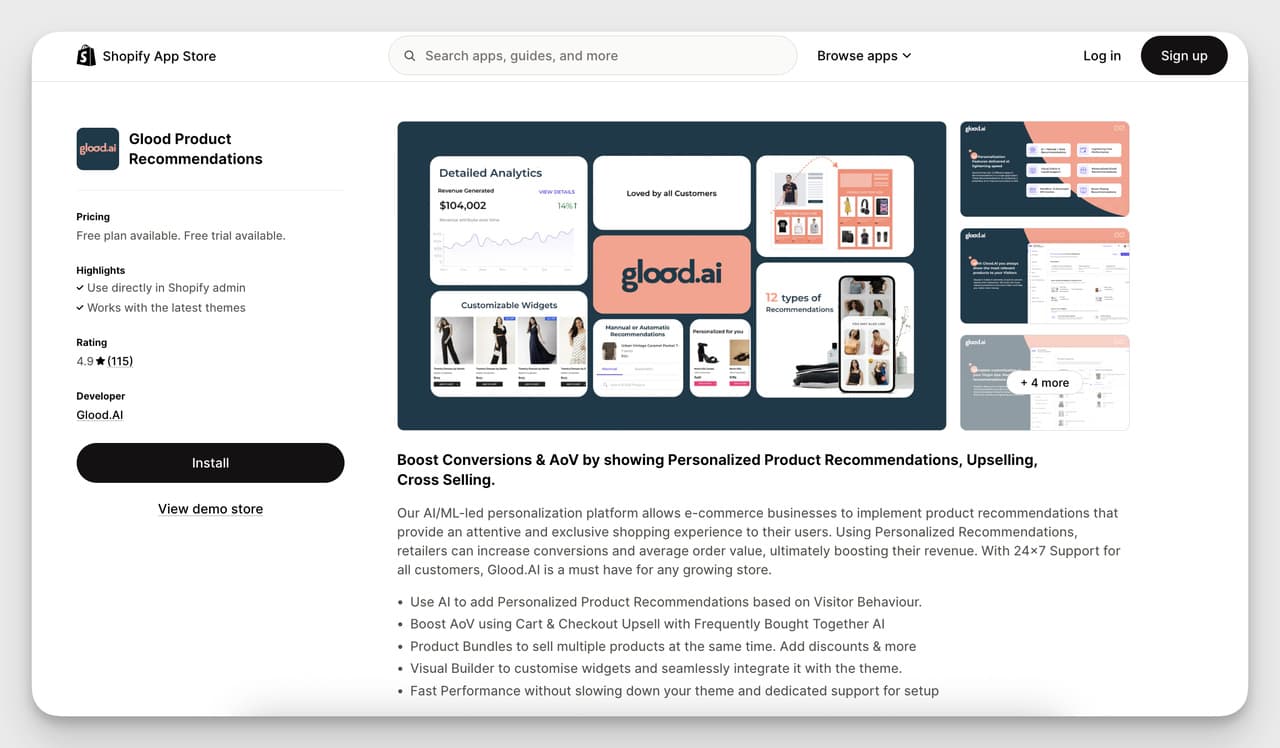
AI functionality: Hybrid engine — automated AI recommendations based on browse and purchase signals can run side by side with custom merchant rules. Widget types include "Inspired by your browsing," "Recently viewed," "Best sellers," and seasonal blocks. Asynchronous loading is documented, which keeps page speed scores intact.
💰 Pricing: Free plan for small stores. Premium plans start around $19.99/month with higher widget impression limits and advanced analytics.
💬 What reviews say: Around 200 reviews at 4.9 stars. Reviewers describe Glood as "lightning fast" — both the dashboard and the rendered widgets. The visual editor is the second-most-mentioned feature, with merchants praising the ability to tweak layouts without writing Liquid. A handful of reviewers mention a short learning curve due to the sheer number of widget types.
📦 Best for: Design-led stores that want personalization without giving up layout control. Especially good for stores running custom themes where standard widget styling looks out of place.
9. Dialogue AI
Dialogue AI approaches recommendations from a CRO angle. Rather than picking one algorithm and trusting it, Dialogue runs continuous A/B/n tests on recommendation formats, copy, and placement — turning the store itself into a self-optimizing experiment loop.
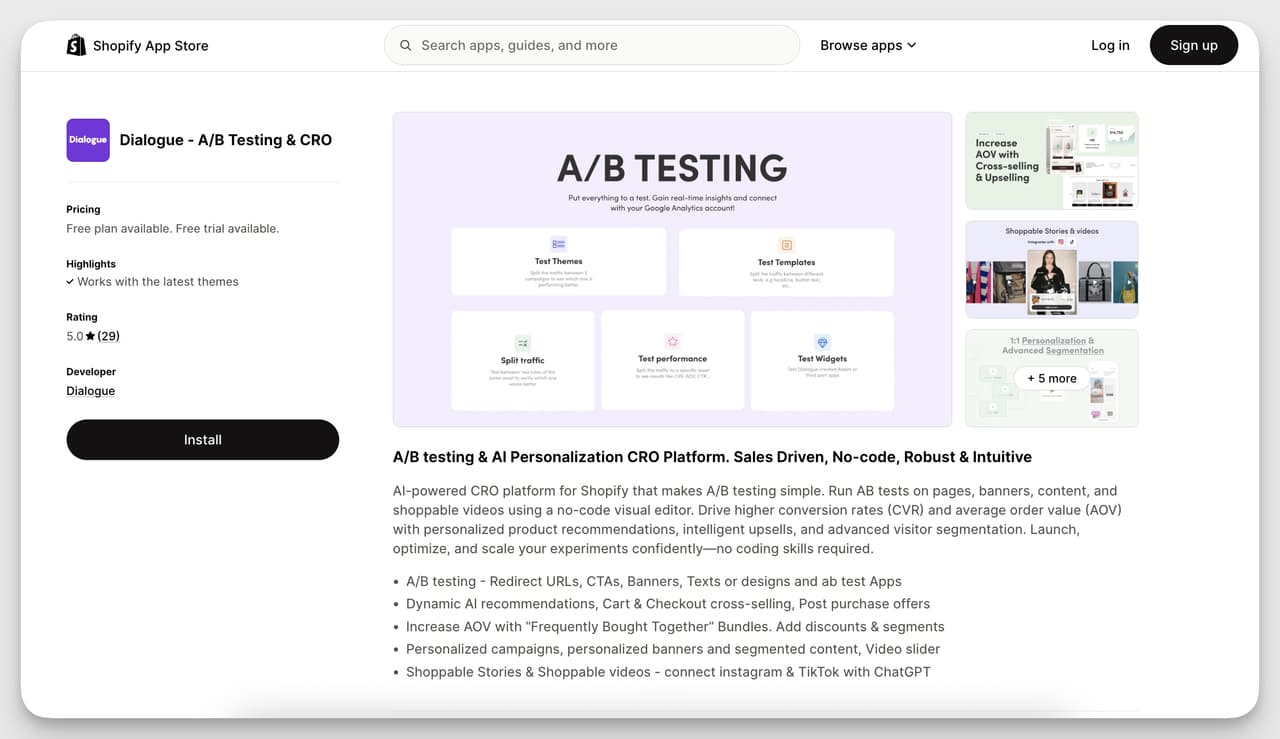
AI functionality: Real-time visitor segmentation (new vs. returning, discount-sensitive, high-AOV, etc.) combined with native multivariate testing. The platform automatically rotates recommendation variants and promotes winners — eliminating the need for an external A/B testing tool like Convert or VWO for recommendation tests specifically.
💰 Pricing: Free plan for low-traffic stores. Paid plans start around $19/month with higher session limits and additional test slots.
💬 What reviews say: A smaller but growing review base, with reviewers consistently mentioning the "having a CRO strategist on staff" feeling. The clean UI gets repeated mentions, as does the proactive support — Dialogue's team reportedly reaches out with optimization suggestions rather than waiting for tickets. Results are described as compounding over time as the testing engine accumulates data.
📦 Best for: CRO-focused teams that want recommendation testing built into the same dashboard as the recommendation engine itself. Good fit for stores that already think in terms of conversion experiments and want recommendation widgets to be part of that loop.
10. Obviyo
Obviyo brings enterprise-grade recommendation logic — inspired by the architectures used at large marketplaces — into a Shopify-native app. The focus is real-time personalization that reacts to on-site actions, not just historical session data.
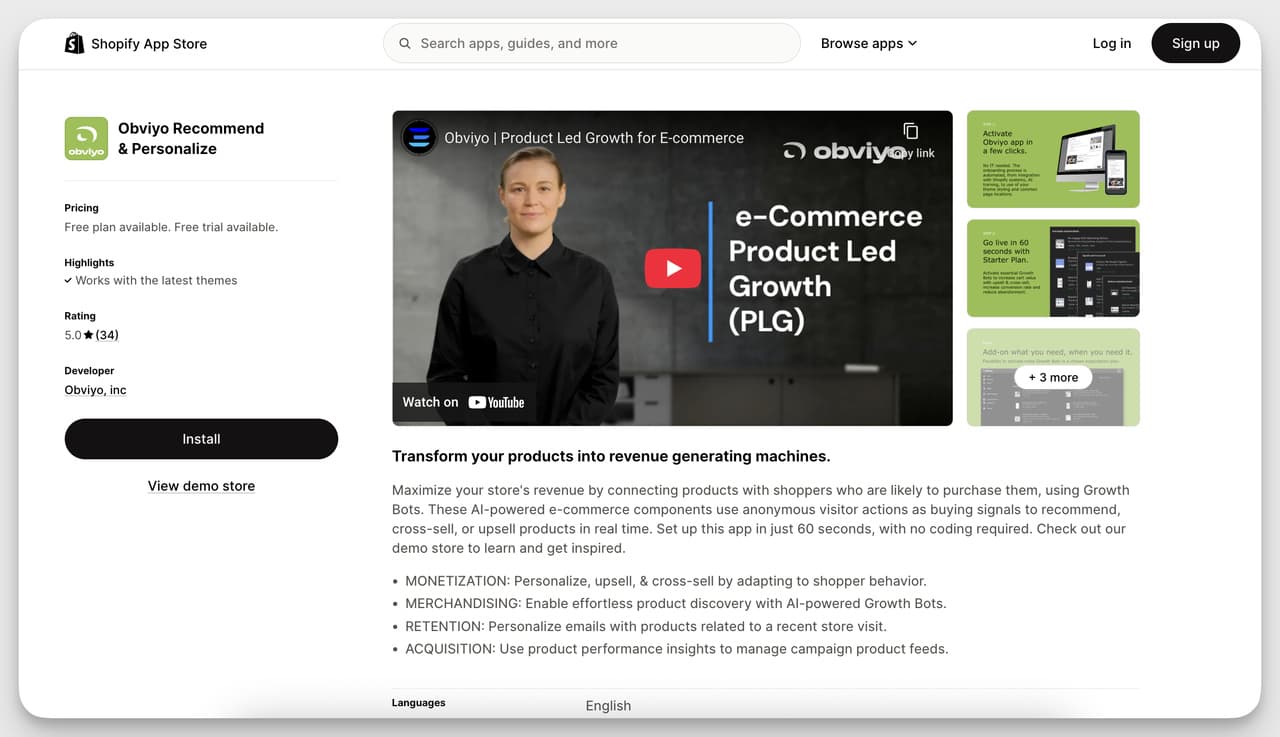
AI functionality: Session-based recommendation AI that updates suggestions on each click rather than at the start of the session. "Smart Stories" layouts let merchants assemble homepage, cart, and PDP blocks that adapt to the visitor's current intent. Built with e-commerce optimization frameworks pre-configured, which means less of the "what algorithm should we use" decision is left to the merchant.
💰 Pricing: Free plan available with usage limits. Paid plans scale up significantly for high-volume stores — published tiers reach hundreds of dollars per month, reflecting the enterprise positioning.
💬 What reviews say: A smaller review base than legacy apps, but consistent praise for the depth of the recommendation logic. Reviewers describe Obviyo as the closest a Shopify app gets to enterprise personalization platforms without the enterprise sales cycle. Some reviews mention that the value compounds at higher traffic volumes — small stores may not have enough behavioral data to see the difference versus simpler apps.
📦 Best for: Shopify Plus stores and high-volume merchants who want enterprise-grade personalization logic without negotiating a custom contract. Less of a fit for stores under roughly 5,000 monthly visitors, where the AI doesn't have enough data to outperform simpler collaborative filtering.
Comparison Table: 10 Shopify Recommendation Apps Side by Side
| App | Best Use Case | AI Type | Starting Price | Free Plan | Highlight |
|---|---|---|---|---|---|
| LiveChatAI | Conversational discovery | GPT-4o agent + Shopify MCP | ~$29/mo | Yes | 5-minute setup, 95+ languages |
| Frequently Bought Together | Bundle upsells on PDP | Market-basket analysis | $9.99/mo | Trial only | 4.9-star rating with ~5,000 reviews |
| LimeSpot Personalizer | Omnichannel personalization | Behavioral segmentation + CF | ~$18/mo | Yes (dev) | Klaviyo and SMS integration |
| Also Bought | Cross-sell carousels | Collaborative filtering | $9.99/mo | Trial only | Async loading, flat pricing |
| Wiser | Funnel-wide upsells + quiz | Behavioral + market-basket | ~$9/mo | Yes | One dashboard for all widgets |
| GLO Related Products | Rule-based merchandising | Smart-display logic | ~$9.90/mo | Yes | Genuinely usable free tier |
| RevenueHunt Quiz | Guided selling + email capture | Conditional quiz logic | ~$39/mo | Yes | Quiz responses feed segments |
| Glood | Design-led personalization | Hybrid AI + custom rules | ~$19.99/mo | Yes | 12+ widget types, visual editor |
| Dialogue AI | CRO-driven optimization | Segmentation + A/B/n testing | ~$19/mo | Yes | Native multivariate testing |
| Obviyo | Real-time enterprise logic | Session-based predictive AI | Free tier; paid scales high | Yes | Shopify Plus-ready architecture |
How to Choose the Right Recommendation App for Your Store
The 10 apps above all "work" in the basic sense — they install, they render widgets, and they generate clicks. The selection problem is fit, not capability. Use the four-step framework below to narrow the list before you start trials.
Step 1: Start With Your Store Stage and Catalog Size
The right algorithm depends on how much behavioral data your store generates. Below roughly 1,000 monthly orders, collaborative filtering apps (Also Bought, Frequently Bought Together) outperform deep-learning systems because they don't need a training dataset — they work from the first co-purchase. Above 10,000 monthly orders, behavioral platforms (LimeSpot, Obviyo, Dialogue) start to shine because they have enough signal to personalize per-visitor rather than per-segment.
Catalog size matters too. A 30-SKU jewelry store doesn't need Obviyo's enterprise architecture — GLO or Wiser will outperform on cost-per-conversion. A 50,000-SKU fashion retailer needs the opposite: enterprise logic that won't collapse under the catalog weight.
Step 2: Identify Your Bottleneck Channel
Look at your funnel and find where shoppers fall out. The recommendation app should address that specific drop-off:
• Product page bounce: Frequently Bought Together, Also Bought, Glood
• Cart abandonment: Dialogue (test cart upsells), Wiser (post-cart widgets)
• Pre-purchase indecision: RevenueHunt Quiz, LiveChatAI
• Low email re-engagement: LimeSpot (Klaviyo personalization)
• Repeat-purchase rates: LiveChatAI (memory across sessions), LimeSpot (segmented email flows)
Step 3: Match Team Profile
Match the app to who'll run it. A solo founder can't operate LimeSpot's full segmentation dashboard — they should pick Wiser or Glood and accept the trade-off. A team with a dedicated CRO manager will get more out of Dialogue's A/B testing than a generalist team would. If you're standing up an AI agent on a non-Shopify storefront in parallel, our guide to creating a BigCommerce AI chatbot walks through equivalent setup on that platform.
Step 4: Pressure-Test the Free Trial
Every app on this list offers a free plan or trial. Use it. Install the candidate app on a staging theme or a low-traffic collection page first. Watch three metrics for two weeks: page load time (does the widget slow PDPs?), click-through rate on the widget itself (are shoppers engaging?), and attributed revenue per session (does the engagement convert?). Apps that fail any of the three rarely recover with longer trials.
Step 5: Plan for Adjacent Tools
Recommendation apps work best alongside the rest of the conversion stack. If you're also evaluating chat tools, our list of the best ecommerce chatbots covers tools that pair naturally with recommendation widgets. For cross-channel discovery on messaging apps, see WhatsApp Shopify AI chatbots, which often complement on-site recommendation widgets for repeat customers.
Frequently Asked Questions
What is a Shopify product recommendation app?
A Shopify product recommendation app is a third-party tool that displays personalized product suggestions to shoppers on your store — on product pages, the cart drawer, the homepage, inside a chat widget, or in follow-up emails. Modern apps use AI to read live behavior and purchase history to choose which products to show each visitor in real time, replacing the manual tagging required by older rule-based systems.
Are there free Shopify product recommendation apps that actually work?
Yes — several apps on this list offer genuinely usable free tiers rather than feature-gated teasers. GLO Related Products and Wiser have free plans that small stores can run indefinitely. LiveChatAI, LimeSpot, Glood, Dialogue, and Obviyo offer free starter tiers with usage caps. Frequently Bought Together and Also Bought don't have permanent free plans, but both run free trials long enough to validate ROI before subscribing.
What do Reddit users recommend for Shopify product recommendation apps?
Reddit threads in r/shopify and r/ecommerce consistently surface a handful of names — Frequently Bought Together and Also Bought are the most-repeated picks for upsell wins, LimeSpot and Glood get nods for stores wanting more personalization control, and conversational tools like LiveChatAI show up in newer threads as a discovery alternative to traditional carousels. The Reddit consensus tends to favor flat-pricing apps over usage-metered ones, because predictability matters when margins are tight.
How does the Wiser Shopify app compare to other recommendation tools?
Wiser stands out because it consolidates multiple widget types — frequently bought together, related products, post-purchase upsells, and a quiz add-on — into one dashboard. Versus Frequently Bought Together (single-purpose bundling) or LimeSpot (omnichannel personalization), Wiser is the breadth pick. It's the right call when you want one tool covering several funnel stages without managing multiple subscriptions and integrations.
Will these apps slow down my Shopify store?
The apps on this list document asynchronous loading, which means the recommendation widget loads after the main page content and doesn't block render time. That said, every app added to a Shopify store has some performance cost. Test PDP speed before and after installing using Chrome DevTools or PageSpeed Insights, focusing on Largest Contentful Paint (LCP) and Cumulative Layout Shift (CLS). If LCP regresses by more than 100ms or CLS rises above 0.1, escalate to the vendor's support team.
Do these apps work with Shopify Plus?
Yes — all 10 apps support Shopify Plus, and several (Obviyo, LimeSpot, LiveChatAI) include features specifically designed for high-volume stores: API access, headless support, custom checkout integrations, and enterprise-grade SLAs. Obviyo's architecture in particular leans toward Plus-tier stores, and its pricing reflects that. Smaller stores can use the same apps, but won't access every advanced feature on lower plans.
How do AI Shopify product recommendation apps work in 2026?
AI recommendation apps in 2026 combine behavioral signals (click patterns, session dwell time, scroll depth), transactional history (past orders, co-purchase patterns), and contextual data (device, location, referral source) to predict which products a specific shopper is most likely to buy in the current moment. The best apps retrain continuously rather than on a fixed schedule, which means recommendations adapt within hours of new behavior signals. Conversational tools like LiveChatAI extend this with natural-language input, letting shoppers describe what they want and getting product matches inside a chat exchange.
Pick a Recommendation App and Test It This Week
The selection framework above narrows ten apps to one or two candidates for any specific store. The remaining work is a free-trial install on a staging theme, two weeks of measurement, and a decision based on attributed revenue rather than vendor marketing. Most merchants spend more time researching the choice than running the test — which is the wrong way around, because every app on this list reveals its fit (or lack of fit) inside 14 days of live traffic.
If your bottleneck is shopper indecision and you want recommendations to happen inside a real conversation rather than a passive widget, start with LiveChatAI — the free tier covers enough volume to validate whether conversational discovery moves the metrics that matter for your catalog. If your bottleneck is AOV and you sell naturally pairable inventory, install Frequently Bought Together first and measure cart value over the next two weeks. Pick the candidate that maps to your bottleneck, run the trial, and ship a decision before the month ends.