



Picking a chatbot agency in 2026 looks nothing like it did even eighteen months ago. Most of our SaaS clients walk in with a stalled in-house build, a support backlog growing 15-20% quarter over quarter, and a board asking why response times still feel like 2019. The agency you hire now has to ship more than a scripted bot — it has to deliver an AI agent that resolves tickets, hands off cleanly, and proves ROI inside the first quarter.
A chatbot agency designs, builds, and maintains AI chatbots and AI agents for businesses, handling everything from data training and platform integration to ongoing optimization. The 11 best chatbot agency services in 2026 — led by LiveChatAI, Botsify, BotNation AI, and Chit Chat Agency — vary widely in pricing, specialization, and the depth of AI agent capabilities they ship.
Choose LiveChatAI if you want a self-serve AI chatbot platform plus an agency partnership program. Pick Chit Chat Agency or TARS for fully custom enterprise builds. Pick BotNation AI or Chat Ergo Bot if you're a startup that needs a flexible drag-and-drop builder with agency support attached.
According to Orbilontech, roughly 987 million people now use AI chatbots worldwide, the chatbot market has crossed $11 billion, and companies report $8 in return for every $1 spent on chatbot deployment. The agency you hire is the difference between cashing that return and writing it off.
What is a chatbot agency?
A chatbot agency is a specialist service provider that designs, builds, deploys, and maintains AI chatbots and AI agents on behalf of client businesses. Instead of buying a self-serve tool and figuring out training data, integrations, and conversation design in-house, you outsource the full lifecycle to a team that does this every day.

The work spans natural language processing, machine learning model selection, knowledge-base ingestion, conversation flow design, CRM and helpdesk integrations, and post-launch tuning. Some agencies are platform-led — they have their own no-code builder and bolt on done-for-you services. Others are pure consulting shops that pick a vendor (OpenAI, Anthropic, an open-source framework) and build on top.
If the line between a "chatbot" and an "AI agent" still feels fuzzy, our AI agent vs chatbot breakdown walks through where each one fits — short version, chatbots answer; agents act.
What does a chatbot agency actually deliver?
Most engagements include a mix of the following deliverables. Not every agency does all of them — that's a useful filter when shortlisting.
• Custom chatbot development: Bots tailored to specific support, sales, or marketing workflows rather than a generic FAQ widget.
• Integration services: Plugging the bot into CRMs (HubSpot, Salesforce), helpdesks (Zendesk, Freshdesk), ecommerce stacks (Shopify, WooCommerce), and messaging channels (WhatsApp, Messenger, Slack).
• Conversation and UX design: Writing tone, fallback paths, escalation triggers, and visual UI so the bot feels on-brand.
• Knowledge-base training: Ingesting your help docs, product pages, and historical tickets so the AI grounds responses in your data instead of hallucinating.
• Maintenance and optimization: Monitoring resolution rates, retraining on new tickets, and patching weak intents — usually monthly.
• Analytics and reporting: Dashboards that surface deflection rate, CSAT, top failed intents, and channel-level performance.
• Strategy and consulting: Roadmap workshops, agent vs chatbot decisions, and team training so your support leads can take over after handoff.
Why hire a chatbot agency in 2026?
The case for hiring out the work is stronger this year than in any of the last five. Three forces are at play: AI agents have matured past simple Q&A bots, support teams are buckling under ticket volume, and the cost of getting the build wrong has compounded.
According to Scalify, chatbots on websites generate 20-35% more leads, autonomously handle 68% of inquiries, and cut support costs by roughly 30%. Those numbers come from deployed implementations, not lab tests — and agencies are the fastest route to that resolution rate without burning your engineering quarter.
Where an agency outperforms a DIY build
• Speed to production: A specialist team can ship a working pilot in 4-6 weeks. In-house teams tend to lose the first six weeks just choosing a vendor.
• Conversation design expertise: Writing prompts and fallback paths is its own craft. Bad conversation design tanks CSAT faster than a slow response.
• Integration breadth: Agencies have already wired their bots into 30-50 platforms. Your engineers haven't.
• Cross-client pattern recognition: An agency that has deployed 200 ecommerce chatbots knows which intents matter on day one. You'll find them after three months of analytics review.
• Compliance work: GDPR data handling, HIPAA in healthcare, SOC 2 evidence — agencies have the documentation templates ready.
Lime Technologies' chatbot case study work found that conversational design lifts lead conversion by 40% — and that's the gap between a well-designed bot and a default template. Most in-house builds ship with template flows because writing real conversation design is slow work.
Where agencies fall short
Honesty matters here, since I work at one. Agencies cost more than self-serve platforms, you don't own the playbook unless you negotiate it, and switching agencies mid-project is painful. If your use case is narrow — say, a single FAQ deflection bot on a documentation site — a self-serve tool plus a weekend of work beats hiring out. The AI-powered chatbot fundamentals guide covers the DIY path if that's where you land.
11 best chatbot agency services for AI chatbot development in 2026
Below is the shortlist I'd hand to a SaaS or ecommerce buyer evaluating chatbot agencies right now. Five of these are direct LiveChatAI competitors — I've kept them on the list because leaving them off would make this comparison less useful, and I'd rather you read a fair evaluation than a sales pitch dressed as a guide.
1. LiveChatAI: AI support that ships in a week
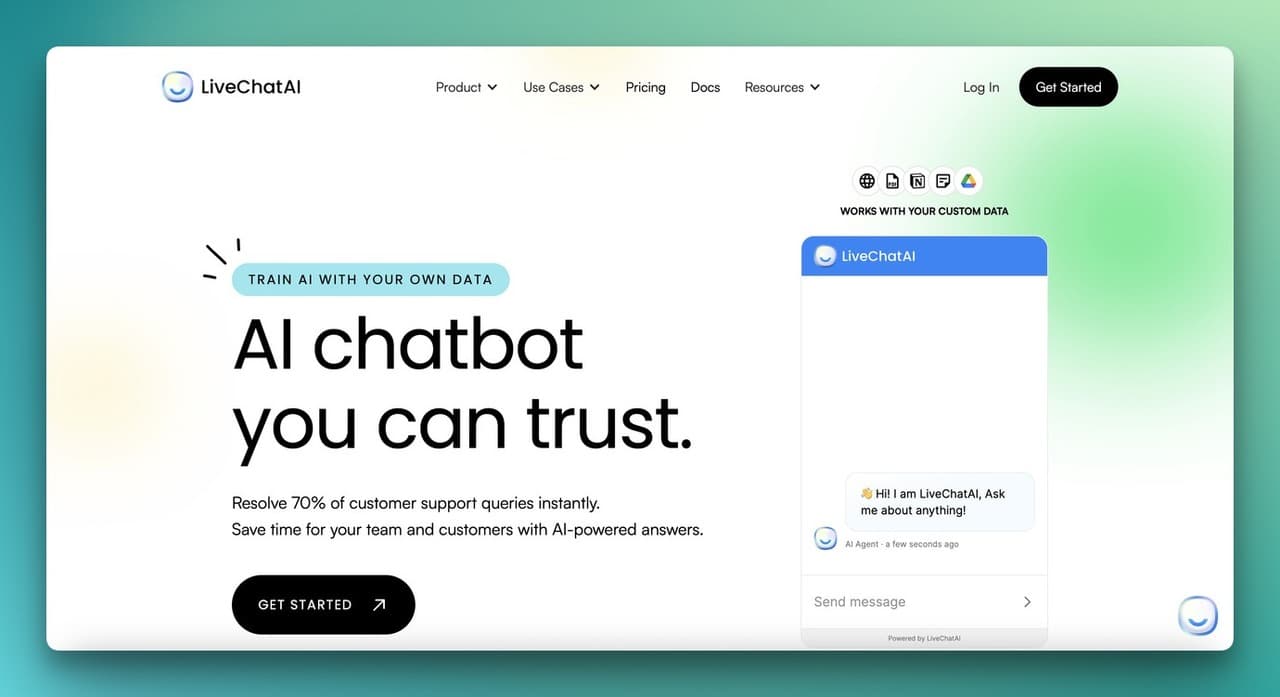
Best for: SaaS and ecommerce teams that want an AI chatbot live in days, not quarters, with an agency partnership option for resellers.
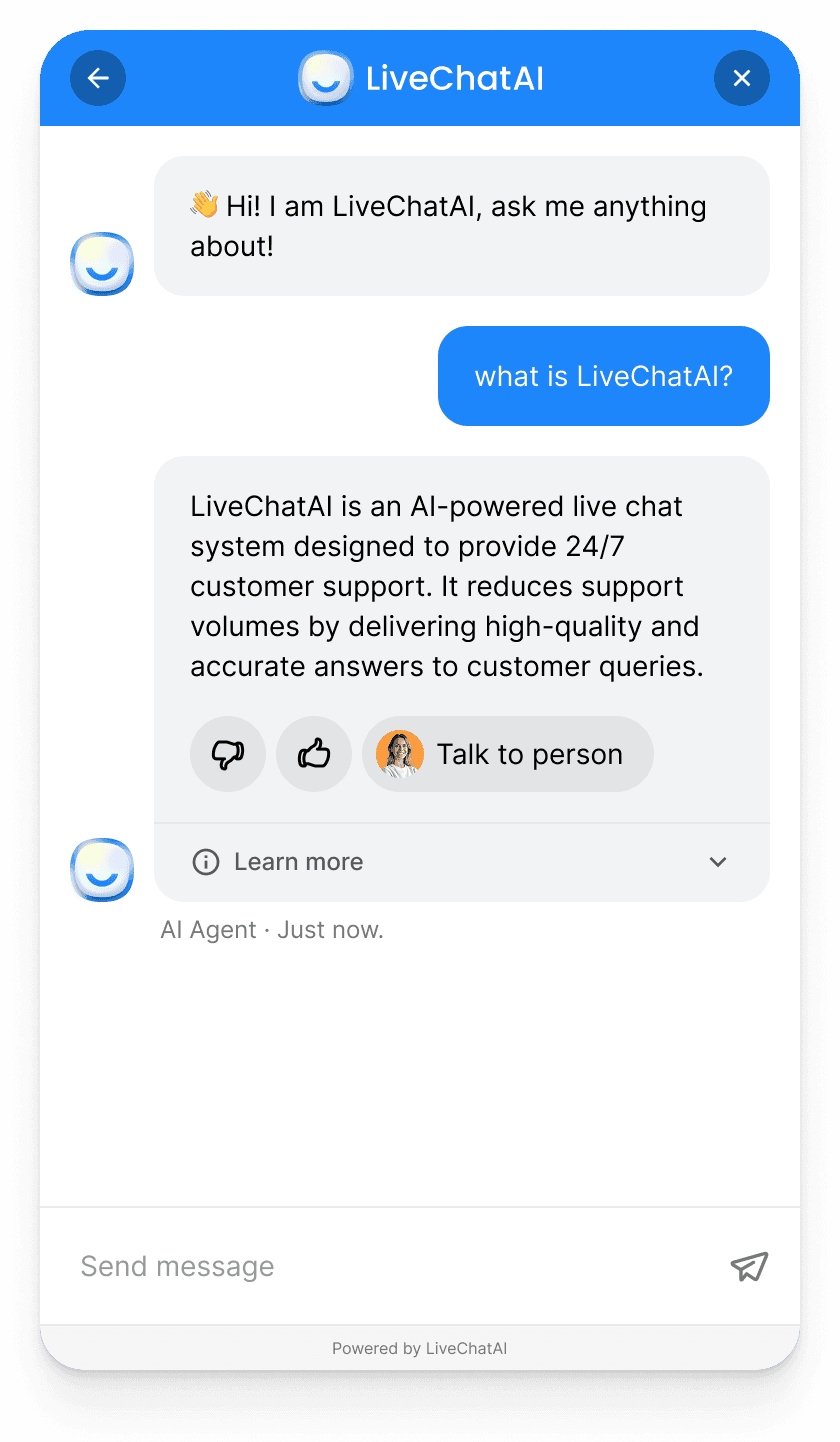
LiveChatAI is the platform I work on, so take the framing with that context in mind. It's a no-code AI chatbot trained on your website, help docs, and support transcripts. We've shipped it for SaaS dashboards, Shopify stores, ed-tech platforms, and B2B service sites — and the pattern that holds is fast deployment plus high resolution.
Where we genuinely fit: teams that need an AI agent live in under a week, want 70%+ ticket deflection on day-one common questions, and need clean handoff to a human agent when the AI hits an edge case. Where we're a worse fit: enterprises that need a 6-month custom build with bespoke ML model fine-tuning — that's TARS or Chit Chat territory.
Key features:
• Custom data training: Train the bot on your URLs, PDFs, docs, and ticket history so it answers in your voice and brand.
• 70% average AI resolution rate: Across the SaaS and ecommerce accounts we've benchmarked, the bot resolves around seven in ten incoming questions without human touch.
• Multi-platform integration: Web widget, Slack, WhatsApp, and Shopify — same knowledge base across every channel.
• 95-language localization: Instant translation for global support teams, with the brand voice preserved.
• Human handoff: Clean escalation to a live agent inside the same chat thread, with full conversation context preserved.
Pricing:
• Free Forever: 100 GPT-4 messages, 1 chatbot, 1 seat — good for prototyping.
• Basic ($39/mo): 3,000 GPT-3.5 messages, unlimited data sources, live chat — solo founders and personal use.
• Pro ($89/mo): 4,000 GPT-4 messages, 2 chatbots, AI actions — small businesses.
• Advanced ($189/mo): Unlimited messages, 5 bots, 3 seats, Make.com and API access, Slack — mid-sized teams.
• Expert ($389/mo): 10 bots, 6 seats, WhatsApp, optional branding removal — scaling businesses.
If you're running an agency yourself and want to resell AI chatbots under your own brand, the LiveChatAI Agency Partnership gives you a structured way to do that without building your own platform. Pricing tiers are documented on the LiveChatAI pricing page if you want to map them against your current stack.
Where LiveChatAI falls short: If you need deep voice-AI integration or a fully bespoke ML model, you'll outgrow our platform. We're best in the "AI agent for support and lead capture" lane, not the "build me a custom voice IVR replacement" lane.
Choose LiveChatAI if you want a deployable AI chatbot in under a week, you need multi-channel coverage, and you'd rather start free and upgrade than negotiate a custom quote.
2. Botsify: White-label platform for agencies
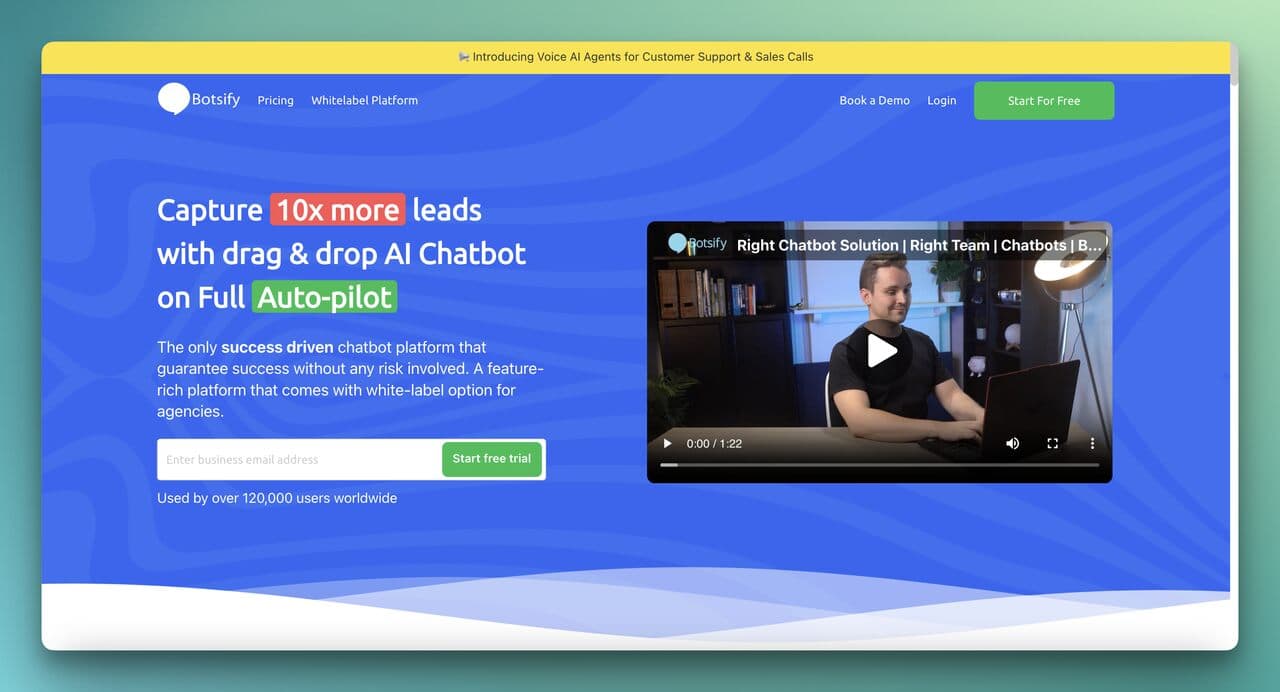
Best for: Marketing agencies and consultancies that want to resell chatbots under their own brand without building a platform.
Botsify is one of the longest-running chatbot platforms with a clear positioning for agency resellers. The drag-and-drop builder is fine, the integrations are decent, and the white-label tier is the real product. If you're an agency that wants to sell "AI chatbots" as a service line without investing in engineering, Botsify is on the shortlist.
Key features:
• Multilingual support: Conversations in 100+ languages with translation built in.
• Third-party integrations: Connectors for CRM, analytics, and major social platforms.
• Conversational lead forms: Replace static web forms with chat-style intake.
• Omnichannel coverage: Facebook, WhatsApp, Instagram, and website widget under one inbox.
• Live agent fallback: Human takeover when the AI hits its limits.
Pricing:
• Do It Yourself ($49/mo): 2 bots, 5K users/mo, all integrations, 1-month chat history.
• Done For You ($149/mo): 5 bots, unlimited users, white-label dashboard, personal onboarding.
• Custom: On-premises, unlimited everything, enterprise contract.
Where it falls short: Botsify's AI is functional but feels a step behind newer agent-style platforms. Conversation design tooling is older and the UI is dated compared to 2026 challengers.
Choose Botsify if you're an agency building a recurring revenue stream on top of someone else's tech.
3. BotNation AI: Marketing-focused chatbot builder
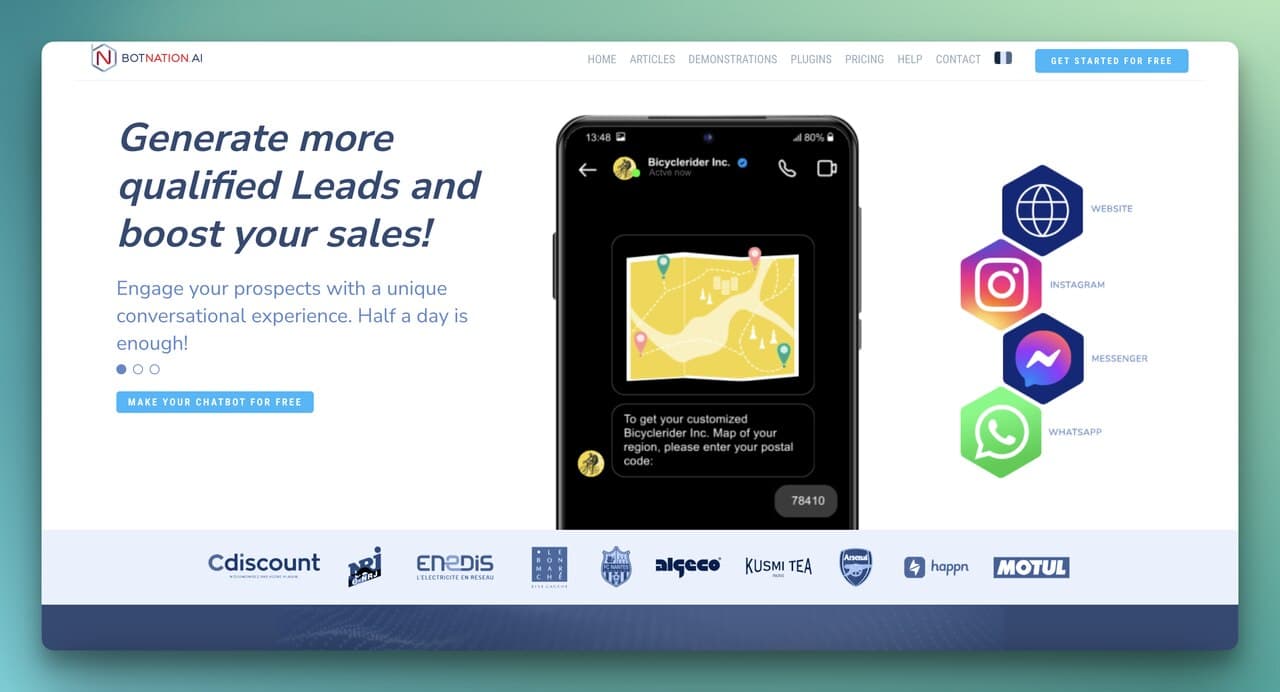
Best for: Marketing teams that want a no-code bot for lead capture, social engagement, and on-site engagement campaigns.
BotNation AI leans heavily into the marketing use case — Messenger funnels, Instagram DM automation, on-site lead-capture bots, and ChatGPT plus DALL-E integrations for richer interactions. The drag-and-drop builder is the friendliest in this list for non-technical marketers.
Key features:
• No-code builder: Visual flow design with real-time testing.
• Multi-platform reach: Web, WhatsApp, Messenger, Instagram, WordPress.
• ChatGPT and DALL-E: AI-generated text and images inside conversations.
• CRM and API plugins: Connect to your existing marketing stack.
• Real-time analytics: Conversation metrics, A/B testing, performance dashboards.
Pricing:
• Free ($0/mo): Unlimited bots, free building, perfect for testing.
• Starter+ ($29/mo): 500 conversations, unlimited collaborators.
• Business ($49/mo): 1,000 conversations, unlimited bots.
• Enterprise: Custom quote with dedicated account manager and premium support.
Where it falls short: BotNation AI is built for engagement, not deep support deflection. If your goal is reducing tickets, a support-first platform wins. The analytics are also shallower than enterprise-grade options.
Choose BotNation AI if your primary metric is engagement or lead capture, not ticket reduction.
4. Chit Chat Agency: Custom messaging automation
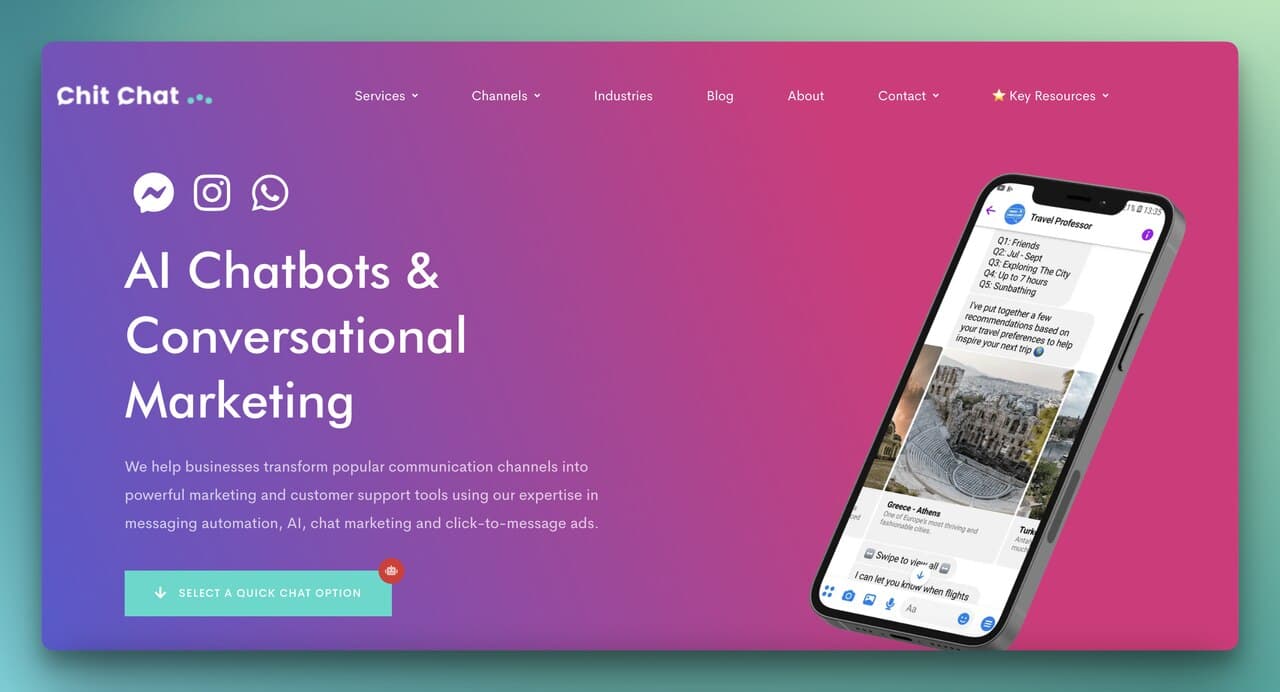
Best for: Mid-market brands that want a fully custom build across Messenger, WhatsApp, Instagram DMs, and Google Business Messages.
Chit Chat Agency is a pure services shop. There's no self-serve platform — you scope a project, they build it, and they hand you a working messaging automation stack. The team is strong on conversational marketing and click-to-message ads, which makes them a fit for ecommerce brands running paid social.
Key features:
• Custom chatbot development: Tailored to your conversion goals, not a template.
• Omnichannel messaging: Unified strategy across major messaging platforms.
• Conversational ads: Click-to-message campaigns on Google and Meta.
• AI and automation: Lead qualification and personalized customer journeys.
• CRM integration: Customer data flowing back into your stack.
Pricing: Custom quotes only — expect five-figure project minimums for a real build, plus a monthly retainer.
Where it falls short: No self-serve option means a slow start. If you need to test ROI before committing, this isn't the path.
Choose Chit Chat if you've already validated the use case and want a senior team building the production version.
5. Chat Ergo Bot: Customizable bots for SMBs
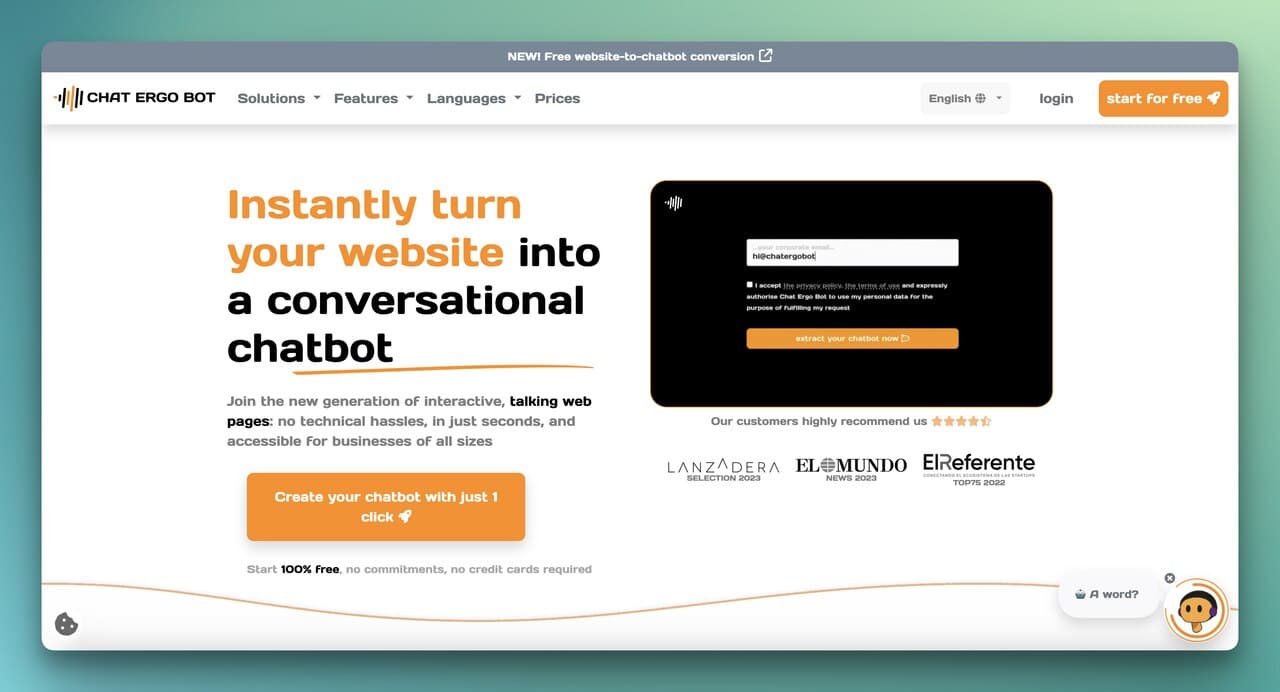
Best for: SMBs and startups that want CRM-connected chatbots plus light voice-AI capability without enterprise pricing.
Chat Ergo Bot sits in a useful niche — small-business pricing with grown-up features. They connect bots to your CRM, surface real-time sales data inside conversations, and even handle company phone-line automation, which most of this list doesn't touch.
Key features:
• Custom CRM integration: Direct connections to your sales stack.
• Real-time data access: Bots that pull live business metrics into conversations.
• Automated workflows: Routine task automation across departments.
• Voice-enabled chatbots: Phone-system integration for hybrid customer service.
• Local plus global expertise: Solutions tailored to specific regional markets.
Pricing:
• Free: 250 interactions, basic features.
• Starter (€23-29/mo): 1,000 interactions, starter support.
• Pro (€43-54/mo): 3,000 interactions, premium support, optional ChatGPT.
• Enterprise (€63-79/mo): 5,000 interactions, customization options.
Where it falls short: Smaller customer base means fewer pre-built integrations and less community content than the bigger platforms.
Choose Chat Ergo Bot if you're a European SMB or startup that wants CRM-connected bots without negotiating an enterprise contract.
6. ChatBot: No-code support automation
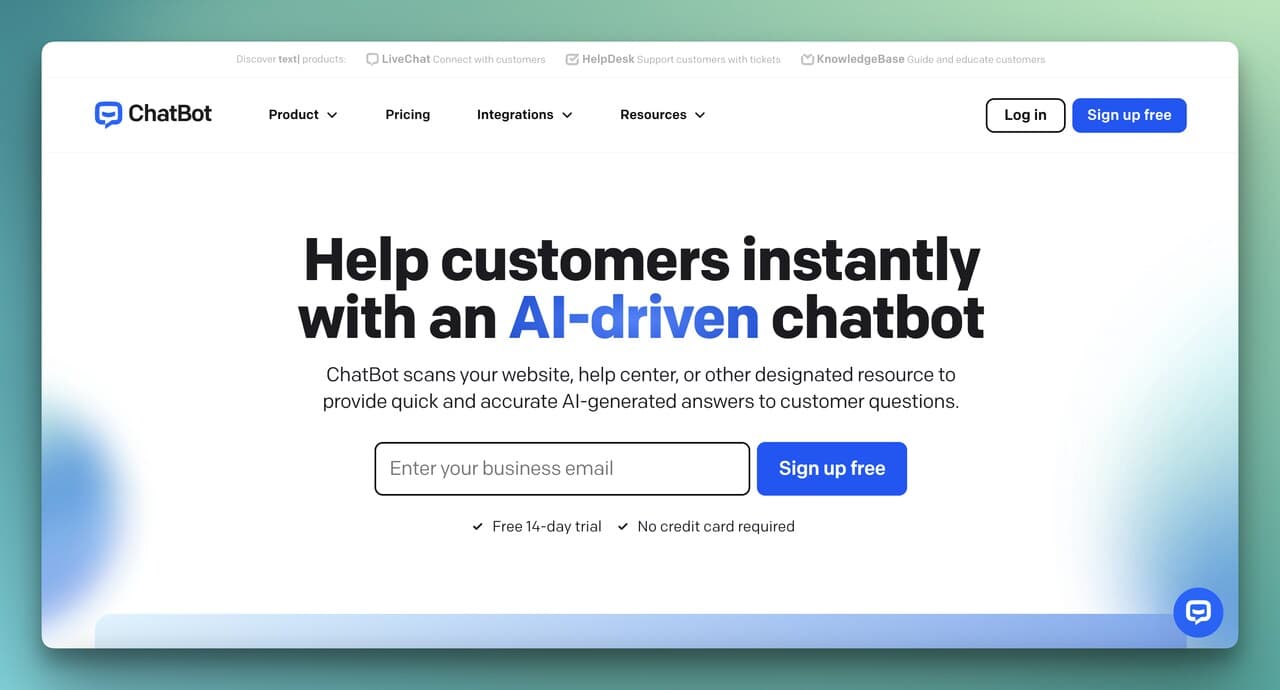
Best for: Support teams that want a no-code bot with FAQ-style answer training and tight LiveChat integration.
ChatBot (by Text Inc., same parent as LiveChat) is a polished no-code platform with strong FAQ management and tight integration to its sibling LiveChat product. If you're already on LiveChat or HelpDesk, ChatBot slots in cleanly. Outside of that ecosystem, the value proposition is thinner against newer agent-style competitors.
Key features:
• AI Assist Technology: Bot trained on your own generative AI framework.
• Multiple data sources: Websites, help centers, and uploaded documents.
• Data security: All interactions processed and hosted in-platform.
• FAQ module control: Manual priority over AI-generated answers.
• Personalized communication: Customer-data-driven responses.
Pricing:
• Starter ($52/mo annual): 1 bot, 1,000 chats/mo, basic reporting.
• Team ($142/mo annual): 5 bots, 5,000 chats/mo, advanced reporting.
• Business ($424/mo annual): Unlimited bots, 25,000 chats/mo.
• Enterprise: Custom — dedicated manager and premium support.
Where it falls short: Pricing scales aggressively at the Business tier. Newer AI-agent platforms now outperform it on resolution rate at a lower price.
Choose ChatBot if you're already inside the LiveChat ecosystem and want the bot tier from the same vendor.
7. LiveChat: Omnichannel chat with bot add-on
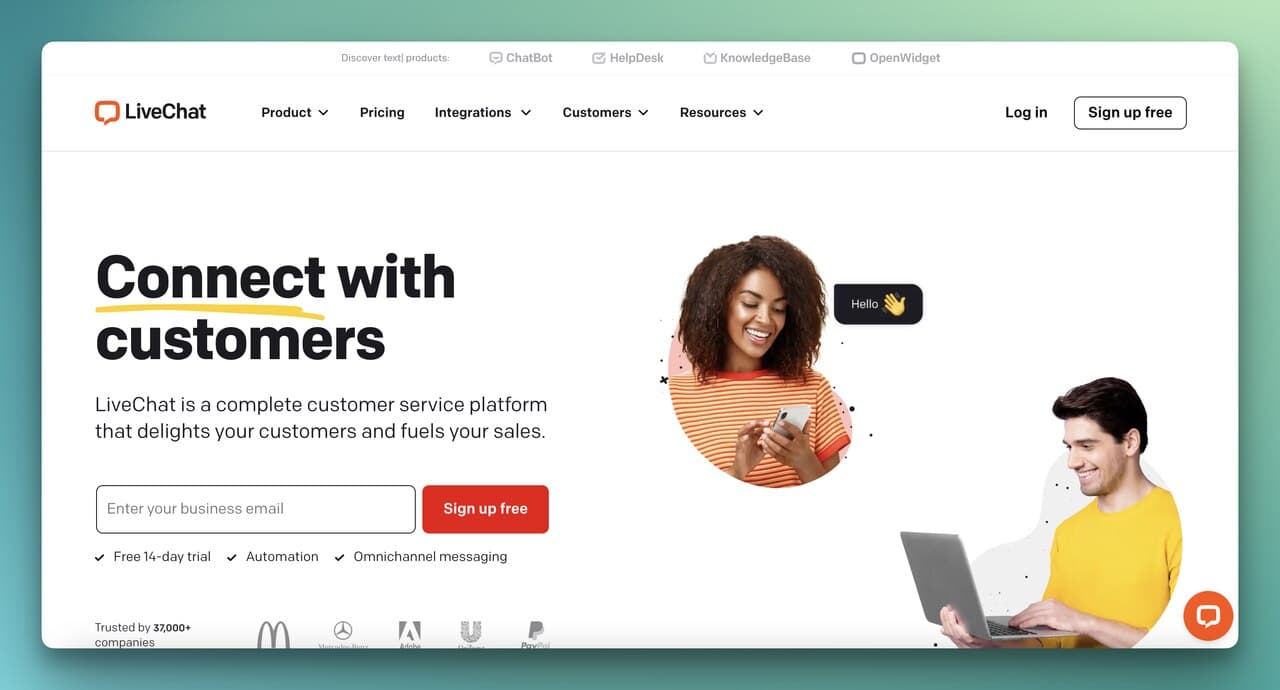
Best for: Sales-led teams that want strong live-agent chat first and chatbot automation second.
LiveChat is fundamentally a human-agent live-chat platform that has bolted on bot capabilities over the years. It shines for retail and SaaS teams where the live agent is still the primary channel and the bot handles overflow or after-hours. The 200+ integrations make it easy to drop into existing stacks.
Key features:
• Omnichannel messaging: Website, social, and email under one inbox.
• AI-driven chatbots: Bot tier available as an add-on product.
• Product showcases: Inline product cards inside the chat window.
• Custom forms and automation: Native chatbot automation for lead qualification.
• 200+ integrations: CRMs, payment processors, ticketing systems.
Pricing:
• Starter ($20/mo per agent): Track 100 visitors, 60-day chat history.
• Team ($41/mo per agent): Unlimited campaigns and full customization.
• Business ($59/mo per agent): 1,000 visitor tracking and advanced reporting.
• Enterprise: Custom — HIPAA compliance and white labeling.
• Add-ons: ChatBot from $52/mo, HelpDesk from $29/mo, KnowledgeBase from $29/mo.
Where it falls short: The bot is a separate product, so total cost adds up. AI-agent capabilities lag behind purpose-built agent platforms.
Choose LiveChat if live human chat is your priority and the bot is a nice-to-have layer on top.
8. Intercom: Enterprise customer service suite
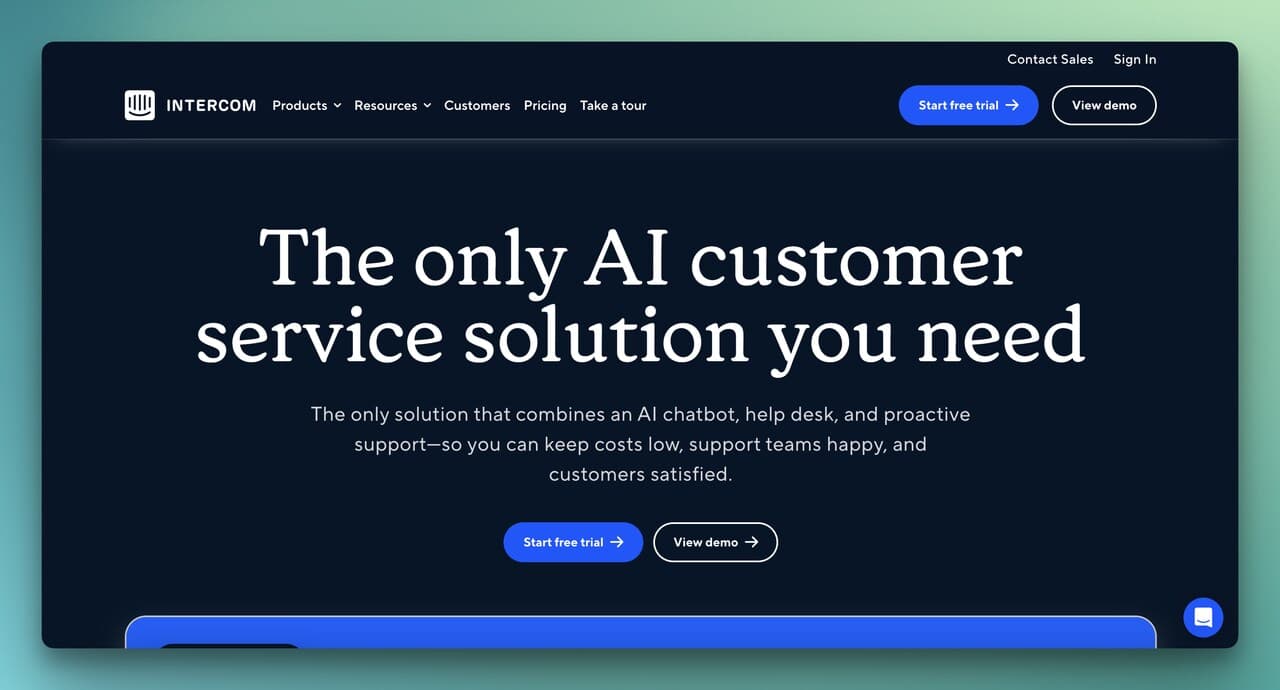
Best for: Mid-market and enterprise teams that want a single suite covering helpdesk, proactive messaging, and AI chatbot.
Intercom is the suite play. Their AI agent (Fin), the help desk, proactive messaging, and the inbox all sit under one roof. The trade-off is price — per-seat costs add up fast, and the AI Chatbot bills separately at $0.99 per resolution on top of the seat license.
Key features:
• AI-enhanced help desk: Inbox, tickets, and help center in one workspace.
• Fin AI Chatbot: Resolution-based pricing on top of every plan.
• Proactive support: In-context messages that reduce inbound volume.
• Omnichannel messaging: Email, SMS, and social channels.
• Platform integrations: Extensive third-party app marketplace.
Pricing:
• Essential ($39/seat/mo): Basic bots, automation, help desk.
• Advanced ($99/seat/mo): Advanced automation and AI capabilities.
• Expert ($139/seat/mo): Enhanced collaboration and reporting.
• Fin AI: $0.99 per resolution, available on every plan.
Where it falls short: Total cost of ownership escalates fast once seat count and resolution fees stack. Smaller teams routinely outgrow the budget before they outgrow the product.
Choose Intercom if you're a mid-market or enterprise team committing to a single vendor across the whole support stack.
9. Freshchat: Unified conversational engagement
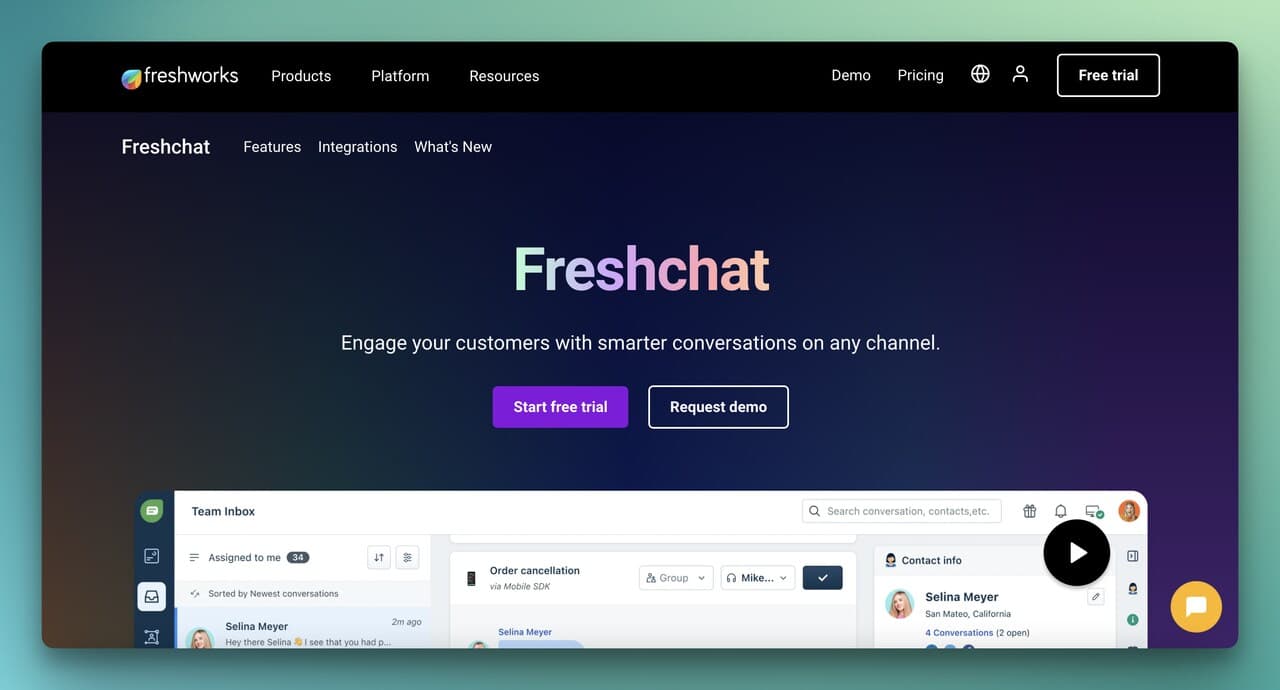
Best for: Companies already on Freshworks' product line that want native chat plus AI agent capability.
Freshchat is part of the Freshworks suite (the same family as Freshdesk and Freshsales). For teams already invested in that ecosystem, it's the obvious choice — context flows across products, billing consolidates, and the bot integrates without extra plumbing. As a standalone, it's solid but not category-leading.
Key features:
• Channel freedom: Customers pick their preferred channel; agents see one inbox.
• Bot-driven support: AI-powered self-service across web, app, and messaging.
• Unified agent workspace: Past interactions and purchase history at hand.
• Proactive customer journeys: Trigger messages on lifecycle events.
• Admin and analytics: Behavior and team performance dashboards.
Pricing:
• Free: Up to 10 agents, basic inbox features.
• Growth ($19/agent/mo): Assignment rules, segmentation, basic dashboard.
• Pro ($49/agent/mo): Auto-resolve, IntelliAssign, live translation.
• Enterprise ($79/agent/mo): Domain restrictions, skill-based routing.
Where it falls short: The standalone AI agent capability is meaningfully behind purpose-built agent platforms. The free tier is generous but caps below growth use cases.
Choose Freshchat if your support team already runs on Freshworks tools.
10. TARS: Conversational AI for enterprises
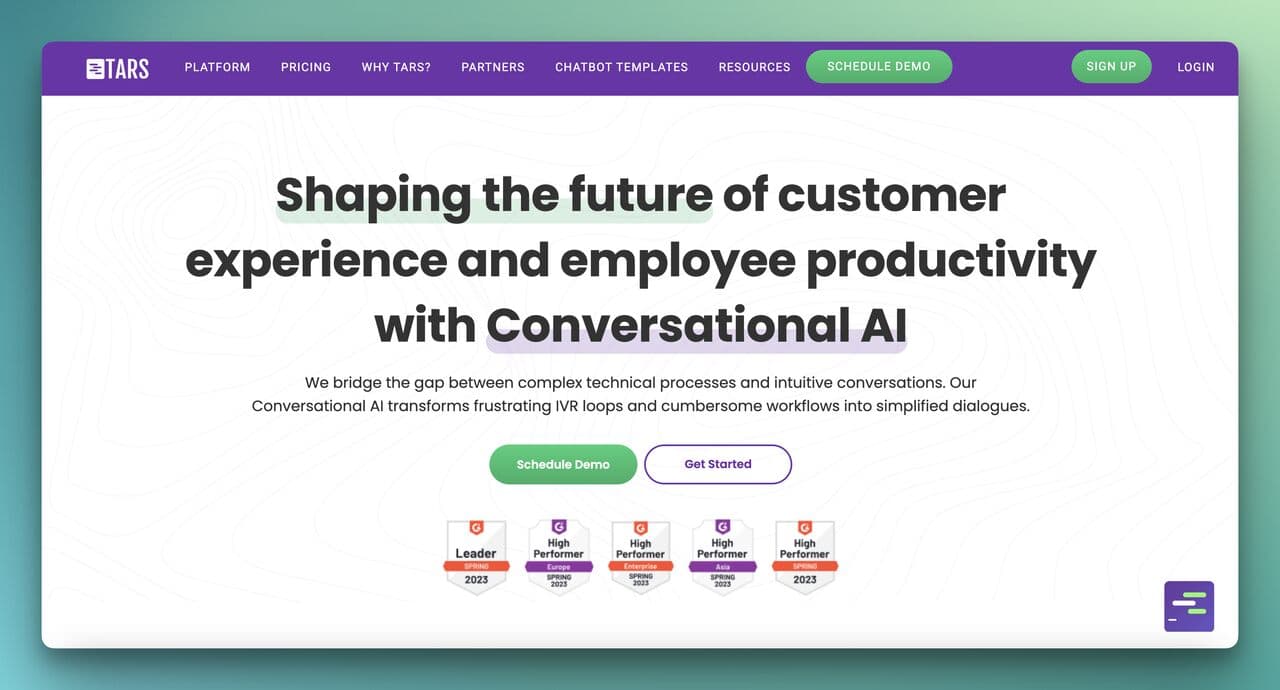
Best for: Enterprises and regulated industries (finance, healthcare, government) that need a custom build with deep compliance work.
TARS is one of the few players in this list that genuinely operates as an enterprise services shop. They've deployed for 700+ global brands, including in government and education, and their work focuses on converting complex IVR systems into conversational interfaces. Pricing is bespoke, timelines are longer, and the output is enterprise-grade.
Key features:
• Conversational AI for complex flows: IVR replacement and workflow automation.
• Documented ROI: Case studies with named annual savings and automation rates.
• High automation rates: Production deployments hitting 70%+ deflection.
• Conversion optimization: Bots tuned for sales lift, not just deflection.
• Industry-specific builds: Government, finance, education, healthcare templates.
Pricing: Custom — fill out the contact form. Expect enterprise minimums.
Where it falls short: No self-serve tier means longer sales cycles. Smaller teams won't get serious attention.
Choose TARS if you're an enterprise replacing legacy IVR or building under strict compliance constraints.
11. Chatfuel: Ecommerce and WhatsApp commerce
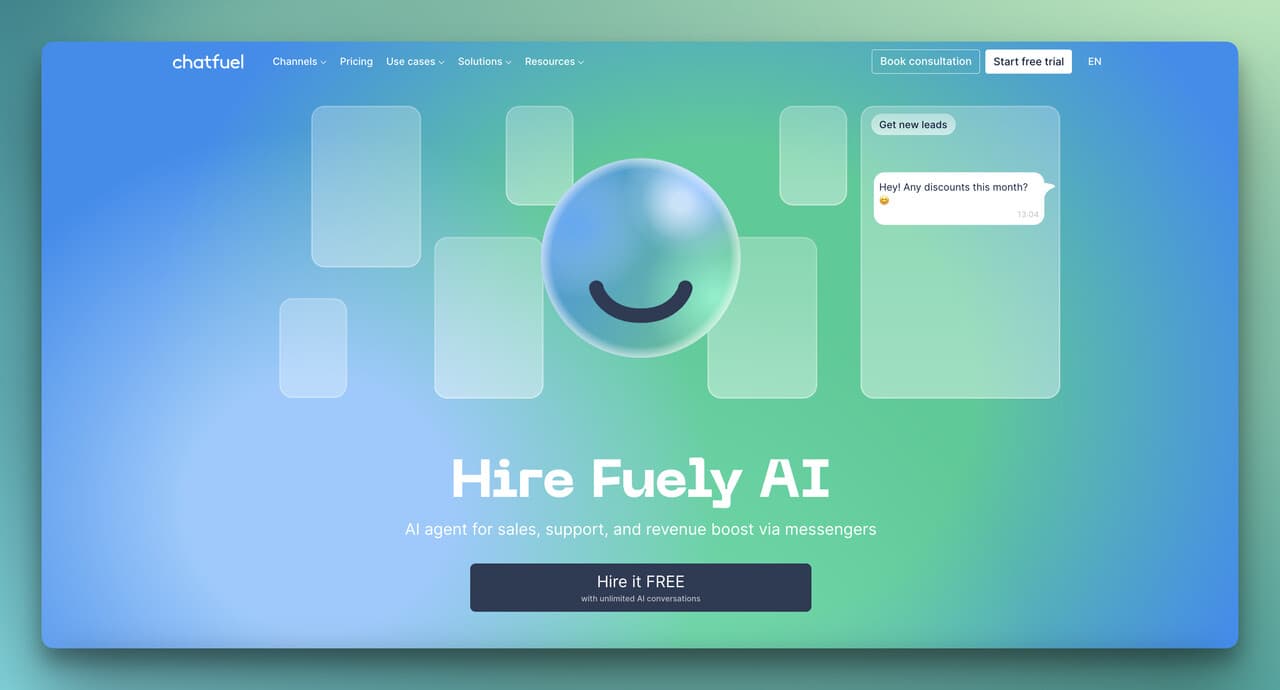
Best for: Ecommerce brands selling on WhatsApp, Instagram, and Messenger that need an AI agent built for commerce flows.
Chatfuel's Fuely AI agent is purpose-built for ecommerce. The platform is an official WhatsApp Business API provider, which matters if WhatsApp commerce is your channel, and the integrations to Shopify, Stripe, and Calendly cover most direct-to-consumer use cases. For a deeper look at ecommerce-specific options, our best ecommerce chatbots roundup compares them side by side.
Key features:
• Versatile skill set: Bookings, FAQs, lead qualification, product recommendations.
• Native ecommerce integrations: Stripe, Calendly, Shopify, Zapier, Google Sheets, HubSpot.
• WhatsApp Business optimization: Unlimited agents under one verified number.
• Built-in ChatGPT: Human-like dialogue for product recommendations.
• Recovery and re-engagement tools: Abandoned cart, upsell, feedback collection.
Pricing:
• Business ($14.39/mo): 500 conversations/mo, $0.03 per extra conversation.
• Enterprise ($300/mo): Everything in Business plus dedicated account manager and bot-building services.
Where it falls short: Heavy ecommerce focus means non-commerce use cases feel awkward. The conversation-pricing model adds up fast on high-volume accounts.
Choose Chatfuel if you're a Shopify or WhatsApp-first ecommerce brand and conversational commerce is your channel.
How to choose the right chatbot agency for your business
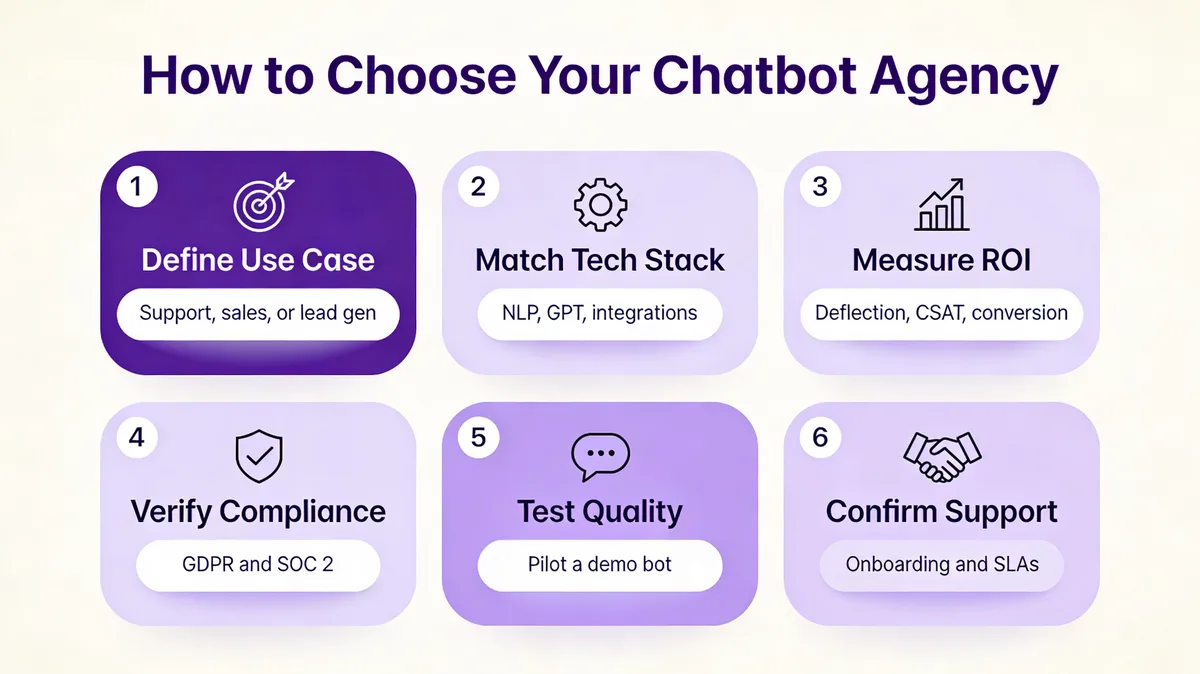
Choosing a chatbot agency is a 4-6 week evaluation, not a one-call decision. The 10 considerations below are the same checklist I'd hand a buyer who has narrowed the shortlist to three. Run every candidate through all ten.
1. Understand your business needs and goals
Define the outcome before you talk to a single agency. Are you trying to deflect 40% of incoming tickets, capture 2x more qualified leads, or replace an aging IVR system? Each goal points to a different agency type, and a vague brief gets you a vague proposal.
Map the use cases too. A bot living on a Shopify checkout has different requirements than one inside Slack for employee support. Write down the channels (web, WhatsApp, Messenger, internal), the volume (chats per month), and the success metric. Our chatbot use cases breakdown has 25 real-world examples across industries if you need a starting frame.
2. Assess the agency's expertise and experience

Specialization beats generalism. An agency that's deployed 200 ecommerce chatbots understands cart-abandonment patterns. A generalist team learns them on your timeline and your budget.
Ask for portfolio links — not just logos on a homepage. Want case studies with named clients, deployed-bot URLs you can actually click, and metrics you can verify. If an agency can't produce three of those, that's a flag. Then look at the team's individual backgrounds on LinkedIn: ML engineers, conversation designers, and prompt engineers should all be on the roster, not just project managers.
3. Evaluate the technology and platforms
The agency's tech stack determines what you can do today and what you'll be locked into in three years. Ask which underlying AI models they use (GPT-4o, Claude, Llama, fine-tuned in-house), which platforms they support natively (Shopify, Salesforce, HubSpot), and whether they build white-label on their own platform or on top of a third-party tool.
Customization matters more in 2026 than it did even last year. According to Databricks, enterprises are shifting from single chatbots to multi-agent systems, which grew 327% in under four months — and more than 80% of databases will be built by AI agents under that report's projections. If your agency can't articulate a multi-agent roadmap, you're hiring last year's stack.
4. Consider the design and user experience
Bad conversation design tanks even the best AI. Ask to see the agency's conversation design process — do they write fallback paths? Do they test on real users before launch? Do they have a UX designer on the team, or is the bot just whatever the developer typed?
The bot's tone has to match your brand. A playful DTC voice in a healthcare bot reads as untrustworthy. A formal corporate tone on a Shopify cart bot feels stiff. Agencies that nail this have a content team, not just engineers.
5. Look into integration capabilities

The bot is only useful if it talks to the systems you already run. Map your existing stack — CRM, helpdesk, ecommerce, marketing automation, internal tools — and check that the agency has shipped integrations for each one. "We can build it" is fine but expensive. "We already have it" is faster and cheaper.
Data handling matters too. GDPR, CCPA, and HIPAA all have real teeth in 2026. Ask how the agency stores conversation logs, where the data physically lives, who has access, and whether they sign a Data Processing Agreement. If their answer is hand-wavy, walk.
6. Analyze the agency's development process
Agile beats waterfall for chatbot work. The first version is always wrong — you find out at the first 100 conversations whether your fallback paths cover the real intents. An agency that ships in 2-week sprints with weekly review calls will catch issues fast. One that disappears for a quarter and emerges with a finished product will hand you a bot that doesn't fit reality.
Ask for the sprint cadence, the communication channels (Slack, weekly calls, async docs), and who from the agency is on each meeting. If a senior person sells the project and a junior team builds it, you're in for surprises.
7. Understand the support and maintenance model
The launch is the easy part. The first three months after launch are where most chatbot projects fail — failed intents pile up, the knowledge base goes stale, and nobody on your team has the playbook to fix it.
Ask for the post-launch model in writing. Monthly retraining? Quarterly reviews? Embedded support engineer? Self-serve dashboard? And training for your team — both the technical team that will own the bot long-term and the support agents who'll handle escalations — is non-negotiable. Skip the agency if training is an upsell.
8. Consider pricing and ROI

Transparent pricing is rare in this space. Many agencies quote project ranges that double under "scope creep," then add monthly retainer fees for maintenance you assumed was bundled. Get itemized quotes — discovery, build, deployment, training, monthly maintenance, model retraining — with line-item costs.
Pre-build an ROI model with the agency. If they can't help you calculate expected deflection rate, cost per ticket saved, and break-even month, they probably don't have the data to know whether your project will succeed. Our guide on chatbot monetization strategies covers the revenue side for agencies and resellers building chatbot businesses on top of these platforms.
9. Check client references and reviews
Three references on a call, not just logos on a slide. Ask the references how the build went, what surprised them, what they'd change, and what the agency does poorly. The honest answer is the useful one.
Then check G2, Clutch, and Trustpilot for unfiltered reviews. Look at the 3-star reviews — they're more telling than 5-star ones. A pattern of complaints about scope creep, missed deadlines, or shallow post-launch support is the real signal.
10. Cultural and ethical alignment
Three years of working with an agency means you'll spend more time with their team than with some of your own employees. Communication style, response speed, willingness to push back, and how they handle disagreement all matter. A 60-minute working session beats a polished sales pitch for testing fit.
Ethics matter too. How does the agency handle bias in AI outputs? Do they audit responses for harmful content? Do they have a clear policy on what the bot won't say? Brands that skipped these questions in 2023 spent 2024 cleaning up screenshots. Don't repeat that.
Chatbot agency pricing models explained
Pricing is where most procurement processes get stuck. Agencies use four common models, and each one suits a different buyer profile.
• Project-based ($5K-$150K+): One-time fee for a defined scope — discovery, build, deployment, and a short post-launch window. Best for buyers with a clear use case and an internal team to own the bot afterward. Hidden risk: scope creep adds 20-40% to the original quote in most engagements.
• Monthly retainer ($2K-$25K/mo): Continuous build, optimization, and maintenance for an agreed scope. Best for evolving needs and teams without internal AI capacity. Hidden risk: agencies optimize for billable hours rather than measurable outcomes, so retainer scope must be written down.
• Platform plus services (hybrid): SaaS subscription plus done-for-you build hours. Best when the agency has its own platform and you want both the tool and the team. Hidden risk: vendor lock-in if you ever want to switch platforms.
• Revenue-share or performance-based (5-25% of attributed revenue): Rare but growing in ecommerce. Agency takes a slice of incremental revenue or cost savings the bot generates. Best when ROI is measurable and the agency is confident in its tech. Hidden risk: attribution disputes and minimum guarantees in the contract.
The chatbot market itself is large enough to support all four models. According to WotNot, the chatbot market size was estimated at $9.56 billion in 2025, and momentum is still building into 2026.
Common mistakes when hiring a chatbot agency
Most chatbot project failures aren't tech failures — they're hiring failures. These are the patterns I've seen wreck six-figure budgets.
Buying on vendor logos instead of fit
The agency that built bots for three Fortune 500 brands might still be a bad fit for your DTC Shopify store. Use case beats reputation. A boutique team that has shipped 50 ecommerce bots will outperform a generalist with one big-name logo.
Skipping the discovery phase to save money
Discovery looks like an upsell. It isn't. Without it, the agency is building in the dark, and you'll spend the savings (and more) on rework. Budget 2-4 weeks for proper discovery on any project north of $25K.
Treating the bot as a "set and forget" product
The bot needs feeding. New product launches, policy changes, seasonal promotions — every one of those requires knowledge-base updates and intent retraining. If you don't budget for that work, your bot decays inside 90 days.
Underestimating change management
Support agents resent bots that take "easy" tickets and leave them with only the hard ones. Train the team, redesign the agent role around higher-value work, and measure agent satisfaction alongside CSAT. A bot that wins on metrics but burns out your support team is a Pyrrhic win.
Ignoring AI-quality fundamentals
Hallucinations, biased responses, and off-brand tone are real risks. Ask the agency about evaluation frameworks, response auditing, and how they catch regressions before they reach production. Harvard Business School research found that AI helped human agents respond to chats about 20% faster while improving empathy and thoroughness — the upside is real, but only if the AI is well-tuned. Bad AI makes humans worse, not better.
Future trends in chatbot agency services
What chatbot agencies sell in 2026 will look different from what they sold even in 2024. Four shifts are reshaping the work.
From bots to multi-agent systems
The single-bot era is ending. Modern deployments increasingly chain specialized AI agents — one handles intake, one handles billing lookups, one handles refunds — with an orchestrator routing between them. That architecture handles complexity that overwhelmed earlier monolithic bots, and it's why the multi-agent growth numbers above are stunning. Agencies that can't design and deploy multi-agent systems are about to look outdated.
Voice AI joining the chat stack
Voice agents have crossed the quality threshold where they're indistinguishable from a polite human caller for narrow tasks. Chatbot agencies are extending into voice — phone-line automation, IVR replacement, voice commerce — and the boundary between "chat" and "call" is dissolving. Expect to see voice quoted alongside chat in agency proposals by the end of 2026.
Vertical specialization beating horizontal coverage
The biggest agency wins this year are going to specialists. Healthcare-only agencies that know HIPAA cold. Fintech agencies with regulatory templates. Ecommerce agencies with cart-recovery playbooks. Horizontal generalists are losing share because vertical buyers value depth over reach. According to ChatMaxima's market data, the global AI customer service market is projected to reach $15.12 billion in 2026, up from $12.06 billion in 2024 — and the vertical specialists are taking disproportionate share of that growth.
Pricing models tilting toward performance
The smarter agencies are increasingly happy to put skin in the game with outcome-based pricing — share of revenue, share of cost savings, or guaranteed deflection rates with rebates. Buyers should ask for it. Agencies that refuse to put outcomes in the contract are signaling that they're not confident in their own work.
Frequently asked questions about chatbot agencies
How much does a chatbot agency cost in 2026?
Chatbot agency pricing in 2026 spans roughly $14/mo for entry-level platform tiers (Chatfuel Business) to $150,000+ for fully custom enterprise builds (TARS, Chit Chat). Most mid-market SaaS deployments land between $5,000-$30,000 for the initial build plus a $1,500-$5,000 monthly retainer. Our deeper breakdown in the 2026 chatbot cost guide maps each tier to specific use cases.
Are chatbot agencies better than building in-house?
Agencies win on speed-to-launch and conversation design expertise; in-house wins on long-term ownership and customization depth. Hire an agency if your goal is a working bot in under three months. Build in-house if you have ML engineers on staff and the bot is a strategic capability you want to own outright.
What's the difference between an AI chatbot and an AI agent?
A chatbot answers questions using a language model and a knowledge base. An AI agent takes actions — it queries APIs, triggers workflows, schedules calendar events, processes refunds. The 2026 trend is from chatbots to agents, and the best agencies already deliver agents by default. See our chatbot business ideas roundup for monetization paths that exploit the agent capability.
How do I integrate a chatbot agency's solution with my CRM?
Most modern agencies ship native connectors for major CRMs — HubSpot, Salesforce, Pipedrive, Zoho. The agency hands you a setup checklist, you authorize the OAuth connection, map fields between the bot and your CRM, and the data flows starts within hours. For non-standard CRMs, an API integration adds 1-2 weeks. Confirm the integration list before signing.
Which chatbot agencies offer free website chatbots?
LiveChatAI offers a permanent free plan with 100 GPT-4 messages and 1 chatbot — enough to deploy a working bot on a small website. Freshchat is free for up to 10 agents on the basic plan. BotNation AI's free tier supports unlimited bots with limited conversations. For full agency builds, "free" rarely applies — discovery may be free, but production work is paid.
How do I tell if my agency's chatbot is genuinely AI or a scripted bot in disguise?
Ask three questions during discovery. First, "what underlying model are you using?" — a real AI agency will name GPT-4o, Claude, or a fine-tuned open-source model. Second, "can the bot handle a question it wasn't explicitly trained on?" — a scripted bot can't; an AI agent will reason its way to an answer. Third, "show me the evaluation framework you use to catch hallucinations." If the answer is vague, the bot is mostly scripted with a thin AI layer.
Picking your chatbot agency partner
The chatbot agency you hire in 2026 is going to look different from the one your peers hired in 2023. Multi-agent systems, voice AI, vertical specialization, and performance-based pricing are reshaping the work — and the agencies that haven't kept up are the ones still selling you scripted bots in a new wrapper.
According to Crescendo, customers using live chat spend roughly 60% more per purchase, and AI live chat agents respond up to 3x faster than human ones. The agency that delivers both — high spend per session and high response speed — is the one worth signing.
Start with one shortlist of three agencies that match your use case. Run them through the 10-point evaluation framework above. Pick the one with the strongest portfolio plus the clearest post-launch maintenance model. Ship a pilot in 6 weeks. Measure. Then expand.
Articles you might like: