



A charity AI chatbot is a conversational assistant trained on a nonprofit's own donation pages, FAQs, program details, and impact reports so it can answer donor, volunteer, and beneficiary questions instantly. Unlike generic support bots, it speaks in the charity's mission voice, hands off sensitive cases to humans, and frees up scarce staff hours.
What is a charity AI chatbot?
A charity AI chatbot is a domain-trained conversational assistant a nonprofit deploys on its website, WhatsApp, Messenger, or email to handle the high-volume questions that used to clog a single info@ inbox. It pulls answers from sources the charity already owns, donation FAQs, program eligibility pages, annual reports, volunteer handbooks, and replies in the same tone the team would use over the phone.
The difference between this and a generic support bot is mostly about training data and tone. A retail support bot is trained on order numbers and shipping windows. A charity bot is trained on grant cycles, gift-aid rules, beneficiary intake forms, and the difference between a one-time gift and a recurring monthly pledge. It has to speak with care, route safeguarding mentions to a human within seconds, and stay accurate when donors ask about tax receipts.
I've worked with charity ops teams shipping their first AI chatbot, and the question I get most often is whether donors will notice they're not talking to a person. The honest answer is yes, they usually do, and they don't mind, as long as the bot is clearly labelled, gives correct answers, and offers a human handoff for anything emotional or financial. Donor trust drops when the bot pretends, not when it admits.
Most charity chatbots today run on no-code platforms. The nonprofit uploads PDFs and points the bot at a sitemap. Within an afternoon, the team has a working assistant trained on its own content, no developers required.
Why nonprofits need AI chatbots in 2026
Charity ops teams are stretched thinner than at any point in the last decade. Inboxes pile up with donor receipt requests, volunteers cancel shifts at midnight, and grant applicants want status updates the same week they submit. The math has stopped working.

The adoption curve is already steep. A chatbot is one of the few use cases where the impact is visible inside a quarter.
The expectation gap is bigger than the adoption gap. According to Nonprofit Tech for Good, 70% of nonprofits believe AI can reduce workload and improve communications, but 60% say they lack the in-house expertise to assess the tools, and only 4% have AI-specific training budgets. That's the actual barrier, not the technology, the confidence to pick a tool and ship it.
And there's a revenue story too. According to Rosica, more than 30% of nonprofits reported increased fundraising revenue in the past year after adopting AI tools. Chatbots aren't the only reason, but they're often the first donor-facing AI a charity ships, which makes them the test that decides whether the team trusts AI for anything else.
Donor expectations have also shifted. People who chat with their bank's AI agent at 11pm assume your charity has the same option. When they don't get an answer, they don't email, they go to the next cause on their list. A customer support cost analysis across 50 industries shows the same pattern in commercial settings, and nonprofits aren't insulated from it.
6 high-impact charity AI chatbot use cases
Not every nonprofit conversation is a good fit for automation. The ones that are tend to share three traits: high volume, predictable answers, and low emotional risk. These six use cases hit all three, and they're where I see the fastest return in our LiveChatAI customer audits.

24/7 donor inquiries
About 35-40% of online donations happen outside office hours. A chatbot trained on the donation FAQ, gift-aid rules, and tax receipt process can answer "Did my gift go through?" or "Can I make this anonymous?" without waking up the duty officer. It also captures the donor's email so the team can follow up the next morning if the question needed a human. Most charities I've worked with see donor email volume drop by 30-50% in the first month.
Recurring donation setup and management
Monthly giving is the highest-LTV donor segment most charities have, and it's also where the questions get awkward. "How do I update my card?", "Can I pause for three months?", "Why was I charged twice?". A bot that knows the payment provider, the cancellation policy, and how to surface a self-serve update link converts more recurring sign-ups and prevents avoidable churn.
Volunteer scheduling and reminders
Volunteer ops is a coordination job, not a coaching job. The bot can confirm shifts, send reminders 24 hours before, handle "I can't make Saturday" with a swap request, and surface backup volunteers from a waitlist. The human coordinator stays on the conversations that actually need a human, the new volunteer who's nervous about the first shift, the regular who needs a tactful conversation about reliability.
Beneficiary intake and eligibility checks
This is the use case that needs the most care. A bot can run a structured eligibility intake, things like "Do you live in our service area?", "Are you over 18?", "Do you have ID?", and either pre-qualify the person for a service or refer them out. Done well, it cuts intake time and gets people to the right resource faster. Done badly, it gates a vulnerable person out of help. Always pair this with a clear "talk to a human" option on every screen.
Event registration and follow-up
Galas, runs, community days, and webinars all share a registration funnel that a chatbot handles cleanly. The bot answers "Is this event free?", "Is parking included?", "Can I bring a friend?", processes the registration, sends the confirmation, and follows up the next day with a thank-you and a donation ask. After watching nonprofits cut donor inquiry response time from days to seconds at events, the gala team gets to actually run the event instead of triaging email.
Grant application status updates
Grant applicants are usually other nonprofits, and they're checking the same three things, "Did you get my application?", "When will I hear back?", "What's the next step?". A bot wired into the grants management system can answer all three without a program officer touching it. That frees the officer to spend time on the actual review work.
Real-world charity AI chatbot examples
The strongest case for a charity AI chatbot is what other nonprofits have already shipped. These four deployments show the range of what's possible.
The Alcohol and Drug Foundation built a bot called Dib that answers questions about alcohol and other drugs in plain language. According to SmartyGrants, Dib is described as a "friendly, knowledgeable bot providing non-judgmental, trustworthy information about alcohol and other drugs." It works by searching the foundation's own website for relevant documents, official policies, drug-specific guides, and harm-reduction updates, and relays the information in language someone in distress can actually parse. The non-judgmental tone is the design choice that matters most here.
Charity:water uses chatbots across its donor flow, particularly for one-time and recurring giving questions. The team built the bot to answer the questions a first-time donor asks before giving, "Where does my money actually go?", "Can I see the project I funded?", "Is my donation tax-deductible?". Pairing the bot with their project-tracking page lets a donor go from question to gift to impact tracking without leaving the chat.
World Vision deploys conversational AI for child sponsorship updates and donor service. The bot handles common sponsor questions like "When does my sponsored child write next?", "Can I send a gift?", "How do I update my address?", and routes anything sensitive, sponsorship cancellations, illness updates, to a human within the same chat thread. The handoff is the part most charities under-invest in.
Make-A-Wish uses chatbots for volunteer onboarding and event coordination. New volunteer applications used to take weeks of back-and-forth email; the bot now handles the qualifying questions, surfaces the right training modules, and books the first orientation call. According to TechSoup, although chatbots are relatively new to the nonprofit community, organizations like these are already using them in interesting and innovative ways. The pattern across all four is the same: pick the highest-volume conversation, automate the predictable parts, keep the human visible.
Benefits of AI chatbots for charities
The benefits a chatbot delivers depend on what your team is currently bottlenecked on. For most nonprofits I've audited, it's some combination of these six.
• Staff time recovered: The biggest win, by far. Charities that ship a chatbot for donor inquiries typically reclaim 10-20 hours of admin time per week in the first month. That time goes back to program work, donor stewardship calls, or actually leaving on time.
• True 24/7 access: Donations, volunteer sign-ups, and beneficiary inquiries don't respect office hours. A chatbot covers nights, weekends, holidays, and the awkward hour after the team has logged off but before the answering service kicks in.
• Multilingual reach: Most chatbot platforms let one bot answer in 50+ languages. For charities serving immigrant communities or international donors, that's the difference between a question answered and a question abandoned.
• Accessibility wins: Chat interfaces work better than phone trees for users with hearing impairments, anxiety, or limited English. The bot doesn't rush, doesn't sigh, and lets the person re-read the answer.
• Operational cost reduction: According to Conferbot, the average nonprofit spends 20-25% of its budget on administrative and fundraising costs (Charity Navigator, 2025). Trimming a few percentage points off the admin line by automating routine inquiries frees real money for the mission. For context on what self-serve AI typically costs, see our chatbot pricing breakdown.
• Scales without hiring: A giving Tuesday spike, a viral cause, or a disaster appeal can 10x your inbox overnight. A bot handles the spike. A team of two doesn't.
How to set up a charity AI chatbot in LiveChatAI
The fastest path from "we should try this" to a live bot is about three afternoons of work. Here's the version I walk new charity customers through.
Step 1: Add your data sources
The chatbot is only as good as the content it's trained on. Start by listing every donor-facing page and document you have, the donation FAQ, the gift-aid policy, the volunteer handbook, the program eligibility criteria, and the annual impact report. In LiveChatAI, you point the bot at a website URL or a sitemap, drop in PDFs, paste plain text, or import a CSV of question-and-answer pairs. Most charities I work with start with their existing FAQ page and a handful of PDFs.

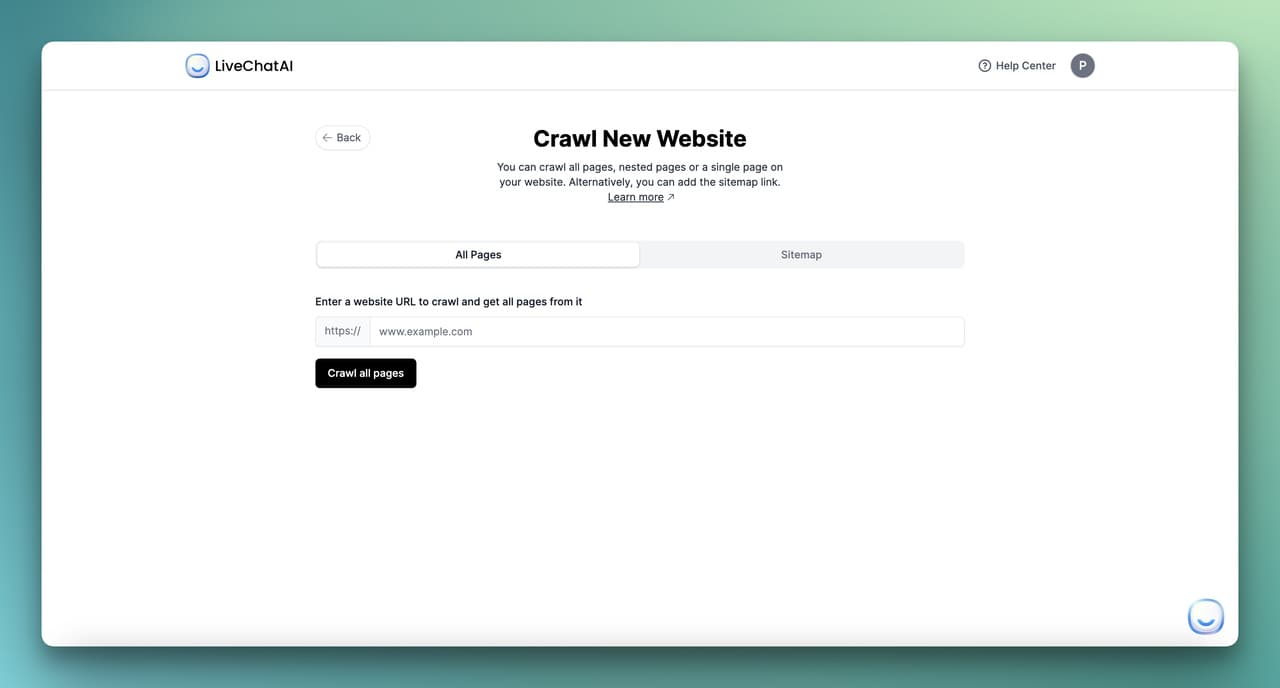
Step 2: Crawl your website content
Once you've added a website, the platform crawls every public page, lists them out, and lets you deselect anything irrelevant, old event pages, broken job listings, the staff bio nobody updated. This is the step where most teams skip ahead and regret it later. Spend ten minutes pruning the page list now and your bot won't tell donors about a 2019 fundraiser. Hit "Import the content & create my AI chatbot" and the index builds in a few minutes.
Step 3: Customize and embed
This is where the bot stops sounding generic and starts sounding like your charity. In the customization panel, set the bot's name (most teams pick something on-brand, not "ChatBot"), write the base prompt with your tone guidance, choose your model, and configure human handoff so any sensitive message gets escalated. Adjust the widget colors and the welcome message, then grab the embed snippet from "Embed & Integrate" and paste it into your site. You can ship it as a Messenger-style widget, a full-page chat, an inline embed, or wire it into WhatsApp and Slack.

One thing I tell every charity: turn on the email-collection prompt. Even when the bot answers the question, capturing the donor's email lets the stewardship team follow up. That's where the real fundraising lift comes from, not the bot itself.
Common charity AI chatbot challenges and how to address them
Charity AI chatbots fail in predictable ways. Plan for these four before you ship.
• Data privacy: Donors and beneficiaries share sensitive information in chat, payment details, health context, immigration status. Pick a platform that processes data in a region your donors trust (UK or EU for most European charities), publishes a clear data retention policy, and lets you redact or delete a transcript on request. Add a privacy notice to the welcome message.
• Donor trust and disclosure: Be obvious about the bot. Name it something that doesn't pretend to be human, label every message as AI-generated, and offer a one-tap human handoff on every screen. Donors forgive a bot that's honest. They don't forgive one that pretended.
• Accessibility: Test with screen readers before you launch. Make sure the chat widget has proper keyboard navigation, sufficient color contrast, and a way to enlarge text. A chat that works for sighted desktop users only excludes a meaningful share of your audience.
• Staff training and oversight: The bot is not "set it and forget it." Someone on the team needs to review the weekly conversation log, flag wrong answers, add new training content for repeated misses, and tune the handoff rules. Budget two hours a week for the first month, then about an hour a week after that. Skipping this step is the most common reason charity bots quietly degrade.
Ship a charity AI chatbot in week one
The fastest-growing charity ops teams I've worked with don't treat the chatbot as a six-month project. They block out an afternoon, point a no-code platform at their existing FAQ and donation pages, customize the tone, and embed it the same week. The first version is rough, and that's fine, the value comes from week two onward, when the team starts watching the conversation log and adding the answers donors actually wanted.
If you're sizing up where to start, the donor inquiry inbox is almost always the right first project. It's the highest volume, the most predictable, and the easiest place to show your board the bot is paying for itself. Volunteer scheduling and event registration are the natural second and third use cases. Beneficiary intake comes later, once the team has confidence in the handoff rules.
The same patterns show up in adjacent verticals, see how an AI chatbot for education handles student support, or how an AI chatbot for ecommerce manages high-volume buyer questions. The mechanics translate cleanly to a charity context, and the lift on staff hours is similar.
Pick one inbox. Train the bot on what you already have. Ship it this week.
Frequently asked questions
Can a charity AI chatbot operate 24/7?
Yes, that's one of the main reasons charities deploy them. The bot doesn't need breaks, doesn't take holidays, and handles donor questions, volunteer sign-ups, and beneficiary inquiries at 2am the same way it does at 2pm. Most platforms also let you change the bot's behavior outside office hours, for example, switching to "we'll respond first thing Monday" mode for human-handoff requests on a Friday night.
Can charity AI chatbots collect feedback from users?
Yes, and it's one of the underused features. After a conversation ends, the bot can ask a single thumbs-up question or a short survey, and the answers feed straight into your CRM. We have a guide on how to collect feedback with AI chatbots that walks through the survey patterns that actually get responses. The trick is keeping it to one or two questions, donors will not fill out a five-star matrix.
Can AI chatbots help with volunteer management?
Yes. The bot can post open shifts, accept sign-ups, send reminders 24 hours before, handle swap requests, and onboard new volunteers with a structured intake. It's especially useful for charities running multiple sites or events, where a human coordinator can't physically track every shift. Pair the bot with your volunteer database and the workflow gets close to automatic.
How do charity AI chatbots handle beneficiary support?
A well-built beneficiary bot runs a structured intake, checks eligibility against your service criteria, and either pre-qualifies the person for a program or refers them out to a partner organization. The hard rule: every screen needs a clear path to a human. Beneficiaries reaching out are often in crisis, and the bot's job is to remove friction, not gate access.
For further reading, you might be interested in the following:
How Much Does a Chatbot Cost in 2026?