



Aista is a low-code AI chatbot platform that turns your website, docs, and uploaded files into a custom GPT bot. The best Aista alternatives in 2026 are LiveChatAI for no-code customer support, CustomGPT for citation-backed answers, and Botpress for developer teams. Pick LiveChatAI if you want a working support agent in under an hour.
What Is Aista?

Aista is a low-code AI chatbot platform — not a marketing suite, not an SEO tool, and not a data-science platform. The product builds custom GPT-style bots from your website content, PDFs, and documents using a Hyperlambda-based low-code environment. Aista's pitch is that you can spin up a private "ChatGPT for your data" without writing much code, then deploy it on your website or integrate it with downstream apps. It sits in a competitive segment that has expanded sharply: according to Grand View Research, the chatbot market size was $9.56 billion in 2025 and is projected to reach $41.24 billion by 2033 at a 19.6% CAGR, so the field of Aista-class platforms has gotten crowded fast.
Where Aista historically wins: developer-leaning workflows, lots of low-code customization, and tight control over how the underlying GPT calls are wired up. Where teams start shopping for Aista alternatives: the learning curve for non-technical users, gaps in turn-key support features (handover, ticketing, multi-channel), and pricing that does not always match SMB budgets.
Pros and Cons of Aista
Here is the honest pros-and-cons read on Aista in 2026, with each point benchmarked against the 11 alternatives in this guide.
Pros of Aista:
• Custom GPT from your own data: Aista trains a bot on your site content, PDFs, and documents so answers stay grounded in what you publish.
• Low-code customization with Hyperlambda: Developers can extend bot logic, wire in API calls, and shape responses far beyond what a pure no-code tool allows.
• Self-hosting and on-prem options: Teams with strict data residency needs can run Aista in their own environment, which most SaaS-only competitors will not match.
• Embeddable chat widget: Drop-in script tag for adding the chatbot to any website.
Cons of Aista:
• Steeper learning curve for non-developers: The Hyperlambda-flavored UI rewards technical users; marketing and support managers usually want a simpler builder.
• Lighter on customer-support workflow features: Aista focuses on the chatbot layer; native ticketing, agent handover, helpdesk integrations, and SLA tooling are thinner than what you get from LiveChatAI, Intercom-style platforms, or Kommunicate.
• Smaller integration catalog: Compared to Chatbase or BotPenguin, the out-of-the-box integration list is short, which forces custom dev work or Zapier glue.
• Pricing opacity: Mid-market and SMB buyers report friction figuring out the right plan and seat counts, especially compared to transparent per-message pricing from Botsonic, DocsBot, or LiveChatAI.
Top Aista Alternatives in 2026 at a Glance

Before the deep-dives, here is a fast read on where each platform shines so you can scan and rule things out quickly. The chatbot category is also moving fast in 2026 — AIMultiple pegs the global chatbot market at roughly $11.8 billion growing at 23% per year, which explains the steady stream of new entrants that crowd around Aista's positioning.
• LiveChatAI: Best overall Aista alternative for AI customer support — fastest no-code setup, free plan, multilingual out of the box.
• CustomGPT: Best for large knowledge bases that need citation-backed answers and strict anti-hallucination behavior.
• Chatbase: Best for marketers who want a fast, polished no-code builder with strong analytics.
• Botpress: Best for developers who want a visual flow editor with first-class LLM hooks and self-hosting.
• Voiceflow: Best for product teams designing conversational AI across chat and voice channels.
• Stack AI: Best for enterprise teams building internal AI assistants and RAG workflows.
• Wonderchat: Best for solopreneurs who want a fast site-to-bot setup with a friendly UI.
• BotPenguin: Best for multichannel deployment across WhatsApp, web, and Messenger.
• Botsonic (Writesonic): Best for marketing teams already inside the Writesonic ecosystem.
• DocsBot AI: Best for documentation and developer-tooling companies that want an instant docs bot.
• Kommunicate: Best for support teams blending AI bots with live human handover and ticketing.
11 Best Aista Alternatives for AI Chatbots
Each entry below covers what the tool is, who it is for, the features that matter, current pricing, pros and cons, and a one-line verdict. The order roughly reflects how often each platform comes up as an Aista replacement in 2026.
1. LiveChatAI

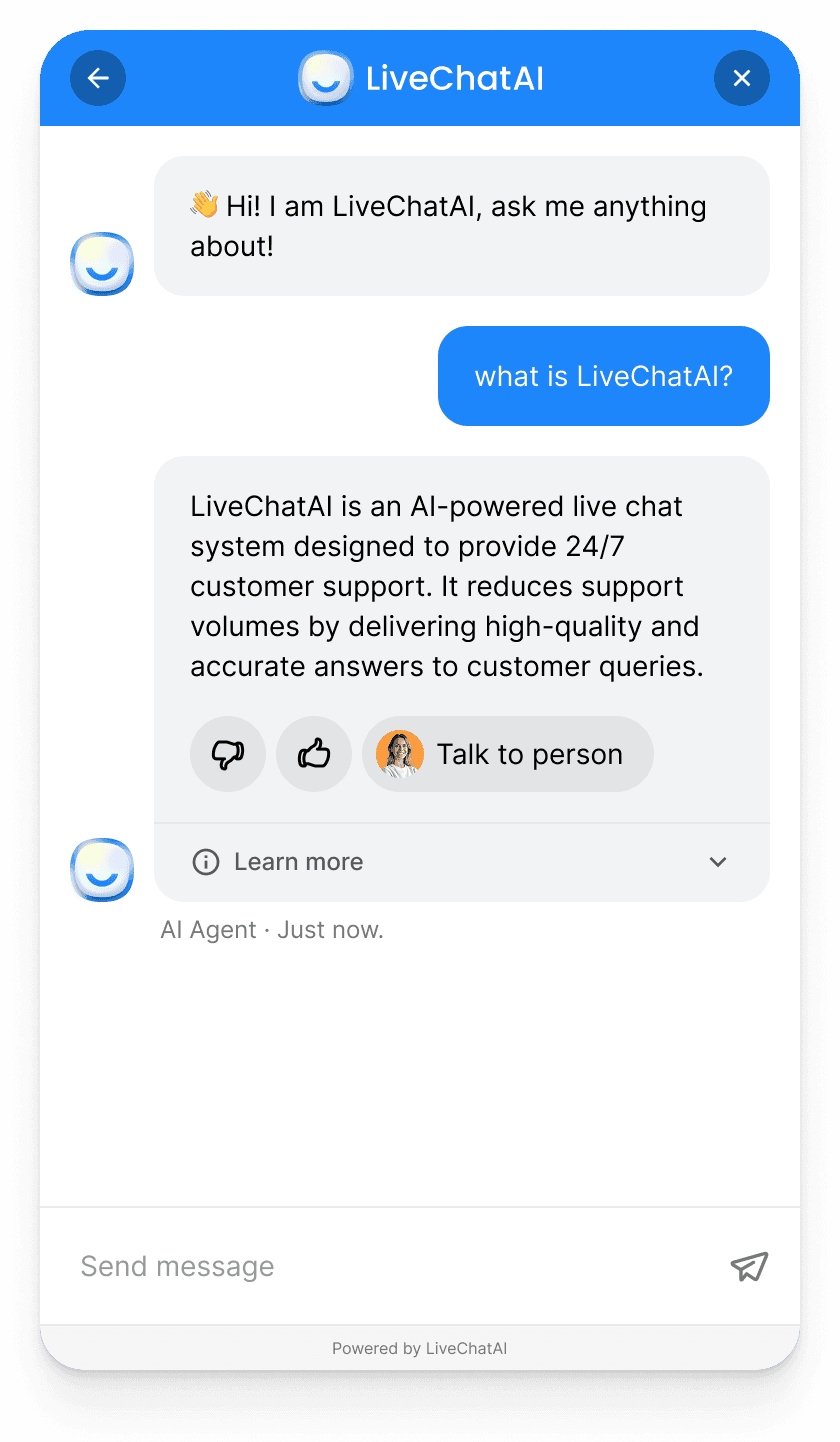
Full disclosure: this is the LiveChatAI blog. LiveChatAI is a no-code AI chatbot built specifically for customer support. Point it at your website, help docs, PDFs, or sitemap, and it trains a GPT-4-class agent that answers in your tone, handles up to 95 languages, and hands off to a human when needed. Setup runs in minutes rather than hours, which is the biggest day-one contrast with Aista's low-code feel.
Who it is for: SMB and mid-market customer support, e-commerce, and SaaS teams who want a "ChatGPT for your help docs" without the Hyperlambda layer.
Key features:
• Train on your sources: Sitemaps, URLs, PDFs, raw text, and Q&A pairs — combine any of them into one bot.
• Human handover: Built-in live chat with shared inbox — AI handles routine questions, agents pick up edge cases.
• Multilingual support: 95 languages including Turkish, Arabic, Japanese, and Portuguese.
• Integrations: Slack, WhatsApp, Shopify, Intercom-style channels, Zapier, and a clean REST API.
• Analytics: Conversation review, escalation rate, deflection rate, and content gap reports that tell you which doc to write next.
Pricing: Free plan available. Paid plans start at $39/month for the Basic tier, with growth tiers around $99/month and enterprise pricing on request. No per-seat penalty on most tiers.
Pros:
• Fast setup: Live in under an hour from URL paste to deployed widget.
• Strong free tier: Real free plan with message volume that is usable, not a marketing prop.
• Native handover: AI plus human inbox in one place — Aista keeps you mostly in chatbot land.
• Multilingual accuracy: Strong performance across 95 languages without prompt-engineering acrobatics.
Cons:
• Less developer extensibility: If you want Hyperlambda-level scripting, Aista or Botpress will bend further.
• No self-hosting: Cloud-only, which is a no-go for the small set of teams with on-prem data rules.
Best for: Teams who want the fastest path from "we want an AI chatbot" to "the bot is answering our customers." Our AI agent builders roundup compares eleven no-code platforms head to head.
2. CustomGPT
CustomGPT is one of the most direct Aista alternatives for teams who care about citation-backed answers. The product ingests large knowledge bases — websites, PDFs, Google Drive folders, and helpdesk exports — then answers questions with inline source citations and tight anti-hallucination controls. It is positioned squarely at enterprises and content-heavy SaaS companies that need their bot to refuse cleanly when the answer is not in scope.
Who it is for: Mid-market and enterprise teams with deep documentation libraries who care about answer accuracy and source attribution.
Key features:
• Citation-backed answers: Every response includes inline source links pointing back to the indexed content.
• Anti-hallucination guardrails: The bot is tuned to say "I don't know" rather than improvise.
• Large data ingestion: Comfortably handles thousands of pages and large documentation sites.
• Multilingual support: 90+ languages.
• API access: Full REST API for embedding the bot inside other apps.
Pricing: Standard plans start around $99/month with higher tiers around $499/month for premium and custom enterprise pricing above that. No free plan, but free trial available.
Pros:
• Strongest citation behavior in the category: Best-in-class for teams that need defensible, sourceable answers.
• Scale on ingestion: Handles very large content libraries without choking.
• Strict guardrails: Reduces the "made-up answer" risk that gets chatbots pulled from production.
Cons:
• Entry price is high: No free plan, and the lowest tier prices out a chunk of SMBs.
• Lighter on live-agent features: Strong on Q&A, lighter on handover and helpdesk workflow than LiveChatAI or Kommunicate.
• UI feels enterprise-leaning: Less playful than Chatbase or Wonderchat.
Best for: Knowledge-heavy companies where a wrong answer is a real liability and citations are non-negotiable.
3. Chatbase
Chatbase is the polished, marketer-friendly no-code Aista alternative. The builder is clean, the bot quality is strong on out-of-the-box prompts, and analytics dashboards tell you what users actually ask. It is one of the most popular tools in the space, which means a lot of integrations, plenty of templates, and a familiar interface for teams onboarding new hires quickly.
Who it is for: Marketing, sales, and lead-gen teams who want a no-code chatbot with strong reporting and a short ramp.
Key features:
• Source ingestion: URL crawls, files, raw text, and notion-style imports.
• Lead capture: Built-in forms for collecting emails inside the chat flow.
• Analytics: Top questions, sentiment, and unanswered query reports.
• Integrations: Slack, Zapier, WhatsApp, and a public API.
• Custom branding: Logo, colors, and welcome messages.
Pricing: Free plan with limited messages. Hobby and Standard tiers start around $19/month and $99/month respectively, with Pro and Enterprise tiers above that.
Pros:
• Best-in-class no-code builder UX: Faster to onboard than Aista's low-code environment.
• Strong analytics: Easy to see where the bot drops the ball.
• Mature ecosystem: Lots of templates and community resources.
Cons:
• Message limits on cheaper tiers: Volume can climb quickly if you hit product-market fit.
• Lighter on multi-agent and team workflow: Less of a "support desk" feel than LiveChatAI or Kommunicate.
• Less developer extensibility than Botpress or Aista.
Best for: Marketing teams that want a great-looking bot live this week without writing a single line of code.
4. Botpress

Botpress is the developer-first Aista alternative. It pairs a visual flow editor with first-class LLM hooks, custom code blocks, and a cloud or self-hosted deployment path. If your team is comfortable with code and wants the most flexible chatbot platform on this list, Botpress is the easiest jump from Aista's low-code mindset.
Who it is for: Dev teams, agencies, and tech-savvy product teams who want maximum control over flows and prompts.
Key features:
• Visual flow editor: Drag-and-drop nodes with full conditional logic and variables.
• LLM hooks: Drop into any node and call your model of choice with custom prompts.
• Self-hosted option: Run the full stack on your infrastructure for compliance-sensitive use cases.
• Knowledge bases: Index sites and docs to ground the LLM.
• Open ecosystem: Active marketplace of community integrations.
Pricing: Free plan with monthly message and AI spend caps. Pay-as-you-go tiers and team plans available, with enterprise pricing on request.
Pros:
• Best dev experience in the category.
• Self-hosting: Matches Aista's flexibility on data residency.
• Granular flow control: Fork, branch, and loop with precision.
Cons:
• Steep learning curve for non-developers: Marketers will bounce.
• You build the support workflow yourself: Handover, ticketing, and analytics need extra wiring.
• AI spend can sneak up: Watch token usage on chatty deployments.
Best for: Engineering teams who want Aista-style flexibility but with a more modern visual editor and a real community around it.
5. Voiceflow

Voiceflow started in the voice-assistant world and grew into a full conversational AI design platform. The visual canvas is one of the cleanest in the category, and the product fits cross-functional teams that need designers, PMs, and engineers collaborating on the same agent. It is the right move when chat is only one of several channels you plan to ship.
Who it is for: Product and design teams building conversational AI across chat, voice, and IVR.
Key features:
• Cross-channel design canvas: Build once, deploy to web chat, voice, and IVR.
• Collaboration: Real-time multi-user editing of agent flows.
• Knowledge bases and RAG: Plug docs and sites into LLM-powered nodes.
• API and SDK access: Embed the agent in custom front ends.
• Prototyping: Strong test mode for designers iterating on conversation flows.
Pricing: Free Sandbox plan. Pro tiers start around $50/month per editor, with Teams and Enterprise pricing above that.
Pros:
• Best collaborative design UX: Figma-like feel for chat agents.
• Multi-channel ready: Voice plus chat in one product.
• Strong template gallery.
Cons:
• Per-editor pricing adds up fast for big teams.
• Implementation work needed for production support flows.
• Less plug-and-play than LiveChatAI for pure customer support.
Best for: Teams who treat conversational AI as a product surface, not just a help-desk widget.
6. Stack AI
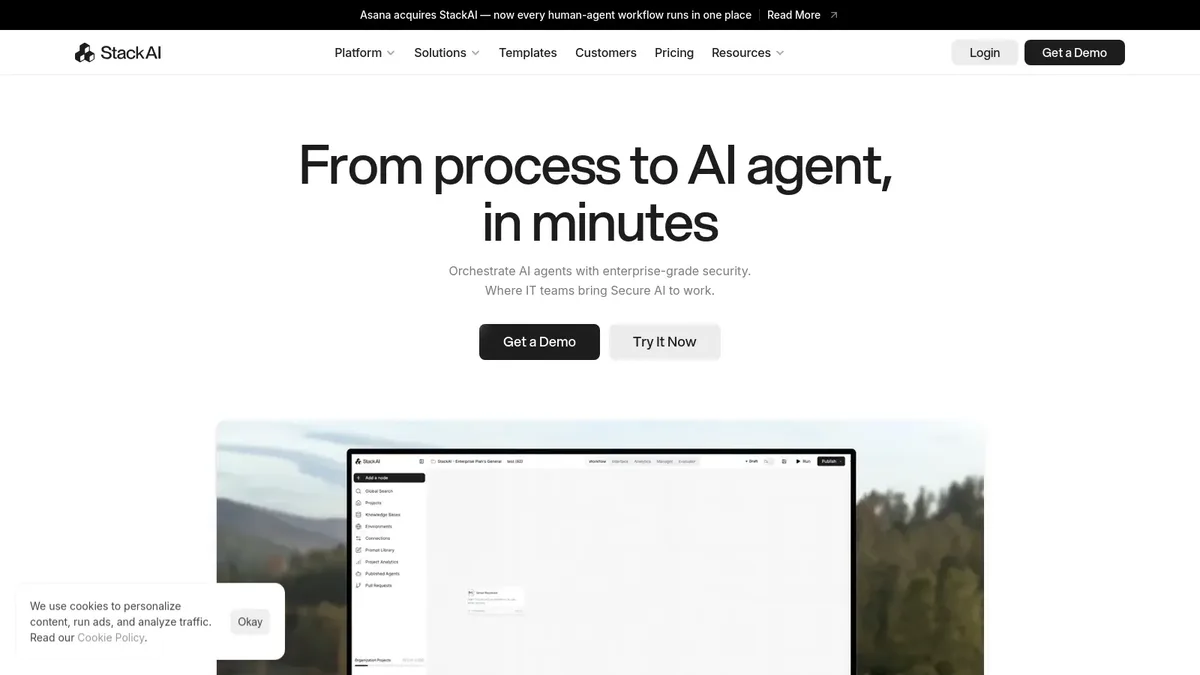
Stack AI sits on the enterprise side of the Aista alternatives map. The product is a no-code builder for AI agents and workflows that ingests structured and unstructured data, calls external APIs, and orchestrates multi-step reasoning. Think of it as a bridge between a chatbot builder and an internal workflow tool — useful when the assistant has to do more than just answer questions.
Who it is for: Operations, IT, and ops-heavy SaaS teams building internal AI assistants and document-processing workflows.
Key features:
• Visual workflow builder: Chain LLM calls, retrievers, and tool calls.
• Enterprise integrations: Connect to Snowflake, SharePoint, S3, and similar sources.
• RAG out of the box: Document ingestion with vector retrieval baked in.
• SOC2 and security controls: Pitched at compliance-conscious buyers.
• API exposure: Publish any workflow as an endpoint.
Pricing: Free starter tier available. Paid plans begin in the low triple digits per month, with enterprise pricing on request.
Pros:
• More than a chatbot: Real workflow logic, not just Q&A.
• Enterprise integrations: Heavier hitters in the connector list.
• RAG-first design: Good fit if you already think in terms of retrieval pipelines.
Cons:
• Overkill for simple support bots: If you just want a help-doc bot, LiveChatAI or Chatbase will be faster.
• Pricing tilts enterprise.
• Less ready for live-agent handover than support-focused tools.
Best for: Teams replacing Aista because they want an AI orchestration platform, not just a chat widget.
7. Wonderchat

Wonderchat is a friendly, fast no-code Aista alternative aimed at solopreneurs and small teams. Paste a URL or upload a PDF, and a ChatGPT-style bot is live in minutes. The UI is clean, defaults are reasonable, and the price-to-output ratio on smaller plans is among the best on this list. If Wonderchat does not fit, our Wonderchat alternatives roundup covers 20 options.
Who it is for: Solopreneurs, small SaaS teams, and consultants who want a bot live this week without learning a new tool deeply.
Key features:
• One-click site crawl: Paste a URL and let it ingest.
• PDF and file uploads: Drag-and-drop knowledge import.
• Custom branding: Logo, color, and avatar tweaks on most tiers.
• Multilingual: Strong support for non-English content.
• Embed code: Drop the widget on any site with one snippet.
Pricing: Plans start around $49.99/month, with higher tiers for more pages and messages. Free trial available.
Pros:
• Setup speed: Genuinely fast from sign-up to deployed bot.
• Friendly UI: Approachable for non-technical users.
• Good price for the lowest tiers.
Cons:
• Lighter on team workflow features: Handover and shared inbox are not the focus.
• Less customizable than Botpress or Aista on the low-code side.
• Scaling cost climbs at higher tiers.
Best for: Indie founders and small teams who want a "site to bot" tool that just works.
8. BotPenguin
BotPenguin is the right Aista alternative when you need a chatbot to live everywhere — web, WhatsApp, Facebook Messenger, Instagram, and Telegram. It is more of a multichannel marketing-and-support hybrid than a pure GPT-on-your-docs play, and the free tier is unusually generous for a multichannel product.
Who it is for: E-commerce and SMB marketing teams who care about WhatsApp and social messaging channels as much as web chat.
Key features:
• Multichannel deployment: Web, WhatsApp, Messenger, Instagram, and Telegram from one builder.
• Drip campaigns: Sequenced messaging on WhatsApp and Messenger.
• AI plus rule-based flows: Combine LLM responses with classic decision trees.
• Live chat and handover: Built-in human takeover.
• Lead capture and CRM sync: Push leads to HubSpot, Salesforce, and similar.
Pricing: Free plan with usable limits. Paid plans start in the $30–$50/month range with higher tiers for messaging volume.
Pros:
• WhatsApp-first: Strongest on this list for WhatsApp business use cases.
• Multi-channel from one builder.
• Real free plan that scales reasonably.
Cons:
• UI is busier than Chatbase or Wonderchat.
• LLM quality is fine but not best-in-class for complex knowledge bases.
• Reporting is shallower than CustomGPT or Stack AI.
Best for: SMB e-commerce and marketing teams who need WhatsApp and social messaging plus web chat. Our best e-commerce chatbots pick covers seven options optimized for online stores.
9. Botsonic (Writesonic)

Botsonic is the chatbot arm of Writesonic, a marketing AI suite. The product builds a custom ChatGPT bot from your knowledge base and slots into the broader Writesonic toolkit for content, SEO, and chat. If you already pay for Writesonic, adding Botsonic is the path of least resistance.
Who it is for: Marketing teams already using Writesonic for content who want a chatbot inside the same account.
Key features:
• URL and file ingestion: Crawl a site or upload PDFs.
• Custom branding and personality: Tweak tone, name, and avatar.
• Integrations: Slack, WhatsApp, Zapier, and CRMs.
• Multilingual: Strong cross-language performance.
• Sits inside the Writesonic suite: Reuse content created in Chatsonic and the rest of the toolkit.
Pricing: Free plan with limited messages. Standard tiers start around $19–$49/month, with enterprise tiers for higher volume.
Pros:
• Best fit if you already use Writesonic.
• Solid content reuse across the suite.
• Approachable no-code builder.
Cons:
• Less specialized than DocsBot or CustomGPT for pure docs Q&A.
• Suite-style pricing can confuse buyers who only want the chatbot.
• Live-agent workflow is lighter than LiveChatAI or Kommunicate.
Best for: Marketers already inside the Writesonic ecosystem. Our Botsonic alternatives roundup ranks 34 platforms.
10. DocsBot AI
DocsBot AI is laser-focused on documentation and developer-content use cases. The product trains a ChatGPT-style bot on your docs site, blog, GitHub repos, support tickets, and uploaded files, then exposes it as an embed, a Slack bot, or a Zapier action. It is the cleanest Aista alternative for "we have a big docs site and we want a bot on top of it."
Who it is for: Developer-tools companies, SaaS docs teams, and technical-content publishers.
Key features:
• Docs-first ingestion: Sitemaps, GitHub, Notion, Intercom articles, Zendesk help centers.
• Slack and Zapier bots: Surface answers where the team actually works.
• Public and private bots: Run separate bots for customers and internal teams.
• Source citations: Inline links back to docs pages.
• Analytics: Track unanswered questions and content gaps.
Pricing: Free plan available. Paid plans start around $19/month with higher tiers scaling on bot count, sources, and message volume.
Pros:
• Built for docs use cases: Best ingestion story for technical content.
• Source citations on every answer.
• Slack integration is a real differentiator for internal helpdesk use.
Cons:
• Lighter on live-agent workflow than LiveChatAI or Kommunicate.
• Less polished as a customer-facing widget than Chatbase.
• Higher tiers required if you want lots of sources.
Best for: Developer-tooling and SaaS teams who want a docs bot and an internal Slack helper from the same account.
11. Kommunicate
Kommunicate rounds out this list as the support-desk-first Aista alternative. The product blends AI chatbots, live agent chat, ticketing, and helpdesk workflow inside one platform. If you are not just replacing a chatbot but rethinking your whole support stack, Kommunicate sits closer to a full customer-conversation platform than a pure chatbot builder.
Who it is for: Customer support teams who want AI bots plus human agents plus tickets in one product.
Key features:
• AI chatbots: No-code bot builder with LLM and traditional intent options.
• Live agent chat: Shared inbox, agent routing, and SLA tracking.
• Ticketing: Lightweight ticket workflow for follow-ups.
• Integrations: Dialogflow, Zendesk, Salesforce, Shopify, WhatsApp, and more.
• Mobile SDKs: First-class iOS, Android, and React Native support.
Pricing: Free trial available. Paid plans start in the $100/month range for the Lite tier, with Advanced and Enterprise tiers above that.
Pros:
• Full support stack in one product.
• Strong mobile SDKs.
• Reasonable bridge between chatbot land and helpdesk land.
Cons:
• Pricier entry point than LiveChatAI, Chatbase, or Wonderchat.
• UI surface is larger and takes longer to learn.
• AI bot builder is solid but not as sharp as CustomGPT for pure Q&A.
Best for: Support teams who want their AI bot, live chat, and ticketing under one roof. Our Intercom Fin alternatives roundup covers fourteen platforms in the same family.
Aista vs. Top Alternatives — Side-by-Side Table
Here is a fast scan across the eleven alternatives plus Aista. Pricing is the entry paid tier in USD per month; "Free Plan" means a real free tier, not a trial.
| Platform | Best For | Free Plan | Starting Price | Highlight |
|---|---|---|---|---|
| Aista | Low-code, developer-focused chatbot builds | No | Custom | Hyperlambda-style customization and self-hosting |
| LiveChatAI | AI customer support with the fastest no-code setup | Yes | $39/mo | AI + human handoff, support for 95 languages |
| CustomGPT | Citation-backed answers from large knowledge bases | No | $99/mo | Strict anti-hallucination controls and deep content ingestion |
| Chatbase | Marketers seeking a polished no-code builder | Yes | $19/mo | Strong analytics and lead-capture features |
| Botpress | Developers needing flow logic and self-hosting | Yes | Pay-as-you-go | Visual editor with full code access |
| Voiceflow | Conversational AI design across chat and voice | Yes | $50/editor/mo | Collaborative design canvas for teams |
| Stack AI | Enterprise internal AI assistants and RAG workflows | Yes | ~$199/mo | Workflow orchestration with LLMs |
| Wonderchat | Solo founders wanting a fast site-to-bot setup | Trial | $49.99/mo | Clean UI and rapid deployment |
| BotPenguin | Multichannel WhatsApp and social messaging | Yes | ~$30/mo | Strong WhatsApp and Messenger integrations |
| Botsonic (Writesonic) | Marketing teams already using the Writesonic ecosystem | Yes | $19/mo | Bundled with content AI tools |
| DocsBot AI | Documentation and developer-support bots | Yes | $19/mo | Docs-first ingestion and Slack bot support |
| Kommunicate | Full support stack combining AI, humans, and ticketing | Trial | ~$100/mo | Mobile SDKs and helpdesk workflows |
How to Choose the Right Aista Alternative
The chatbot category in 2026 is not short on choices — DemandSage reports the chatbot market climbing from $10.32 billion to a projected $29.5 billion by 2029, with ChatGPT alone holding 79.79% of the AI chatbot mindshare. Translation: you are not picking between two or three options anymore, and the cost of picking wrong is wasted onboarding plus a stalled rollout.
Here is the framework to run when you are replacing Aista.
Step 1. Define the bot's primary job. Is it answering customer support tickets, generating marketing leads, deflecting docs questions, or driving an internal workflow? Each of those maps to a different shortlist. Support-first teams should look at LiveChatAI, Kommunicate, and BotPenguin. Lead-gen and marketing teams should look at Chatbase, Botsonic, and BotPenguin. Docs-heavy teams should look at DocsBot, CustomGPT, and DocsBot again. Internal workflow teams should look at Stack AI and Botpress.
Step 2. Audit your data sources. If your content lives in tidy help articles, almost everything on this list will ingest it. If it lives in PDFs, GitHub repos, Notion, or internal databases, narrow to platforms that explicitly handle those sources — DocsBot, Stack AI, and CustomGPT are the safest bets there.
Step 3. Decide on team profile. If marketers or support managers own the bot, prioritize no-code UX (LiveChatAI, Chatbase, Wonderchat). If developers own it, Botpress and Stack AI will reward the extra rigor. If product design owns it, Voiceflow's canvas is hard to beat. For a broader scan of no-code builders, our ChatBotKit alternatives roundup compares forty platforms by team profile.
Step 4. Pressure-test the live-agent story. A surprising number of chatbot rollouts stall when a customer needs a human and the bot has no handover. LiveChatAI, Kommunicate, and BotPenguin handle this natively. CustomGPT, DocsBot, Chatbase, and Botsonic mostly assume you bring your own helpdesk.
Step 5. Check pricing realism. Build a cost model for 1k, 10k, and 100k monthly messages and rerun the math on each shortlist. According to First Page Sage, ChatGPT holds 76.4% of the AI chatbot market and Gemini holds 16.2% — most platforms here route to one of those models, so your bill is largely a function of how tightly you control prompt length and retrieval scope.
Step 6. Run a two-week pilot. Pick the top two from your shortlist and run them in parallel against the same content for ten business days. Measure deflection rate, escalation rate, and a sample of 50 conversations for answer quality. Then commit.
For a marketing-leaning angle on the same category, our ManyChat alternatives roundup covers ten options that overlap with this list.
Pricing Comparison Across Aista Alternatives
The chatbot market keeps growing — Quantumrun, citing Mordor Intelligence, projects $11.45 billion in 2026 and $32.45 billion by 2031. More vendors means more pricing models, not fewer. Here is a clean snapshot of 2026 entry points.
• Aista: Custom pricing — contact sales. Self-hosted options change the math significantly.
• LiveChatAI: Free plan available. Basic tier from $39/month. Growth tier around $99/month. Enterprise on request.
• CustomGPT: Standard from $99/month. Premium around $499/month. Enterprise on request. No free plan.
• Chatbase: Free plan with limited messages. Hobby from $19/month. Standard from $99/month. Pro and Enterprise above.
• Botpress: Free plan with monthly AI and message caps. Pay-as-you-go on top of that. Team and Enterprise plans available.
• Voiceflow: Free Sandbox plan. Pro from $50/month per editor. Teams and Enterprise tiers above.
• Stack AI: Free starter tier. Paid plans start in the low-to-mid hundreds per month. Enterprise on request.
• Wonderchat: Plans from $49.99/month. Trial available.
• BotPenguin: Free plan available. Paid tiers in the $30–$50/month range scaling on volume.
• Botsonic (Writesonic): Free plan. Paid tiers from $19/month to $49/month, with enterprise above. Often bundled inside Writesonic suite pricing.
• DocsBot AI: Free plan available. Paid plans from $19/month scaling on bot count and message volume.
• Kommunicate: Free trial available. Lite from around $100/month. Advanced and Enterprise tiers above.
Pricing is trending up across the category. According to Joyz, the chatbot market is on track to hit $27.3 billion by 2026 at a 23.3% CAGR, so most vendors are nudging entry prices upward as adoption climbs. Lock in annual pricing when you can.
Frequently Asked Questions
What is Aista used for?
Aista is a low-code AI chatbot platform used to build custom GPT-style assistants trained on your own website content, PDFs, and documents. Teams use it to deploy chatbots that answer questions, capture leads, or handle scripted conversations on their site. It is not a marketing suite or an SEO tool, despite older content on the web that mis-positioned it that way. Aista's sweet spot is dev-leaning teams who want low-code control over how their AI chatbot is wired and where it is hosted.
Is Aista free?
Aista does not have a fully free, production-ready plan in the way LiveChatAI, Chatbase, or DocsBot do. There are open-source components and trial options, but most teams using Aista in production are on paid or self-hosted setups. If a free plan is a hard requirement, LiveChatAI, Chatbase, BotPenguin, Botpress, and DocsBot AI all offer genuinely usable free tiers — that is one of the most common reasons teams switch.
How much does Aista cost?
Aista's pricing is on the custom side and depends on usage, self-hosting choices, and feature scope. Most public discussions land in the "contact sales for a quote" bucket. Compared to transparent SMB-friendly entry tiers — LiveChatAI from $39/month, Chatbase from $19/month, DocsBot from $19/month, BotPenguin from around $30/month — Aista is generally a step up in both complexity and price point. If you need a public, predictable price tag before you sign a contract, that pushes you toward the no-code alternatives on this list.
What are the best Aista alternatives?
The strongest Aista alternatives in 2026 are LiveChatAI, CustomGPT, Chatbase, Botpress, Voiceflow, Stack AI, Wonderchat, BotPenguin, Botsonic, DocsBot AI, and Kommunicate. LiveChatAI is the best overall pick for AI customer support, CustomGPT wins on citation-backed accuracy, Chatbase is the cleanest marketer-friendly no-code builder, and Botpress is the dev favorite. Voiceflow is the design-led option, Stack AI is the enterprise workflow option, and DocsBot is the docs-team favorite. Kommunicate is the right pick when you want chatbot plus live agents plus tickets in one product.
Aista vs LiveChatAI — which is better?
If your priority is AI-powered customer support that goes live fast, LiveChatAI is the stronger fit. The setup runs in minutes, there is a real free plan, the bot ships with native human handover, and 95 languages are supported out of the box. If your priority is low-code flexibility, on-prem hosting, and developer-leaning extensibility, Aista has a real edge. For most SMB and mid-market support teams replacing Aista in 2026, LiveChatAI is the simpler, faster, more support-native choice.
Which AI chatbot platform is best for small businesses?
For small businesses, the most realistic Aista alternatives are LiveChatAI (free plan, $39/month entry), Chatbase ($19/month), DocsBot AI ($19/month), Botsonic ($19/month), and BotPenguin (free plan with paid tiers from around $30/month). LiveChatAI wins for support-first use cases because the free plan is usable, the bot ships with handover, and you do not need a developer to wire it up. Chatbase wins for marketing-first use cases. BotPenguin wins when WhatsApp is a major channel. Pick the one whose primary job matches your bot's primary job.
Can I migrate from Aista to LiveChatAI without rebuilding everything?
Yes — this is the most common migration path. The data sources Aista uses (website URLs, PDFs, documents) are the same sources LiveChatAI ingests. Export your Q&A pairs from Aista, point LiveChatAI at your sitemap and PDF library, and the new bot is usually live within an afternoon. The piece that does need rebuilding is any custom Hyperlambda logic — LiveChatAI's no-code builder covers most use cases, but advanced custom hooks may need to be re-implemented through the API or webhook setup.
Pick Your Aista Replacement Today
Aista is a capable low-code AI chatbot platform, but in 2026 it is no longer the most pragmatic pick for the majority of teams. Per SEOprofy, the global AI chatbot market hit $9.9 billion at the end of 2025 and is projected to reach $113.35 billion by 2034 — that growth has produced a generation of focused, faster-to-deploy, and friendlier-priced platforms that beat Aista on specific use cases.
Plain-language verdict by use case:
• Go with LiveChatAI if you want the fastest path to an AI customer support agent with a real free plan, human handover, and 95-language support.
• Go with CustomGPT if your bot has to defend its answers with citations on a large knowledge base.
• Go with Chatbase if marketing owns the bot and you want a polished no-code builder.
• Go with Botpress if developers own the bot and you want a visual flow editor plus self-hosting.
• Go with Voiceflow if you are designing conversational AI as a product surface across chat and voice.
• Go with Stack AI if you need AI workflows, not just Q&A.
• Go with Wonderchat if you are a solo founder and want a site-to-bot tool that just works.
• Go with BotPenguin if WhatsApp and social channels are core to your support story.
• Go with Botsonic if you already use Writesonic and want to keep the suite tight.
• Go with DocsBot AI if your docs are the main thing the bot has to know.
• Go with Kommunicate if you want AI bots, live chat, and ticketing in one product.
If you are still deciding, start a free LiveChatAI trial, paste your sitemap, and see how the bot answers your real customer questions within an hour. The right Aista alternative is the one your team can actually ship.